Pomona Ops was the Latin goddess of plenty.
Single parts of her province were taken over by various utter divinities,
Among whom was Pomona.
Pomorum Patrona.
She who cares for fruits.
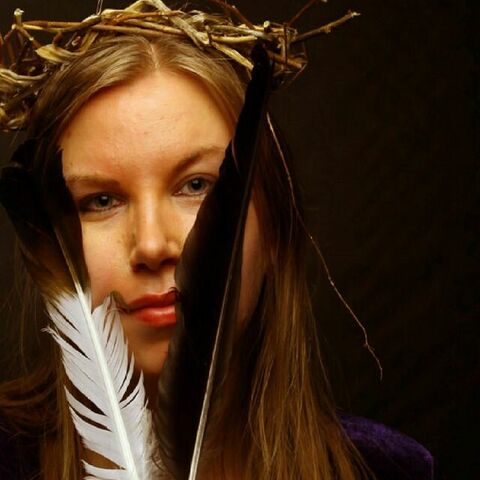
She is represented as a maiden with fruit in her arms,
And a pruning knife in her hand.
I am the ancient apple queen.
As once I was,
So I am now.
I am more of hope unseen,
Betwixt the blossom and the bow.
Ah,
Where's the river's hidden gold?
And where's the windy grave of Troy?
Yet come,
I ask,
I came of old,
From out of the heart of summer's joy.
Many Roman poets told stories about her,
The best known being by Ovid,
Who says that she was wooed by a man by many orchard guards,
But preferred to remain unmarried.
Among her suitors was Vertumnus,
The changer,
The guard of the turning year,
Who had charge of the exchange of trade,
The turning of river channels,
And chiefly of the change in nature,
From flower to ripe fruit.
True to his character,
He took many forms to gain Pomona's love.
Now he was a ploughman,
Spring,
Now a fisherman,
Summer,
Now a reaper,
Autumn.
At last he took the likeness of an old woman,
Winter,
And went to gossip with Pomona.
After sounding her mind and finding her averse to marriage,
The woman pleaded for Vertumnus' success.
Is not he the first to have the fruits,
Which are thy delight?
And does he not hold thy gifts in his joyous right hand?
Then the crown told her the story of Anaxaretta,
Who was so cold to her lover.
If is,
That he hanged himself,
And she at the window watching his funeral train pass by,
Was changed to a marble statue.
Advising Pomona to avoid such a fate,
Vertumnus daunt his proper form,
That of a handsome young man,
And Pomona,
Moved by the story and his beauty,
Yielded and became his wife.
Vertumnus had a statue in the Tuscan Way in Rome,
And a temple.
His festival,
Fortunalia,
Was held in the 23rd of August,
When the summer began to wane.
Garlands and garden-produce were offered to him.
Pomona had been assigned one of the fifteen Flamina,
Priest whose duty it was to kindle the fire for special sacrifices.
She had a grove near Ostia,
Where a harvest festival was held about November 1st.
Not much is known of the ceremonies,
But from the similar August holiday,
Much may be deduced.
Then the deities of fire and water were propitiated,
That their disfavor might not ruin the crops.
On Pomona's day,
Doubtless thanks,
Was rendered them for their aid to the harvest.
An offering of first fruits was made in August.
In November,
The winter store of nuts and apples was opened.
The horses released from toil,
Contended in races.
From Pomona's festival,
Nuts and apples from the Druidic Zawen,
The supernatural element,
Combined to give later generations the charms and omens from nuts and apples,
Which are made trial of at Halloween.