Dreamcatchers are iconic,
Well-known symbols within Native American cultures.
The tradition of dreamcatchers originates from the Ojibwe tribe.
The Ojibwe dreamcatchers symbolize natural wisdom.
Ojibwe is the name of the tribe in Canada.
The name of the American tribe is Chippewa.
Ojibwes reside in southern Canada in Manitoba and Ontario and in the states of Michigan and Wisconsin.
Dreamcatchers were originally made of twigs of the willow tree.
Twigs were gathered fresh and they were pulled into a spiral or a circle.
The web was made of thread stock of stinging needle.
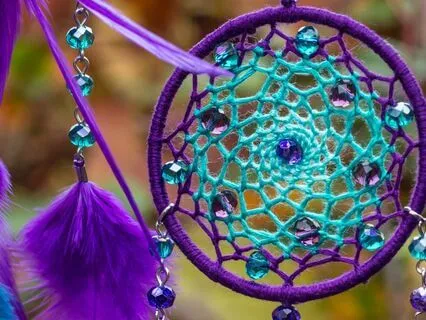
Ojibwes decorated their dreamcatchers with bird feathers found from the ground and gemstones.
Bad dreams get caught into the web and when morning sun rays touch the web the bad dreams get destroyed and good dreams go through the holes.
It is recommended to hang the dreamcatcher above one's bed.
Once the good dreams travel through the holes they gently fall down through the ribbons and feathers,
The mind of the dreamer.
Good dreams know their way in,
Bad dreams get tangled and perish.
According to the myth of the Ojibwe,
Clans used to live in a place called the Turtle Island.
Their protector goddess was Asebikashi,
The spider woman.
In the myth,
Asebikashi helped to bring the sun deity,
Itis,
Back to people.
She built a special lodge before dawn.
It was completely made of a spider web.
Asebikashi catched the sunlight,
Itis,
Into the sparkling dew drops.
Ojibwe nations grew larger and Asebikashi had difficulties keeping track of everyone.
So Ojibwe women,
Mothers,
Sisters and Nokomi,
The grandmothers,
Decided to help her.
They started to weave magical webs into willow loops.
First dreamcatchers were hanged above baby cradles.
Air playing with the feathers was entertainment for the newborns.
The round shape of the dreamcatcher represents Tsangades Kichis,
Who travels across the sky each day.
Gemstone in the middle of the web is the symbol of the great spirit,
Whose energy flows in every living being.
Gemstones have become so rare that the modern day Ojibwe don't tend to use them anymore in their dreamcatchers.
Eight knots that tie the web into the hoop are the eight legs of the spider woman.
Sometimes feather is added into the middle of the dreamcatcher.
The feather symbolizes air.
Owl's feather is known as the woman's feather and it stands for the Kipro wisdom.
Eagle feather is known as the man's feather and it symbolizes courage.
Not all Ojibwe dreamcatchers are round.
One can also find tear-shaped dreamcatchers.
The shape of the tear symbolizes the dew that Asebikashi collected.
Thank you very much for listening.
Bye!