Hujutar and Xiliq from Xili,
A hedgehog,
Take charge of the wasps that haunt the woods.
Two other forest spirits who are not directly connected with Tapio should be mentioned here.
The chosen,
Kunutar or the golden Karehetar is asked to leave off.
Mending gold or silver as a trapper has already put some into her bough,
According to Ganandir.
Ganandir was a Finnish folklorist in the 18th century.
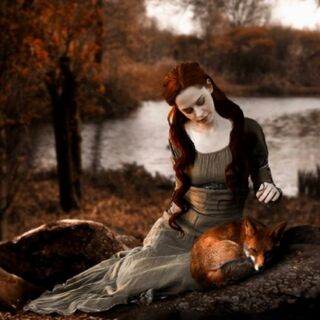
Karehetar was the patroness of foxes who brought them to the hunter's traps.
Tapio's abode is Tapiola or Mezzola,
Forest home or Havulina,
Brushwood castle or the famous village of the woods.
It was sometimes imagined that in the forest there were tree forts or castles of the forest in the forts of stone.
A mere prayer was not always enough to appropriate Tapio and his numerous family.
He needed an offering.
Accordingly,
A trapper asked them to take a fancy to his growth and salt and in return to send quantities of animals into his traps.
Kuipana,
The king of the forest,
The brisk man of the woods,
With a beard of three moths or the liberal mistress of the forest,
Is desired to accept the hunter's tribute of salt and growths and sent game into his traps.
A hunter beseeches the grey-bearded old man of the forest and his wife,
Mimerki,
To make an exchange of gold.
The hunter's is Swedish gold obtained by fighting in the wars while Tapio's,
As we have seen,
Consists in his white animals with precious furs.
The bear as a forest animal was naturally enough nursed by Hångadar and rogged by Tuamadar at the foot of a standed fur.
And the woodland sprites,
Mierki,
Anniki and Telermo are requested by a bear hunter to muzzle their dogs,
Bears,
Till he can approach them.
In order to obtain the game he covets,
The hunter is ready to adopt any device.
He is willing to go as Tapio's manservant or even as the boy who picks up the arrows.
If Tapio will only be propitious or he asks the forest to marry his hunter's men to the pleasant daughters of the woods to the downy-breasted little chicks.
If Tapio happens to be asleep he desires Anniki of the fair complexion,
Who wears a down-like shirt to awake the king of the forest or to wake up the forest mistress by playing a tune in her ear.
On one occasion he invites the forest to play the sitzer,
Gantele,
So that the white animal shall lend an ear and be attracted towards himself.
He invokes the oatman of the knoll with a golden breast and who wears a hat of twigs,
Mierki,
Delerva,
Nyrki with the tall red cap,
To show him the direction he ought to take by setting up posts and landmarks.
He implores oatukko with the rambled beard,
The hollow fur with a fur twig hat to beat the wilderness and make the trees resound with puns in order to drive out the game for him.
Ortuliki,
The delightful forest-girl,
Is invited to chase out the animals from the slopes of the forest-fort and to make a fence with her hands on each side of them,
To keep them on the right track.
If obstacles intervene,
She is to remove them.
He beseeches the famous beauty,
Tuliki,
Pihletar,
Short,
Tuometar and kindly Hungatar,
To chase wild animals in front of him,
And if none are near to fetch them from Lapland,
He desires the forest-ute with a golden hat and the forest-mistress,
Jónetar,
To send the best of the flock to his trapping-places.
If the animals are sluggish,
He implores the lively Vitsary and Delerva to take from Tapio's heel a whip of roven or a cattle-scorch of uniper with which to drive out the game.
Lastly he prays Mirki to set plenty of animals so near him that he can knock them over with a stick or seize them with his hands.
If that is out of the question,
She is to support his bow or steady his gun and thus enable him to shoot a squirrel and pay his tax.
So there are lots of these types of hunting myths and spells in Finnish folklore.
The wild animals are represented as being kept in a magazine or a storehouse,
So Mirki,
The famous golden buckle of the woods,
Is invoked to take the golden key at her side to open Tapio's storehouse and let the silver and gold escape towards a hunter dressed in white.
So this is a metaphor how the forest goddess releases the animals for the hunters to hunt.
If you have any questions or you need to ask something about this deity,
Just leave the questions to the comments.
Or Mirki,
The mother with the lovely face,
Is asked to open the honey chest and let loose a vial of animals in front of a hunter.
Should she be disciplined to do this herself,
She is to send one of her servants,
The queen of the forest Kuriðar,
Is requested to open her money magazine and let out the animals for hunter to catch in his traps.
Annik,
The girl with honeyed mouth,
Is asked to open the storehouse door and throw out the hunter's share on the bod of a tree.
Then she is to spin a thread along with an arrow that can travel straight to the brow of a little squirrel.
The forest mistress,
Simandar,
Is begged to make a din in the copper hills and to let the mountain storehouse be opened for the mountain cattle to run out and enter the hunter's traps.
Annik,
Who keeps the keys,
And Ewa,
The little serving maid,
Are desired to open the magazine and let out the animals.
In one instance,
Tapir is humorously represented as carrying the game about with him on his own person.
The good and splendid old man,
The golden forest king,
Is implored to take his best and fattest ewes and rams from out of his shirt or his waist-ghost and to poke his sheaves of flax into the traps of the supplicating hunter.
In a lesser decree Tapio,
As lord of white beasts or one of his people,
Was implored to watch over flocks and herds grazing in the woods and protect them from the attacks of bears,
Thus Mielki and Tuadar are requested to anoint a bear's paws with wort and its teeth with honey that it may not hurt the cattle.
The king of the forest,
Kuitua,
And the benevolent Hongas are solicited to retain their dog from injuring the herds.
The forest king,
Kuipana,
Is supplicated to control his pastured son,
The bear,
And to stick a mushroom up its nose to prevent its getting scent of the pasturing kine.
The good mistress,
Hongatar,
And the observant,
Tapiotar,
Are urged to keep a bear in check and prevent it doing harm.
The forest,
Nikinaki or Tapio,
The coding king of the woods,
And the kindly mistress are invoked to take care of the herds grazing in the forest.
In the capacity of herd-girls,
The tiny lassie,
Pihlatar,
And the lovely Katayatar are desired to cut a branch from the back of Tapio's heel and with it drive the cattle from the woods back to their own home.
Anniki is one of Tapio's daughters and she is interesting because she is connected to weaving.
Her symbol is the spinning wheel,
So in one way she is also the goddess of fortune telling and future.
Or she is like the three gnomes in Noismitache,
That she knows things.
Evil might come from Metzola,
It is usually evident is the delightful Metzola and it was full of honey.
A beast asked to fetch honey from Metzola,
Luscious stuff from Tapiola from which an ointment may be made and Vodar,
The maker of salves,
Contacted them a whole summer in Metzola for delightful honey is there from which she made the ungents.
So that was the end of the forest chapter.
So I am reading magic songs of the Finns.
This is from Elias Leonhard written in 1880 and translated into English by John Abercrombie in 1898.
It is one of my favourite books at the moment.
So you might know Elias Leonhard because he wrote Kalevala,
But Kalevala is more of his own creation.
It actually doesn't have that much to do with Finnish folklore,
But I suppose these magic songs are a bit closer to what the Finnish folklore actually was.
I think the next part where we are going to go is the spells and the magic.
So when it comes to the part of the bears and how bears they were originally seen as these magical,
Powerful beings,
But as you can see what I just read,
When agriculture became a bigger thing and also Christianity,
Utilitarianism and Catholicism in the Middle Ages,
Bear was now demonized.
So an animal that was once highly respected became a less favourable animal.
It's really sad,
But yeah,
That's the way it is.
I think the next chapter is wizards and sorcerers.
Let's see B.
My Tea here.
The Finns possess a considerable number of words and evidence for wizard,
Sorcerer,
Witch,
Seer,
Ecstatic and the like.
Some of these are native words like noita,
A sorcerer,
Teetomies or teete,
A knower,
Loytsja the reciter of a magic song,
Loytsju,
Arpoya a diviner,
Näkija a seer,
Murusmies or indomies,
An ecstatic,
Lumoya a stupefier,
Lukija a reciter,
Katselja an observer,
Laulmies a songman,
Ampuye an archer,
Kukkaromies a backman.
Others are of foreign origin like mähtimes or mähtaja,
God,
Matz,
Magt,
Magician.
Taikori,
He that uses taika,
God,
Tekin,
Stokken,
A wonder,
Velho,
A witch,
A wizard.
It's probably an early slob loan while a latter one is poppamis,
A priestman from the Russian pop.
Though between these appellations no heart and fat line can be drawn,
Dividing them into good and bad categories.
Yet on the whole in juries or black magic would generally be the work of the noita,
The ampuye,
The velho and the kukkaromies.
So there is a very long tradition of shamanism in Finland.
Beneficial or white magic,
Like the great bulk of the magic songs,
Was used for ejecting evil spirits of disease,
Etc.
And would be practiced by a luitsja,
A teite,
A lukija or laulumjes,
In some instances by a lumoya,
Näkija or an arpoya.
Yet we have an example of an exorcist terming himself a noita and a lap.
As a rule there is nothing in magic songs to show what sort of a wizard the reciter of it might be,
So as his function is to drive away disease,
I shall term him the exorcist.
The sorcerer Noita the fortune teller Arpoya is said to have been born behind the limits of the north,
On the flat land of laps,
On a bed of fur bows in a pillow of stone.
The sorcerer has a nose like an eagle's beak and wears a tall hat.
Sorcerers when they exercise their arts are naked and without a stitch of clothes.
They are said to drink water from a pool in the crop of his horse,
And in drinking to make it his.
The offensive weapons of the sorcerer,
The wizard,
Teite and the archer are knives of iron,
Pointed into and shooting instruments.
Sorcerers and wizards use arrows and witches,
Velho,
Have knives of steel,
But these expressions are not usually to be understood literally.
They imply sickness,
Disease,
Or any injury caused by the spells of a knife or a nail into the foot-print of an enemy to do him harm,
And there is a vague allusion to roasting and melting an image,
Into which pins or nails would first be struck.
The arrows of a sorcerer are said to be made of the wood of a tall fur,
Growing on the heel pain,
And he is quite indifferent where he shoots them.
Or they were made from chips of a huge oak that were taken to a smithy by a scroundow,
Who made the arrows to be stitched and plusury in demand,
Sudden sickness in a horse and elshots,
Jacked spikes in kind,
Or from the chips of a fiery oak they were made into arrows by his son.
Wizards,
Sorcerers,
Witches and diviners are to be found at every gate,
At every fence,
Along every road,
In a damp dales,
Near water and in fact everywhere.
It would have been interesting to live during these times,
Like when I think about the time when I would have liked to live in ancient Finland,
I would choose the Viking era,
Because then there was all this research in every corner,
Not so much in the medieval era,
But definitely in the Viking era.
A cursing spell may be repeated in a whining or mumbling voice,
And it is said to be bitten off with the teeth,
Just as one might bite off a length of a thread from a clue hold in the mouth.
Words,
Spells or magic songs are brought from the north from Lapland.
An exorcist requires a fluent mouth,
A ready tongue and pliant fingers.
In order to make him into a wizard,
A skillful man and a singer,
An exorcist was washed naked three times one summer night on the nighter stone of a hand-mill by his mother,
Probably to harden and strengthen him,
The stone itself being hard and strong.
Another boasts that he is the son of a northerner,
Bojolainen,
Was rocked by a girl of Turia and was cradled by a lamp.
The want of another is that he is the youngest son of a sorcerer,
The calf of an old diviner.
He can repeat a spell learned from his father to obtain a favorable wind.
So a lot of these Finnish shamans,
They were known especially for the way they could control winds.
So they would help fishermen to control winds.
And then when they would be sailing,
They could control the winds.
And there's been some speculation,
Of course,
How many of them were men and how many of there were women.
What I have studied,
It seems to be pretty equal.
So there was rich women and rich men.
So there really wasn't much difference in the genders,
What it came to witchcraft in Finland.
It's not like in pop culture,
Which is usually a woman,
But definitely we had male shamans and female shamans here.
And it's the same in Estonia and in Sweden and Scandinavian countries.
And I suppose it was the same everywhere back in the days.
Where was I?
He depends on his father's strength of mind and armaments,
But he also inherits power from his mother.
An exorcist's mother could bring back stolen milk from mana,
From tuana,
From sorcerers.
And what she did can do likewise.
Another brags that sharp frost has no effect on him or on any of his family and kin.
In fact,
He kills frost and takes from it clothing with which to protect himself.
If he has need of magic songs,
He will go and learn from the old wife of Bojola and also how to use an eagle's claws.
I am guessing that the old wife of Bojola is Lohi.
At a later date,
An exorcist wishes the creator,
Whose words and phrases are wholly and well arranged to speak for him.
And God is asked to save a person from the effect of village spells and incantations with words framed by the creator and prescribed by the Holy Ghost.
By his song and exorcist's boast he can split the shoulders of a witch or of a sorcerer by his leg and beset his jawbone and feed him on snakes and toads,
By singing he can bring a big skin over the eyes of a sorcerer and dog skin over their ears.
By means of his song he turns the best singers into the worst and puts strong gloves and shoes on their hands and feet,
Meaning that they are now bound and helpless.
He sings sorcerers,
Wizards,
Witches and archers with their knives,
Arrows,
Etc.
Into the mighty Rutia or Durya rabbits.
By the power of his song a wolf is bitten or a bear is changed.
He boasts that he can milk adders,
Handle snakes and can arm one thousand men in one night,
Can beat wolves and shackle bears.
As comrade he has one of his people who is of great strength and will give him hardness of body.
Elsewhere he brags that he has a sandy skin,
A hide of iron slag,
A body made of steel,
Or one taken from the branches of fur.
In fact,
From his possessing a sandy skin and iron-colored hide,
It is useless for a wasp to try to sting him.
One exorcist describes how skillful he is at surgical operations,
And not the wants that he is a man without his like and a famous son.
So a lot of the shamans would like to boast with their powers.
But the exorcist is not always in boasting mode and does not rely solely upon bounds.
Sometimes he is far from being overconfident.
In his difference he refers to himself as an unfortunate lad,
As a poor boy.
He lays great stress on the difficulty of the task,
Ejecting evil spirits of disease.
He asks how he is to proceed,
How he is to protect himself.
He pleads complete ignorance of the cause of an illness or accident.
And if he is not afraid,
It is because he has put on a shirt of defense,
Or something of the short.
In the latest period he can do nothing without the grace and aid of God,
The true Creator.
Or he speaks with the Lord's good breath and washes the sick man with the blood and tears of Jesus.
He acts with the Creator's leave and by the mercy of the Lord.
So these stories were collected in the 19th century.
And Finland was a Christian country in the 19th century.
These were basically the last,
This was the last chance to collect any folk tales that was left.
So you can see different layers in Finnish mythology.
There's the pagan layer and then there is the Christian layer.
And then there is a time where the Christian and the pagan stuff are mixed.
Which is actually most of the spells and the stories.
So you do come across characters like Jesus and Virgin Mary in these myths.
Which in itself is actually quite interesting.
I think there is a part about the Creator that I could read to you.
The term God,
Jumala,
Originally meant the sky,
The sky spirit.
And in course of time it came to mean God in a general sense.
I am using my backup laptop because it has a better microphone but it's also a little bit slower than the one that I normally use.
Now here is the humpback from the home of gods.
I am going to read you the passage from the magic songs of the Finns.
And X exclaims,
May help from the gods arrive from the nourishing mother age in a charmed beast when hitting a vapor bat.
It is said that the gods above and the earth,
Mothers down below,
Use hot bats.
The Virgin Mary is employed first to help before the rising of the sun.
One of the most popular of Finnish gods was certainly Tapio,
The hunter,
Dependent on him for game,
Not so much for consumption as for their valuable furs which could be sold or bartered.
The sheep and cattle,
Of which every family had a few,
Were pastored in the forest and took a welfare and safety from wild beasts.
But therefore,
Large economies,
Contingent on the goodwill of the forest divinity.
The chief of peace was Tapio,
The golden king of the forester,
With a mighty beard and who wears the castian god for her tweaks.
Though also known as Odu-ko,
With the rumpled beard,
The feather had the blow of the woods.
Sometimes he was simply called the forest or kwipana,
The long-necked,
Kwitwa,
Kwitwa,
Nikkinaki or hitsi-haksi.
The wild animals that belonged to him are figuratively spoken as of his flocks and herds.
His limbs and rams or trooping ears and his coat and silver and even as his sheaves of flax,
But in a riddle Tapio's bull is a made for tree.
So all these trees and animals they were called as Tapio's cattle,
Tapio's animals,
Tapio's kingdom,
They're all umbrella terms for him.
His wife has several applications which depend partly on her frame of mind,
As it seems to her that he never gives her all,
And he is probably thinking of Tapio,
Though the name of the forest god is replaced by that of the creator.
When kindly disposed,
She was merely the amander bull and was pictured as wearing the rule of the earth to give him abundance.
When unkind and deaf to his prayers,
She was kurik,
The deaf,
Was black and terrible in appearance,
Being horribly dressed in rags.
While the rings and bangles on her arms were fewer,
Which means that these are the ones that you are interested?
When it comes to myself,
My interest keeps her forth depending on the area that I am studying.
So perhaps it was given her by any charcoal burner,
As she is not connected with wild animals in the ones as it is because I made a lecture series about where a daughter was and who she was.
You can find a link there for the mythology courses in the video description.
It really depends on what is the subject that I am studying at.
In Sweden,
Denmark and Styrmark,
Definitely the forest wife,
Skåksvildfrau,
And there was lots of different varieties,
Or what Wildfrau is pictured in the popular imagination as being hollow behind like a hollow.
When another hunter beseeches dear Skåd the rules of the earth to give him abundance of wild animals,
Mentioning at the same time that he does not prostrate himself merely to be given stumps of trees,
He must have animals again.
When God of the Creator is invoked to watch over a herd at pasture,
It is quite possible that new names have been worked into an older incantation.
Some of the songs in which the name of God is employed appear to belong to the transition period between heathendom and Christianity,
For his name is invoked in a way that clearly shows the exorcist was no professional theologian.
The aerial God,
The spirit of Lord Jesus,
Is described to harness his coat to take a seat in his ornament slide,
And drive two bones and loosened veins in order to join them together,
And where a bone was broken to fasten in another.
God,
The Father,
Jesus,
The Lord of Air,
That knows how to throw a bullet and to recite a charm for stopping bullets,
Is invited to let water fall on the touch-hole of an enemy's gun so that it will not flash and go off.
God,
The Creator is desired to recite a charm to heal a sick man,
And to assuage his pain with formulas that are holy and well arranged.
In a charm for making a healing a vapor bat,
God,
The Father of Air,
Jesus,
The Lord of Air,
Is invited to let water fall on the touch-hole of an enemy's gun,
And to let water fall on the touch-hole of an enemy's gun.
In a charm for making a healing a vapor bat,
God,
The Father of Air,
Is asked to enter the steam to restore health to the sick person and give him repose.
But he is to do it secretly,
Without being hurt by a worthless wretch,
And without the knowledge of the village people.
God the Creator is prayed to give luck and contentment.
He is to build around the supplicant's property an iron fence,
A stone castle,
Reaching from the earth to the sky.
God is around the supplicant's property an iron fence,
A stone castle,
Reaching from the earth to the sky.
God is called the oldest of spell-recipters,
And the Creator the oldest of wizards.
The Creator is desired to come and exercise.
God to come and speak,
And aid a man in overthrowing his enemies and envious persons.
And the Creator's golden wreathlets is implored to come and speak on man's behalf,
But it is also to stop the judge's ears,
To bright the jury man,
And bind silks across the Sheriff's eyes.
Why the Creator has a cock with golden rattles is explained,
Perhaps,
By a riddle.
One cock is an iron cock,
The second a copper cock,
And the third a golden cock.
The iron cock split the ground,
The copper cock got the sea,
The golden one divided the sky.
Answer!
A plow,
A sheep,
The sun,
Though it may be reminiscent of the thunderbird as mentioned above.
At a later period,
In order to staunch blood,
An exorcist could say,
May the word of the God become a bar,
May trust in the Maker be a pluck.
If blood should flow in rapid drops,
May the Creator hold it fast,
May God say his hold of it.
But when he continues,
Let some of kindly Jesus' flesh,
A bit from the sight of the Lord,
Be a pluck for the fearful whole,
A dam for the evil gap.
He is only adapting an older heathen formula to the new terminology,
So too when the Lord is asked to fling his gloves down as a stopper on the fearful whole from new fate.
May the Maker's luck be luck,
May the Lord's words be a bar,
That the milk to the ground sand,
Flow nor the giddless blood upon the dirt,
Despite the nature of God,
Against the intentions of the blessed.
An exorcist declares he can do nothing without the great and help of God,
The Creator.
He throws himself on his God,
Who abandons not the good and virtuous.
He declares that the arrows of a sorcerer can be extracted by virtue of the Word of God by the Spirit of the Lord's decree.
The bread that he exhales is the bread of the Lord.
He wants that he emits is that of the Creator.
The water he employs is the blood of Jesus,
And he asks,
Is a man to be put to death without God's mercy,
Without the true Creator's leave?
The diviner begins,
I pray from the Creator,
Leave assistance from the Lord,
I beg.
That the diviner's cheer,
O God,
Dividing cheer,
Declare to me whence the calamity has come.
And he finishes,
If the diviner in cheer speaks truth,
Its reputation is enchanced.
The diviner in cheer is raised aloft to the knees of the Holy God.
A child of the quiet child begins,
Allow the child to sleep,
O God,
Cause it to slumber,
Mary dear.
On going to bed,
One may repeat a lorica like the following.
May the earth be good defense,
The only potent guard.
May the Creator lock the door.
May a saint show to the bolt.
May Jesus be a shield.
Mary a sword.
In preparing a bandage,
An exorcist says,
Let the Maker's silk be liqueur,
The cloak of the Lord be a covering.
Let the word of God be a bolt,
The verse of the Lord be a coverlet.
May the Creator's mercy grant.
May God's word bring about what the wound shall not inflame.
The Creator nature,
God that dwells above,
Is invoked to save a person from incantations and spells by means of words framed by the Creator prescribed by the Holy Ghost.
Fire is said to have been created by God to be born of Jesus' word and worked by the Virgin Mary.
And as souls are said to be prepared behind the stars,
They are desired to trickle down from the mount of the gracious guard or from the beard of the blessed one.
How interesting.
So all these Christian deities,
They were used to replace the old pagan deities in the spellmaking.
Let's talk about spellmaking.
The disease.
The disease an exorcist has to drive away is either sent by God,
The Creator,
An idea evidently of late date,
Or is caused by the spells of a sorcerer for reward,
Which is undoubtedly the older belief.
When an illness is affected by the spells of an enemy,
It is said to be the result of human art and is thus disquenched from a natural melody.
Disease in general is pictured as a huge and hideous devil or as a bogey,
Riena.
It is termed as a hese,
A devil,
A filty lempo,
An uninvited shape,
Moto,
A hound of hese,
A monster of the earth,
And next is quite astonished that a mouthless,
Eyeless,
Toothless,
Tongueless creature like rickets can see to suck to eat.
Sometimes an illness may have been ordered to attack a man by its father,
Mother,
Brothers or sisters.
On the other hand,
It is invited to approach and recognize the evil it has done on the pain of a report being made to its mother,
Who would be greatly vexed thereby,
For after seeing the harm it has wrought,
It is capable of feeling ashamed,
And of repairing and making amends for it.
An exorcist may even treat it as he would a boy and threaten to flog it with a robe and shoes and tips of fur.
The person who sends an illness or disease by means of spells is called its master or mistress,
And so the melody may be taught to go home and break the heat of its master or mistress,
Or to injure in some terrible way the individual that sent it,
Such as by giving her veins a sudden squeeze,
Making her blood pipes pipe a tune.
The sickness may also come from a grave or from the spirit of the departed.
From this may be inferred that the fiends sacrificed to the manes of their ancestors,
Who were occasionally dissatisfied and then avenged themselves by sending disease on their descendants.
Ailments are also brought by wind and water.
Once upon a time three attacks of sickness came along a swamp,
Along firm ground and by water.
The first had a neck like a pole,
The second a neck like an arch,
And the third was the worst attack,
But it is not further described.
Or three attacks of sickness came along a swamp,
Along a winter road,
And along springs of water,
But on this occasion the worst had come along the swamp.
So pain,
Disease,
And sickness of any kind were generally taught as evil spirits with human propensities,
Yet they can be wound up into a ball and thrown into the sea.
A next puts them into his wallet,
And they extended the three lonotars who collect them in a copper box,
And gave a dart they made of pains and sicknesses,
Poesties in a little kettle on the top of a hill of pain.
So,
Kivutar is not somebody who takes the pain to herself,
But she is the one who heals the pain.
She is the one who shapes the pain so that the human doesn't suffer.
So she is a helper goddess,
Even though she can sound a bit scary.
Okay I feel like I'm losing my voice after all this reading,
And I think I will make another one of these live streams very soon.
So thank you for joining me,
And I will talk to you soon.
Bye