Hello,
My name is Evan and today I'm going to be leading you in an intermediate Vipassana meditation.
So,
First let's find a position that we can sit in comfortably for about half an hour.
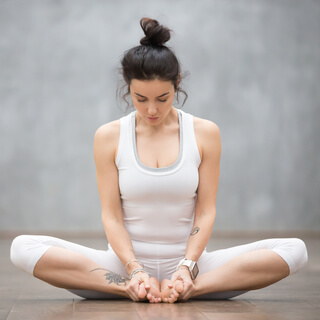
If you're comfortable sitting cross legged,
This is great.
If you're not comfortable sitting this way,
You can sit in a chair,
But I encourage you to practice sitting cross legged.
This is one of the best ways to meditate because it keeps your back straight and it also keeps you grounded.
When you sit in a chair,
Your butt's not on the ground so you don't feel as grounded.
So I encourage you to try it out and if you are really uncomfortable with it,
You can use a chair.
If you want to try to use some cushions,
Put some under your butt,
Put some under your knees.
That can help to have a more comfortable cross legged position.
So let's all close our eyes.
So I'm going to just go over,
Again,
The goals of Vipassana and why we're doing it.
One of the big Buddhist virtues is impermanence.
This is the idea that nothing lasts forever.
Everything arises and passes away.
So Vipassana is sort of a way to train the mind to be more aware of impermanence and more accepting of it.
So as we scan our body,
We may notice spots of pain.
So I just want to say if there's a spot of pain while you meditate,
We're going to be meditating for half an hour.
I want you all to practice sitting for half an hour without moving at all.
This is sort of to train us to be aware of these negative sensations that we might have and to not fight them and to not react negatively to them.
The same goes for positive sensations.
If we have a really pleasurable sensation,
We don't want to cling to that sensation because that sensation will also pass away.
And we're going to feel sad if it passes away and we've been clinging to it.
So really quick,
I'm just going to go through how to practice Vipassana.
So we close our eyes and we scan our bodies from the top of our head to our toes.
So I'm just going to go through how exactly I want you to scan your body.
If you have another method that you use,
Then you're more than welcome to use that.
How I scan my body is I start by noticing the sensations on the top of my head all along my scalp.
And I move my awareness down over my forehead,
Over my eyebrows,
Over my eyes.
And I scan my awareness over my temples.
I scan my awareness over my ears.
I scan my awareness over my nose.
I make sure to notice the sensation of breathing as I breathe in and out through my nose.
I scan my awareness over the top of my upper lip and over my lips and even inside my mouth.
I scan my awareness over my cheeks and finally over my chin and over my jaws and all the way down my neck until I reach the bottom of my neck.
Then I scan my awareness over both shoulders simultaneously.
And then scanning my awareness over my upper arms,
Making sure not to miss my armpits,
Over my elbows,
The inside of my elbows,
And over my lower arms.
Just sort of spreading my awareness like it's this ring of awareness that's going over my arms.
Scanning my awareness over my palms and over each individual finger simultaneously on both hands at the same time.
So my thumbs,
My pointer fingers,
My middle fingers,
And so on.
I usually scan the fronts of my fingers and then the backs of my fingers.
Scanning my awareness over the backs of my hands and then picking up at my collarbone.
Scanning my awareness over my collarbone,
Down the top of my chest,
Over my ribs,
In the middle of my chest,
Over my navel,
Over my stomach,
And over my genital area.
And then starting back up from the top of my neck,
But the back of the neck.
Scanning my awareness down the whole back of the neck and over my upper back,
Over my shoulder blades,
All the way down my back until I reach my butt.
And scanning my awareness over the bottom of my butt,
And over both thighs simultaneously,
Over both knees simultaneously,
Over both lower legs simultaneously,
Over the bottoms of my feet simultaneously,
And the bottom of each toes simultaneously,
And the tops of each toe simultaneously,
And the tops of my feet.
And scanning my awareness all the way up my body,
Back to the top of my head,
Using the same method,
Just backwards this time,
Because we're going up.
And when you get to the top of the head,
Going back down,
Scanning the body in the same way.
So it's just like a cycle.
When we reach the toes,
We go back up.
When we reach the top of the head,
We go back down,
Back and forth,
Back and forth,
Scanning our body.
So before I allow you all to practice on your own for half an hour,
I'm just going to give you all some tips.
So if there is a spot that is really painful for you,
Sometimes it's my knee a lot that starts to hurt,
Try not to focus too much attention on that spot.
Try to be okay with it.
Try to just keep scanning your body over that spot,
Not spending too much time on it.
And you'll notice that sometimes the pain goes away after a while.
Sometimes it may be really strong at one point and then lesser at one point.
So this is the whole object of impermanence that we're trying to understand better here.
The fact that all sensations arise and pass away.
So as we practice Vipassana,
We're going to get better with accepting these negative sensations and accepting these positive sensations and just having a peaceful and equal attitude towards them.
And something else I want you to keep in mind is just to take it slow.
Scan your body very slowly.
It's not a race to see how many scans we can get done in 30 minutes.
The whole point of this is just to be aware of the sensations in our body and to be okay with them,
No matter what they are.
So I just want you to scan very slowly.
And you might notice there are some sensations you didn't notice before.
So just remember to scan slowly.
And finally,
If there is a spot of pain that's really bothering you,
You can move,
You can get up.
Just try your best to stay seated for half an hour.
The tactic I use is,
You know,
If this pain is really bothering me,
Then maybe I'll stop scanning my body for a moment and I'll focus my attention on the pain and I'll just say to myself,
This too shall pass.
This too shall pass.
And sometimes also when we just focus on that pain for a little bit,
It starts to dissipate.
Alright,
So I'll give you all some time to practice now for 30 minutes.
Thank you.
Thank you.
Thank you.
Thank you.
Thank you.
Thank you.
Thank you.
Thank you.
Thank you.
Thank you.
Thank you.
Thank you.
Thank you.
Thank you.
Thank you.
Thank you.
Thank you.
Thank you.
Thank you.
Thank you.
Thank you.
Thank you.
Thank you.
Thank you.
Thank you.
Thank you.
Thank you.
Thank you.
Thank you.
Thank you.
Thank you.
Thank you.
Thank you.
Thank you.
Thank you.
Thank you.
Thank you.
Thank you.
Thank you.
Thank you.
Thank you.
Thank you.
Thank you.
Thank you.
Thank you.
.
You you you you you you you you you you you you you okay when you're ready you may open your eyes and move around you just did 30 minutes of Vipassana thank you for meditating with me