How do you know if you're meditating correctly?
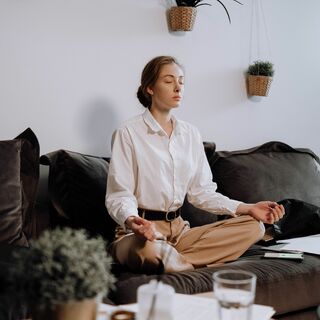
Let's say you're sitting in front of your app and your eyes are closed and you're focusing on your breath.
You're practicing mindfulness meditation,
But given the internal and,
You know,
Solitary nature of the practice,
How do you know that you're doing it right?
How do you know that what you're doing each day,
Every day,
For minutes every day,
You know,
This thing that you're really working on and dedicating a lot of time to,
Is actually correct?
How do you know you're just sitting with your eyes closed and thinking?
This is one of those things that troubles a lot of meditators that don't have access to a teacher in person.
Someone that they can direct their questions to and from and get instant feedback.
And even if you have such a teacher,
There's still the risk that when you're not talking to them,
When you're in that seated meditation position on your own,
In your own consciousness,
That you're not following the practice.
Because meditation is unlike any other form of pursuit.
If you're doing a sport or an art or business or anything else external,
There are objective measures of success.
You can tell if you're doing your sport correctly based on how you perform in the sport.
You can see the physical product of the art and you can see how it's being produced.
The market will decide if the products and services you are putting out to the market are worth supporting with their money.
But what are the measures of success for the meditator?
We're going to be looking at mindfulness meditation or a practice of vipassana,
You know,
Breath-focused meditation for this talk.
But the general principles can apply to any internal practice.
The way you know if your practice is working is if you are getting the results that are promised by that practice.
But the problem of course is you are the subjective judge of those benefits.
And depending on the philosophy that you subscribe to,
Those benefits may take gears to manifest.
Or the benefits are of a nature that is one of waking up,
Of enlightenment.
And all of the little benefits along the way aren't necessarily something to pursue.
So it can be hard to not become disillusioned,
To not become jaded by the the perceived lack of progress,
By the confusion,
By the the doubt in the method.
Because if you're just taken to this practice,
If you've just taken to sit down and meditate,
You're going on an act of faith.
Faith that the instructor is teaching you correctly,
Faith that the information in the book or in the app is teaching you correctly,
And then also faith in yourself to be able to act upon that.
You've got little ability to compare how you're actually performing.
But let's talk the benefits of mindfulness meditation.
What should you start to see relatively quickly in terms of your practice?
Now I want to highlight that the benefits that I will describe here are obviously subjective.
And depending on your starting position,
Your lifestyle,
Your circumstances,
And how much you practice,
And obviously the quality of your practice,
These benefits will be different.
So once again it's it will be impossible to allay the fear that you're doing it wrong.
Only by continued practice,
Continued listening,
Continued reading,
Continued study,
Both internal and external,
Will you be able to get a better gauge on your performance in this area.
But with that in mind,
What can we hope to expect?
Given that at least initially mindfulness meditation involves continually returning your focus back to the breath,
We're training our ability to focus.
Our mind wanders,
We bring it back to the sensation of the breath entering and leaving the nose.
We have a thought,
An emotion,
A feeling,
A physical sensation.
We acknowledge it and bring it back to the breath.
So what are the benefits in real life of such a focus?
We should notice our ability to have longer conversations,
To be able to read for longer stints,
To be able to focus on training and personal development to a far deeper extent.
We should notice our ability to do mundane or boring tasks to a far higher proficiency because we've been able to focus on something as you know mundane as the breath.
We should also begin to notice,
We should also begin to be able to start taking control of our addictions and our habits.
This isn't to say that we'll be able to conquer them,
At least not initially,
But we should be able to at least see the triggers,
See the cause and effect that causes us to use the substance or consume a food or do a certain action that's detrimental.
Because what's happening is by training our ability to be mindful,
We are able to see these sort of thoughts as they pop up,
As they come across.
So when you get this urge,
When you get this desire to do something,
It will be noticed and flagged.
Now the first step to overcoming the addiction is to notice the triggers because if you don't notice the triggers you'll just be following that addictive behavior.
However instead if you notice them you can take a breath and start taking actions to slowly overcome them.
So as your practice improves your addictive behaviors should start to decline.
Down a similar path you should also start developing better relationships in the sense that your interaction,
Your interpersonal skills,
Your ability to control your own emotions will increase.
In the sense that if you would previously get angry with a certain person or in a certain situation,
Your mindfulness practice will help you to recognize that anger.
It will allow you to see it for what it is.
It will show you that you're not the anger,
You're just the thing that has the anger.
And like with the addiction,
Like with the intruding thoughts,
It'll give you a brief moment to step back,
See it for what it is and potentially change your course of action.
The same is true for annoyance,
For jealousy,
For all of the other things that get in the way of healthy relationships.
You'll be able to see the emotionality in your situation and rather than just act on impulse you'll be able to take a breath and step back and potentially make a different choice.
The net result of this newfound ability will be improvements in your relationships.
There'll be less arguments,
Less misunderstandings,
Less miscommunications,
Potentially less disagreements or alternatively you'll be able to see your role in those actions and you'll be able to see the reality of the relationship and potentially make better choices in connecting in future relationships,
Both platonic,
Romantic and employment based.
Over time you should also see a improvement in your desire to and ability to practice self-care.
You may want to start exercising,
You may want to start eating well,
You may want to start cutting down on intoxicants,
You might want to start living a more ethical life.
And the reason for all of these changes is that your mind will start to clear up and you'll start to see that there's more to life than just a scrambling to survive,
Just going through the motions to get to the next day,
To the next moment,
Just living off this pleasure principle of going towards what feels good and running from what feels bad.
Instead you'll be able to take a breath,
Step back and look at the larger picture of your life to see that the actions you're taking now will impact you in the future.
So you'll start to be able to make better decisions,
Those long-term decisions.
The more you exercise,
The more better diet you have,
The less intoxicants you have,
Just the better lifestyle you have,
The the more likely of a positive outcome on the future you'll have.
You'll make better money choices,
You'll make better relationship choices,
You will start making decisions that benefit future you,
Potentially at the expense of your short-term pleasure.
But because you're able to see what that pleasure is and what pain is as a distinct separate entity to what you are,
You won't be as drawn or as pulled to the short-term outcomes because you'll have a detached perspective from them.
From the psychological perspective you might start to notice a general reduction in your anxiety levels,
A general reduction in your feelings of depression and remorse,
A general lifting of mood.
It won't be a dramatic change,
It won't be a miracle cure,
But it might be more akin to a slow trending upwards,
A 10% change.
So things will just seem slightly better,
Colours slightly brighter,
Memories of the past slightly less dramatic,
Slightly less strong.
And from that place you'll once again be able to make deeper and more meaningful connections to yourself and to the world.
And the final place you're likely to see benefits of a legitimate meditation practice is in insights.
You might start having many revelatory experiences into the nature of consciousness,
Into the nature of reality,
Of human connection,
Of the human experience.
And some of these will come as a,
You know,
A big shock,
Almost like it's announced with fanfare.
And other times it'll be just a,
Huh,
That makes sense.
And you'll start to share these experiences and then you'll realize that other people are already living in that plane of existence,
They've already had those thoughts,
And that there's a whole community of meditators,
Of seekers out there that are living by these truths.
And the more you continue meditating the deeper these revelations will come.
And the thing is is you will have already heard them,
You'll have heard these concepts spoken to you now,
But your experience meditating will give you the tools and the ability and the insight to understand them and to sort of live by them so to speak.
Now if you've just listened to this and you're feeling lost,
You're feeling like you haven't experienced any of those things,
Or that you've experienced them to such a small amount that you're not sure if it's a placebo or not,
There's a couple of things you can do.
The first one of course is to persevere.
If you've only just started,
Keep going.
There's a lag between actions and results.
If you exercise today you're unlikely to see the results of that exercise in terms of strength or body compositional changes for months.
So in the same way if you've only just started meditating you're unlikely to notice any tangible differences for quite a while.
So keep going,
Persevere.
However if you've been meditating for a while and you're still struggling to see results,
I would suggest that you need to step back and evaluate the practices that you're doing.
How are you meditating?
What process are you going through?
Do you have enough information on the practice?
Do you need to listen to some more tutorials or read some more books or get access to a class or a workshop or a one-on-one session with a meditation master?
Someone that has proven experience.
So if you want to go down the path of further education,
Do a little little read around.
Ask for people's experience with that person or with that resource and try a few because it's it's tempting to sort of fall into the false guru problem in which a charismatic leader promises a lot but delivers quite little.
A better approach would be to get a sample of different options,
Try them all and see which one works for you.
Don't feel discouraged by a lack of progress because what you're doing is you're discovering what works and what works for you and you will have at the very least practiced the ability to develop a practice,
To develop a time in your life that you can dedicate and focus and that itself is proof of your dedication to yourself and if you're not getting the the results from the meditation you can practice with and experiment with new options until you find one that is working.
The final point that needs to be considered is that each meditation session will be different.
So at the end of this talk I invite you to sit down and meditate,
Do a five-minute mindfulness meditation focusing on the breath entering and leaving the nose.
When thoughts or emotions pop up acknowledge them and let them go.
Come back to the sensation of the breath entering and leaving the nose.
Now in this session you might feel feelings of elation,
You might feel nothing,
It might be terribly distracted,
It might be the best meditation session you've had.
Whatever comes you accept it and you just go hey that's the meditation that I've been having today.
You can only have the meditation that you're having and what that means is that we're going to look beyond the the immediate impact of each session but rather look at the sessions as a collective.
How are you feeling about that session isn't as important as the overall trend.
How do you feel after six months of daily meditation?
How do you feel after two years?
Are you trending upwards?
That's the goal not a elation feeling at the end of a single session.
So now I invite you take a seat,
Close your eyes,
Focus on the breath entering and leaving the nose.
If your mind wanders,
If any mental or physical phenomena arise to distract you,
Acknowledge them and draw your attention back to the breath entering and leaving the nose.
Happy meditating.