Hello and welcome.
Today we are going to be doing a guided meditation over calmness and insight which functions around the buddhist ideal of pleasantly abiding.
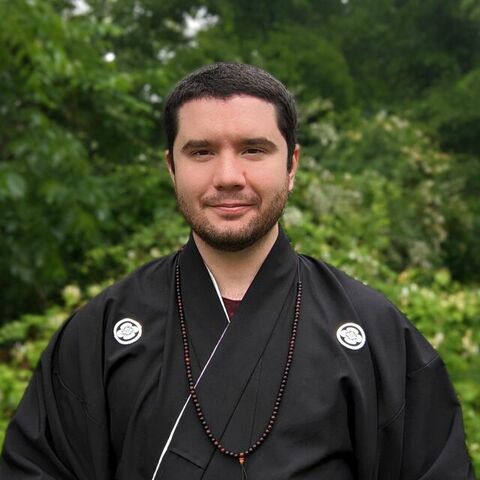
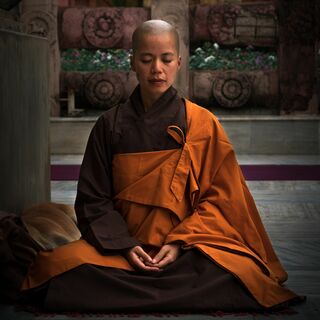
Begin by getting into a meditation posture of your choice,
Either on a cushion,
In the cross-legged position,
In a chair,
Standing,
Sitting or walking.
Come into the body.
Find a sense of balance.
Not too far back or forward.
Not too far left or right.
Shoulders not slouched,
But not uptight,
But relaxed.
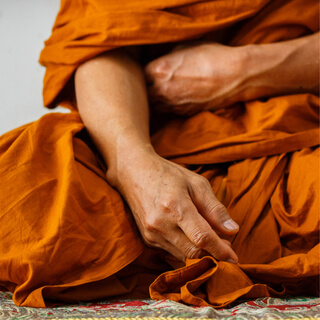
Hands in a comfortable position,
Not tight,
And the head at about a 40 degree angle pointed towards the floor.
Your eyes may be slightly open or they may be closed.
Now,
There are many different types of meditation,
Many different styles and varieties.
In the text,
The Path to Purification,
There are 42 mentioned alone.
There are many others than that.
Yet all of them point to the same two things,
Essentially.
To calm and to insight.
And in one way or another,
No matter what tradition you are working with,
You are moving towards calm and insight.
Calm and insight work side by side in our meditation.
They guide us and give us proper direction.
They can provide the map from their first breath to our last.
Both calm and insight need to be worked and cultivated if we hope to obtain more than a surface level of understanding that meditation brings about.
Most people want calm.
Who doesn't?
Everybody is looking for a little more stillness,
Peace,
And that special feeling of blissful contentment that comes with real and true calm.
We get glimpses of this in our meditation.
Very early on,
We can experience incredibly deep states of calm and insight that give us hints of what the path further down is to come.
I like to call this or think of it as beginner's luck in meditation.
You stumble into things that you don't even know are there.
A good example of this historically is when the young Siddhartha who would become the Buddha was sitting as a child before he had experienced meditation at all.
He slipped into the first jhana,
Which is a very deep state of meditation.
But I think that most would be satisfied to sit in this state of calmness and bliss.
But to do that is to get stuck and spin in the same spot over and over again.
It is getting caught up in the ego trap of enjoying the calm and bliss.
Calm is a tool that we use,
A skill to develop,
A means to an end that is the arising of insight and wisdom.
The calmness and peaceful states that arise in meditation are essential.
Just like it is necessary to use a pencil to write something down.
But the pencil should never be confused for what was written down.
The calm should never be confused with the insight.
Yet because that calm is so pleasant and wonderful,
We latch on to it and tether our experience of meditation to it,
Thinking that the calmness is the point.
So a new attachment arises.
It is our constant battle every moment.
We reject that which is unpleasant and accept that which is.
If you make this your purpose in life,
To try and rid yourself of all that is bad and only have that which is good,
You will wander blindly from place to place.
As long as we apply this same strain of thought to our meditation,
We are not making any progress.
That does not mean it is not good for us,
Just that you aren't making any progress down the path towards awakening.
So today,
Rest in the calmness that arises through a focus on the breath and a general awareness of the world around you through the breath.
If we can focus on the breath,
There will be some calmness that eventually arises.
If we can keep our awareness on the breath,
Our mind will stop moving.
A mind in motion is the opposite of what we want in meditation today.
A good way to check to see if the mind is moving is to feel whether the eyes are in motion.
If you are meditating with your eyes closed,
Feel the eyes move against the lids.
If you are meditating with your eyes slightly open,
You will see them darting from place to place as you think.
In this,
Though,
Will come moments where the mind is at ease.
The breath is steady,
And the eyes are not moving.
We want to prolong this experience.
With patience,
This will come.
At first,
As soon as you notice this,
Your mind will move again.
I always like to chuckle at this.
It is like going,
Haha,
I have done it!
Yet,
By doing so,
You lose it.
The one ingredient needed to make all of this work is determination.
Be determined to return to the breath whenever the mind slips away,
Or the awareness,
Or the focus.
Check into the body when it slouches.
Keep watch.
It is a balancing act.
Every time you fall,
You must pull yourself back up and keep going.
When you can rest in that state of calmness,
Buddha calls this pleasantly abiding.
It will slip away because of its impermanent nature,
Coming and going as all things that arise do,
Just like the breath.
But the longer we can sustain there,
The more we are training the tool of calmness.
The more we can see the calmness not as the point,
But as the path,
The better off we will be.
It is not that you cannot enjoy this calmness,
But that you cannot be caught up in the calmness.
So let's just sit and be determined to develop a state of calm,
To become a master of the tool,
To pleasantly abide so that we may allow wisdom and insight to arise.
In ten short minutes,
A chime will ring,
And it will be the end of this meditation.