This guided meditation is for a four session class for a retreat in Costa Rica on February 20th,
2026.
If you're interested,
You can still sign up.
You can find retreat info on InsightTimer under my teacher profile.
All right.
We're going to explore some perspectives from Anapanasati Sutta with TMI,
With that framework.
So if you could,
If everyone will start with our eyes open.
That allocentric awareness that we were exploring earlier.
Try and establish that.
This wide open scene.
We establish mindfulness in front of us.
Ease up on attention.
I know most of us are,
All of us are in a room,
But try and get the sense like if you were outside sitting under a tree in a nice field.
Let your vision open up.
If you're using attention,
Looking at it,
It's totally fine.
It's not a big deal,
But we're leaning more into the openness.
And it's helpful to maybe find something about the openness that you like.
Maybe it's the clarity.
Maybe it's the non-resistive nature of it.
The acceptance,
The way it accepts everything.
Maybe it's the unboundedness.
Maybe it's the equanimity that we explored earlier.
Whatever it is,
Just notice,
See if you can notice.
Maybe it's all of those.
See if you can notice and enjoy those qualities of being wide open.
Maybe you don't feel so constricted and small.
There's an expanse of openness that's enjoyable.
And so we establish this wide open scene.
You don't really have to do anything.
It's more just a noticing of what's already here,
What's already available with awareness visually.
And when that's stable enough,
Wide open hearing.
Allow yourself to hear wide and far.
Establish awareness in front of us with wide open hearing.
Don't forsake the seeing,
Maintaining the seeing and the hearing.
When that's stable enough,
A wide open feeling.
We feel the whole body at once,
Not with attention,
Just with awareness.
In the same way,
Allocentrically,
With seeing and hearing all at once.
The whole body at once.
Again,
Don't let wide open seeing and wide open hearing collapse or background.
Just add or notice that the feeling's here too.
And again,
Find something enjoyable about this,
Being this wide open.
This is step one of the four-step transition,
Establishing awareness.
And now we'll do our six-part preparation.
Really keep the wide openness.
So now we're going to use thought,
Going to go into the mind with thought,
But from here.
So part one of the six-part preparation is what?
What is our goal,
Our motivation?
Why do we do this?
But stay open and intend to go into thought.
Don't let this openness collapse.
Just a light attention on thought.
Keep the openness and contemplate or bring to mind why you do this.
I'll share mine.
I use Wilber,
Ken Wilber's ups.
It's to grow up,
To wake up,
To show up,
To clean up.
That's why I do this,
But from awareness.
So whatever yours is now,
Stop thinking,
Come back out of thought.
Did awareness collapse because you thought?
Did you lose a bit of it?
Re-establish it.
All right,
So now we're intentionally going into the mind and coming out of the mind.
Staying open.
Part two of the six-part preparation is what are we practicing now in this sit?
Well,
We're going to explore the first four steps of anapanasati within the TMI framework.
That's what we're going to practice now.
As we thought about that,
Did awareness collapse?
So again,
Re-establish.
The third part of the six-part prep is do we have any expectations about what's going to happen?
Try to put those expectations down.
And as you,
Again,
As you thought about that,
Did you go into thought or did you look at thought from this openness?
So again,
Let's come back out of thought.
Wide open seeing,
Wide open hearing,
Wide open feeling.
In part four,
Now back in the thought,
But stay open.
We realize it's not expectation,
But it's diligence that transforms us,
That allows us to achieve our goals.
So it's a vigilant awareness,
A watchful awareness,
And a directed and sustained attention.
That is not expectation.
It's this that cultivates our minds and propels us down the path.
So again,
Did awareness collapse or are we still open as we engage with thoughts or come back out of thought?
Maybe notice the quietness of awareness versus the activity of thought.
This openness is required.
Part five of the six-part preparation is what can get in the way.
And so there's some known suspects that each of us has,
Right?
Could be thought,
Could be pain,
Could be distraction,
Whatever it is,
Bring it to mind,
Recognize it,
And kind of feel like you want to put that down,
Not going to engage with this.
Maybe you have something on your mind from work or family.
I'm going to put this down now.
Come back out.
In part six,
There's a body here.
So now our attention can start to come to the body,
If it hasn't already.
The body's erect,
Cross-legged maybe.
We don't let awareness collapse.
We start attending to the physical sensations of the body.
So my eyes are still open.
I'm sort of maybe looking past my nose,
Gazing like at the floor,
Maybe two meters ahead of me.
There's wide open seeing,
Wide open hearing,
Wide open feeling,
But now attention is also on the feeling of the whole body.
So we've made this wonderful open spaciousness,
A light attention on the body.
And what's the body doing?
Well,
It's breathing.
So we naturally start to attend to the breath sensations.
Don't let the openness collapse.
We're just light attention on what's happening in the body.
The body's a little more gross,
A little more solid.
The breath is lighter and more dynamic.
It takes more attention to start to attune attention to the breath,
But we take our time.
With the openness,
There's a lighter touch with the body.
It's not so constricted just because we started using attention.
The first way we'll relate to the breath is taught to me by one of my teachers.
It's called chasing or hunting.
So what we'll do is as we breathe in,
We'll start at the tip of the nose and follow the path of the breath all the way down to our sitting bones on the inhalation and then follow the path of the breath all the way up back through the body out through the tip of the nose.
I think that's why they call it hunting because you're on the hunt for where the breath is moving.
So you might have already said,
Well,
The breath doesn't really go down to the sitting bones,
Eric.
I understand that,
But it feels like it because the diaphragm is moving down there.
So just allow yourself on the inhale,
Go past the nose,
Past the sinuses,
Past the throat,
Down into the chest,
Through the midsection,
To the lower belly,
All the way down to the sitting bones.
And on the exhalation,
We reverse the path.
Now there's a way to make the breath longer without controlling it.
There's a way to investigate long breathing,
A longer breath.
As you exhale,
Just give yourself permission to wait for the breath to fully exhale.
So just be patient and naturally,
Like a balloon collapsing,
Just allow the breath to fully exhale.
And this will make the breath longer.
Then the inhale will be naturally longer.
Yes,
It's a little bit of control,
But it's a control where we let go.
And this will make the breath longer and can lead to a parasympathetic nervous system response of relaxation.
This is the beginning of shamatha practice of calming or tranquilizing the body using the breath.
Now we're not pushing the air out at the end.
We're just waiting for the lungs to naturally exhale.
We're still hunting.
We're still chasing.
As the breath gets longer,
We're noticing the effect it has on the body.
So we needed more attention to feel all those sensations,
But did awareness collapse?
So if you've closed your eyes,
Open your eyes.
Did you lose any of the allocentric nature of wide open seeing,
Wide open hearing,
And wide open feeling?
If you did,
So now re-establish it with eyes open.
And hunt now,
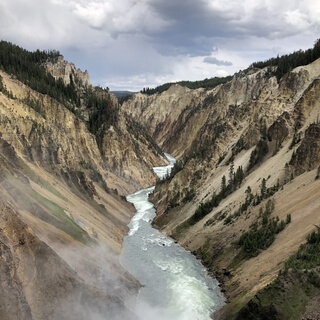
But sort of look down a little bit towards your body and imagine like you're in the mountains looking at a river.
And the breath is the river.
The path that the breath takes is the river,
And so follow it.
But with that mountain view,
That open view,
Without awareness,
The sort of structure of the body can make us sort of feel like we're in a small space.
So by looking at the breath in this way,
The path,
We open up again.
And if there's a restrictive quality to your breath meditation,
This will counteract that.
There's a natural structural restrictiveness to the body.
You can't breathe the balloon 10 meters out,
Right?
Naturally,
There's a restriction.
But by seeing that the breath is moving in this open space,
Tempers the restriction,
If there is any.
All right,
This mindfulness in front of us,
This allocentric awareness while we're focusing on the breath.
For me,
It really brings in a quality of ease around the breath because of the space.
The breath is freely moving through space.
Keep trying to extend the length of the breath by being patient at the exhale.
Just watch how it calms the body in this wide open space.
And give yourself permission to enjoy that wholesome quality.
Next,
We're going to focus attention in the lower dantian.
So that's like two inches below the navel and two or three inches inside the body.
Some people call this the hara.
We just want to put our attention on the sensations that are associated with the breath.
So maybe it's the rise and fall of the diaphragm.
Maybe there's a sense of expansion or contraction.
However it's showing up for you.
That becomes the object of our attention.
Stay open,
Wide open seeing,
Wide open hearing,
Wide open feeling.
In here too,
Let's continue with our long breathing.
For some of us,
We sort of grip down here in the lower belly.
So see if you can allow the breath to fully exhale and see if there's a release.
If you are gripping,
Maybe you're not.
But if you are,
Just patiently let that unwind if there's any tension down there.
Just each breath a little more relaxed at the very end of the exhale.
Maybe this stirs up some energy.
In awareness,
We feel the rest of the body there.
There's a space in which this energy is releasing.
There's a nice openness in which this can relax.
If there's any pent-up energy there,
It moves through the space that's around what you're attending to.
So maybe it goes up the torso or through the legs.
But because of the openness,
There's room we can unwind the tension.
So really giving space and allowing room for the relaxation to spread.
And again,
Give yourself permission to enjoy the relaxation.
Feel how nice it is to have a very relaxed lower abdomen.
Maybe you need to sit up a little straighter to allow the muscles to release,
Not in a stiff way,
Just aligning a little bit.
So the breath flows more freely in the wide open space.
Again,
If your eyes are closed,
Let's open them again and see if awareness collapsed.
And if it did,
Again,
A wide open seeing,
Wide open hearing,
Wide open feeling.
And as we focus on the lower abdomen,
I'm looking at it with my eyes,
With my eyes open.
See the space and see that the breath isn't constricted because there's an open space outside of the body.
So the structural constriction of the body isn't so strong.
We temper it with the openness of awareness,
Seeing it,
Feeling it,
Relaxing and enjoying the movement with a wide open awareness.
Let's put our attention in the middle dantian.
So by the breastbone,
Inside a little bit.
And feel the lungs expanding and contracting.
Again,
Maybe a little straightening of the spine,
Just with alignment,
Not with muscles,
Just aligning the spine to feel a freedom of expansion and contraction.
And the same thing,
Just allowing the exhale to fully exhale.
And the inhale is just naturally longer and more full.
We're not billowing the lungs,
We're just naturally letting them expand more because we allowed the breath to exhale more.
A wide open seeing,
A wide open hearing,
A wide open feeling as we focus on the expansion and contraction of the lungs.
Can you feel the expansion down into the lungs?
Can you feel the expansion and contraction in the front of the body?
Can you feel the expansion and the contraction in your back?
Creating space and giving ourselves permission to feel a breath in the body.
Taking an interest in how that feels.
Can you feel the expansion and contraction up in the sides of the body,
Into the armpits?
Can you feel it up into the collarbones even?
Once again,
Let's open our eyes.
Did awareness collapse in any way?
Re-establish it.
With a down gaze with the eyes,
With open eyes,
See where the lungs are.
See the space beyond the body and that the lungs really aren't that constricted by the structural nature of the body.
There's room for the breath to expand and contract.
We can focus attention on the upper dantian.
That's sort of two inches maybe inside of your eyebrows,
But with a little bit broader aperture of attention.
Your whole head is in attention.
In the same way we were chasing,
Maybe chase a little bit from the nose down to the throat.
See if you can be really clear with how the breath comes in through the nose,
Goes past the sinuses,
Past the palate,
Down towards the throat,
And that's where we'll end.
Then we'll come back up on the exhale in the reverse direction,
Just trying to feel the subtle sensations in that pathway.
If there's any constriction in the head,
Bringing awareness,
The openness to the head so it doesn't feel like we're bearing down with a narrow focus.
There's an openness.
In which these sensations are arising.
So relaxing the face,
If there's any tension,
Bring openness to the head,
To the face,
To the jaw.
The back of the palate is an interesting place.
Can you feel the breath going back past the back of the palate?
It's subtle,
So you gotta be a little chill,
Right?
This is why the breath is so amazing.
It's a sensation like this.
You've got to be really calm and a nice light attention,
And oh,
There's this subtle sensation back there.
Maybe we never felt that before.
It's okay if you don't feel it.
Eventually you will someday,
But just try to relax.
Wide open awareness.
If you can't feel it,
You can just go to the nose,
Where you usually go,
If you go to the nose.
Again,
Open your eyes and see if awareness collapsed or if there's still an openness.
With seeing,
With hearing,
With feeling as you lightly attend to the breath sensations at the nose or the palate.
And if it's collapsed,
Open up again.
See the space around the head and the structural constriction that if you felt to be tight inside the head allow that visual openness to relax the structural constriction,
Felt constriction.
And it can be a very light attention on the nose with a very open feeling in the body,
Even in the head.
So what's the balance of attention and awareness?
60-40?
70-30?
80-20?
Each of us,
It'll be different.
What's the awareness that gives us this wide open feeling of relaxed,
Open awareness?
And you can still discern the breath.
I would say the shift is more to awareness.
Very light attention on the breath.
Let's attend to the whole body breathing,
With eyes open or closed,
It doesn't matter.
And just feel a whole body breathing in attention with a wide open awareness.
Relaxing on the inhalation and surrendering the weight of the body to gravity,
To the earth,
On the exhalation.
Relaxing on the inhalation.
Surrendering any heaviness to the earth on the exhalation.
A wide open awareness.
Letting go and relaxing.
Enjoying the breathing.
Once again,
Let's narrow our focus,
If you haven't already,
To the breath sensations at the tip of the nose.
The fourth step in anapanasati is calming the body conditioner.
So a little bit longer of a breath,
And see if you can make it calm and smooth.
Just get out of the way and just let the breath be smooth,
Natural and flow through the nose.
For the breath to be smooth,
You've got to be really relaxed.
For the breath to be smooth,
You've got to be really open.
Once again,
Open your eyes if they're not open,
And see if awareness has collapsed.
Re-establish connection with it,
If it has.
Wide open seeing.
Wide open hearing.
Wide open feeling.