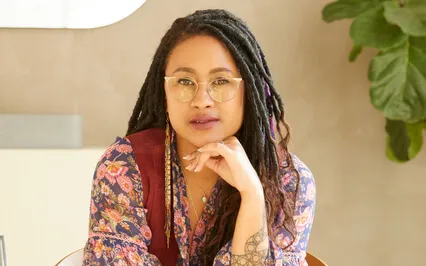
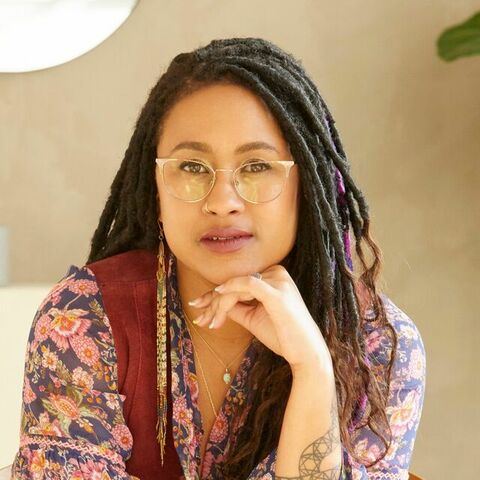
Welcome to Conda Mason's Brown Rice Hour,
A podcast that quilts together a fabric of connection between land,
Race,
Money,
Culture,
And spirit.
Discover a connection that engages with the most inspiring and cutting-edge thought leaders today pointing toward our collective healing and liberation.
If you are interested in supporting the Brown Rice Hour,
Please visit beherenownetwork.
Com forward slash conda.
Hi,
I am so happy to be here with you.
Me too,
Conda.
Yay,
Yay,
Yay.
Look at us.
Look at us.
We got our hoops on.
Yay,
Yay,
Yay.
Oh my God.
So I am happy to be here today.
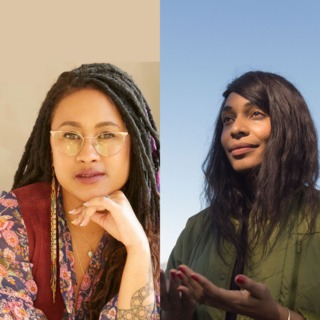
My name is Conda Mason and I am the host of this podcast called the Brown Rice Hour.
And we have conversations at the intersection of land,
Race,
Money,
Culture,
And spirit.
And you know,
The way I look at it,
That kind of sums up America.
And so it gives a lot of latitude for conversation.
And I am being joined by my dear friend and comrade and bestie,
Sarah King,
Who is here with us.
And so before we get into anything,
I like to open up a little bit of sacred space.
Okay.
And in that,
I like to just begin sacred space by honoring our ancestors,
Those who have come before us,
Who have gone through tremendous,
Tremendous suffering to allow us to be here today and who have paved the way for the resiliency that we have.
And so we have a responsibility to those ancestors and I feel it every day.
And then I just want to also give honor to those who are coming and the younger ones and those who we are leaving this planet to and may we be worthy of your trust.
And yeah.
Ase.
Ase ahoh.
Ase ahoh.
So,
Sarah.
Yes.
I am going to introduce you to folks,
Okay.
For the few people who don't know who you are.
I'm going to read a bio.
And so Dr.
Sarah King is a UCLA trained neuroscientist,
Political and learning scientist,
Social entrepreneur,
Scientific speaker,
And yoga and mindfulness meditation instructor.
She has over 20 years of experience as a research scientist.
Lord,
20 years,
She looked so young.
And specializes in the study of the relationship between mindfulness,
Complimentary alternative medicine and social justice.
She is also the scientific consultant for peace in schools,
A Dharma teacher with presence collective and the founder of mind heart consulting,
A scientific consultancy offering up seminars,
Research and development and trauma healing circles based on the framework she developed called the science of social justice,
Which we will get into later on.
And it's a way of both studying,
Researching,
Teaching,
Facilitating,
And healing individuals and communities from the dis ease of othering and systemic oppression.
Welcome Sarah King.
Dr.
Sarah King,
Thank you for joining me.
Thank you so much for having me,
Conda.
I know that this podcast is probably a long time coming.
And I am just so excited to dig into the juiciness of you of this with you of this incredible,
Palpably powerful historical moment in time that we are all so fortunate,
Particularly as black people,
I would say to be living in and through.
Yeah,
I say so too.
I really feel like,
Wow,
What a time to be on this planet and to be doing this work and being called to do this work that we're doing.
It's just,
It's really something.
Absolutely.
Absolutely.
Especially when considering the opportunity that is being given,
At least in my experience to really vocalize with candor,
With truth with a capital T,
The magnitude of the pain and suffering that it is that we have had to endure.
And what I see right now is there is a systematic dismantling of the veils that we have experienced as gaslighting.
Yeah.
For generation after generation.
No,
Your experience is not what you say.
It's not what you think.
Yeah.
Everything you say is in your mind.
I'm going to do this.
We're going to get into some juicy stuff,
But before we do that,
I have a opening question that I asked folks.
Okay.
All right.
And this opening question,
I asked this question because I think that,
Well,
I believe that this question has everything to do with really the showing the inside and the outside interior and the exterior of who you are.
And one simple fun question.
And we get a chance to see a lot about you and that who that's around you and how you come to be.
And the question is this as a child,
What was your favorite comfort food?
And who prepared it?
Oh,
Wow.
You know,
It is so interesting.
No one has ever asked me that before.
And when you did,
I felt this visceral blossoming of energy well up and forth from my belly.
It was like a,
Like a flower blossom that like,
Like those kind of those little packets of tea where you put them in hot water and it just like curls.
So I can't say that there is one in particular because I loved my mother's cooking and I love my grandmother's cooking,
But I can remember what made you that comfort food.
My mother was in the habit of making magic out of tofu.
And as a family,
We were mostly vegan,
But for the kids,
She allowed us to be vegetarian and to eat cheese.
But she would make this fantastic tofu crumble.
And I remember,
You know,
This was back in the day when health food stores were like far and few in between.
And we lived on the East Coast and we didn't have a car.
So my mother would have us go on these like three and four hour bus trips.
So it's clear to another state we had to go to just to get organic food because she was only about eating all organic.
I don't know if I've ever told you that my mom was one of the black Hebrew Israelites.
And she moved to Israel as a part of that first original settlement that they made in the Negev.
So that's where she picked up on a lot of her ideas about the links between nutrition and land and the body and the impact that was having on the earth.
So for her,
Tofu was a way of like really supplementing the protein in our diet when we couldn't get it through meat.
And she would find this packet of seasoning by this company called Dr.
Bronner's and sprinkle it all over the tofu and put it in the oven.
And then that would go on pizza and it would go on sandwiches and all different sorts of things.
And I just remember this delectable spongy texture and the way that it like settled in my body,
But it didn't make me feel like heavy and weighed down.
It made me feel like energized and really alive.
But I also have to say that I am now recalling this evening practice that my mom had of washing and cleaning collard greens.
So I'd say collard greens were my other comfort food.
But I remember being a kid and just like being so mumbling and grumbling like,
Oh,
I have to get like all the dirt out of all the little portions of the leaves.
And it was always my job and be like,
I always have to wash the collard greens when you're a kid and you don't really understand that there's this powerful cultural transmission that's coming through.
And I recall being about six years old.
And I think that that's when I can like really recollect like strong memories of being at her mother's house,
My grandmother and tasting my grandmother's collard greens.
And the moment in my mind that I was able to detect the flavor of my grandmother's love and how that had been passed down to my mother and reflected in her cooking.
I could taste my grandmother's cooking and my mother's cooking.
And there was something about that really deep in my soul that just reminded me of the fact that there were so many ways in which love was transmitted to me through the cooking of the women in my family.
And I didn't even realize the depth of the healing that that was bringing her out in my soul.
And that by them opening up a space for me to come into the kitchen and to be part of what I thought at the time as like,
You know,
A chore was a spiritual,
Cultural and even religious transmission that they were opening,
Opening me up towards.
And so now,
To this very day,
When I cook,
Because we always prayed over our food,
You pray food when you're cooking it,
You pray before you eat it.
And then the act of eating itself is a prayer.
And so when I am in my kitchen now with my daughter Dahlia,
Who is 12.
I didn't.
It was interesting.
I used to make it mandatory that she would pray over our food.
And then I kind of backed off from that.
And I thought,
I'm just going to see if she gravitates towards it herself.
And I'll notice her in the kitchen,
Baking up some,
Some cupcakes or some cookies or something.
And she'll take her hands and close her eyes in the way that I do because this is I take my hands,
I close my eyes,
And I hover them over my food.
And I imagine that I am my grandmother and I am my mother.
And I feel the energy of that transmission coming through my hands.
And that's my way of sanctifying the food that we eat.
And so to see her at 12 years old in the year 2020,
Standing there with her hands over her food,
Really feeling and believing and knowing that she is taking a part of this intergenerational transmission of healing through food is really powerful to me because I didn't ask her to do that.
I just picked up on it as a tradition and took it upon herself.
That's amazing.
That's amazing.
I love that.
You see why this question brings out so much,
Right?
Absolutely much.
And people tend to go into this place of just like this feeling place that feels so warm and fuzzy and wonderful and memory.
And it's interesting that you said collard greens because actually this morning I got up and I harvested collard greens from my garden,
Washed them,
Cut them up,
Cooked them.
And as soon as I'm done with this,
I will be eating collard greens since Sunday.
And we have collard greens on Sunday and black eyed peas.
So I've got black eyed peas and collard greens sitting over there right now in the kitchen.
The classics,
The staples.
Yes,
That's right.
Well,
I am so happy to hear those stories.
Yeah.
And I didn't hear that one about your mom before and as you're like,
That's really,
Well that actually brings me to,
You know,
I remember when we met and we met at Spirit Rock and I was teaching something,
I don't remember what it was.
It was a retreat and you were attending the retreat.
And we met,
You were in a group with me,
Interview group,
And you just bore your soul in that group.
And I remember the tears and the bigness of everything you were saying.
And it struck me so deeply.
And I thought,
I need to know her.
I already know her.
Yeah.
I already know her.
I know her.
And we have been tight ever since then.
Absolutely.
I think that may have been Spirit Rocks.
Wasn't it the 20th anniversary of their POC retreats?
I don't remember which one it was.
Okay.
Was it that?
It may have been that.
Yeah.
I think it was before that.
Was it?
Yeah.
Right,
Right.
We've been at this for so long.
It's hard to remember.
But what I do remember is hearing so much of your story and then seeing who you are and the work that you're doing,
The path you're on,
And seeing their direct healing.
The work that you're doing is healing you and others,
Is how I see it,
From all the stuff that we're looking at today that we've been talking about forever,
For 400 years.
Black people have been talking about the disparities,
The discrimination,
And what happens and what life looks like.
The world that's created from,
Basically,
From the genocide of indigenous people and the enslavement of African people,
An entire world has been created that continues to this moment.
I think of you as a Black girl and all that you went through.
I want to talk about the work that you're doing in this moment.
I want to talk about all of that stuff.
But for me,
I don't know how.
.
.
I mean,
We didn't talk beforehand what we were going to talk about.
So I don't know how comfortable you feel.
You just tell me.
But there's something about talking about where you come from that will lead us to where you are.
Whatever you feel comfortable about sharing,
The mic is open.
Wow.
I really appreciate that,
Conda.
I had to just take a moment and drop into my body and what's really alive for me right now in terms of opening towards what it is that I want to share.
A few days ago,
Because I'm located in Portland,
Oregon on Multnomah lands.
For those of you who don't know,
I'm studying and training as a neuroscientist at Oregon Health Science University.
That's OHSU.
I work in the Department of Neurology and because of the extreme intensity,
Particularly of the history of Oregon as a state that was intended to be the white man's state,
There is a certain intensity of the experience of whiteness and white supremacy here because there has not been the intermingling and diversification that has been experienced by other states in this country.
They said,
Dr.
King,
Would you come and speak to us about your experience being a black scientist here at OHSU?
Because I am the only black postdoctoral scholar in my department.
That's it.
And I think out of 89 professors,
Two are black and they're both black women.
So when they put me on the mic for that meeting in front of everybody,
It was like a diversity committee meeting,
I thought to myself,
What do I want to start out by just talking about my experience as a black scientist as though that is somehow not connected to where I have come from?
Right,
That's where you began.
And I thought to myself,
Uh-uh,
We can't even go there yet.
So this is a little bit about what I said and also some of the communications that I have been sending out to some of my colleagues there who I felt were proceeding with business as usual after George Floyd,
After Breonna Taylor,
After Emote Arbery,
On and on and on.
And I've been like,
No,
Actually you need to know who you're talking to first.
So one of the things that I said was,
My family comes from Virginia.
We are one of the first generations of black people to ever occupy these lands.
They were slaves in the Virginia colonies and then they became sharecroppers after Reconstruction.
So my family belongs to the first population of people who ever farmed lands,
Tilled these lands,
Made them into something fertile that could nourish the bodies and hearts and minds of everyone in the United States.
And then they moved to Lancaster,
Pennsylvania.
And my family became deeply merged with the Iroquois Indian population there.
They were one of the first colored,
Mixed colored families to come into wealth in the Lancaster,
Pennsylvania area.
In my grandfather's generation,
My grandfather was the first in our family to become college educated on the East Coast.
And I told them that from slavery in Virginia,
From Reconstruction,
From the Black Codes,
From Jim Crow,
On into my family's participation in the civil rights movement where all of my aunts and uncles were on the front lines in SNCC as my mother was a member of the Black Panthers.
Through the years of segregation,
I am,
What I had to say to them is like,
I am the direct offspring and descendant of five generations of the fight for black liberation in this country.
I am a manifestation of the original battle here in embodied form.
So when you see me and you say the words,
Dr.
Sirah King,
You have to understand what it took for us to rise from chattel slavery,
From total abject dehumanization and objectification and living in a society where reading books and educating ourselves was punishable by death.
And now here I stand,
A member of your community and within my family,
There are so many advanced degrees that I almost can't count.
We probably have close to 40 advanced degrees in higher education,
College degrees,
Master's degrees.
I am the sixth person with a doctorate in my family.
We are,
In spite of everything that the United States has thrown at us,
One of the most educated families that exists here on these lands.
And I'm exceptionally proud of what that says about the sheer tenacity of our being to rise up through these structures of white supremacy.
None of them could hold us down.
Now the thing that is very interesting about my family,
And perhaps this could be said about a lot of different families.
Yeah,
So I wanted to tie the conversation into mental health in this country.
And a lot of my colleagues who are psychologists or psychiatrists,
They'll say things who are white identified are so incredibly concerned about the impact of systemic racism and oppression on the mental health of black people.
And a lot of the time comments will be made about access to mental health care and why more black people,
Especially of older generations,
Are not seeking out the help of psychologists and psychiatrists.
So my mother was a person who I believe was a shaman.
And she was born into the body of a beautiful,
Voluptuous,
Very dark-skinned black woman in Jim Crow South in Virginia.
And it is my belief that to be born in a body such as hers with the incredible spiritual and intellectual gifts that she was given,
Which could have changed the world.
And the depravity of the injustice that she faced of being not just a second-class citizen,
But her sensitivity to the felt experience of dehumanization.
This is just my perspective.
I think what she witnessed broke something.
I think that the pain,
This epigenetic transmission of intergenerational trauma from slavery as it resided in her bones,
It was too much.
And I am a child of the mid-80s.
So I was born into a world where I was reaping the benefits of all that the previous generations had fought for.
I was not subjected to the same kind of pain.
So some people may want to say,
And perhaps I have even said in the past,
She's never been diagnosed.
I think that she was suffering from a variety of what is called mental illnesses,
What may be called schizophrenia or multiple personality or bipolar,
This and that and the other.
I'm not a psychologist and I can't determine that for myself.
But what I do know is that there was a certain fracturing that occurred within her being that was so fundamental to her ability,
Her inability to integrate all of the dimensions of her being and the violence which she ingested from this country,
The violence of white supremacy was like a virus.
You want to talk about a virus?
You want to talk about a pandemic?
Yeah.
In the same way that so many of us in the black and brown community are not surviving the coronavirus,
How many of us have been taken out in mind,
Body and spirit by the dramatic violence that functions explicitly through white supremacy?
So that is to say that in spite of the vast majority of many of my family members being highly educated,
And she herself was a student at Amherst College and then at Texas A&M for a time.
And this is when she was really deeply involved in the civil rights movement,
Worked side by side with Alice Walker,
So I have been told to my knowledge.
And then the Vietnam War broke out when she was in college.
And she was dating my brother's father at the time and they were getting ready to draft him.
And the idea that the love of her life should be shipped away to a nation full of brown people to murder them at the behest of a United States government that was doing the same thing to us on our lands,
It was too much for her.
It was,
There are a variety of historical events that occurred which were too much for her mind and her body and her psyche.
So by the time I was born in the mid 80s,
She,
Her suffering was so great and she was unable to hold down regular jobs.
I would say that we probably moved to a new city or a new state every two to three months.
She had no childcare.
A lot of the time,
You know,
We were either living in homeless shelters.
That was you,
She and your brother too,
Right?
No,
This was just my brother and my older sister had been sent to live with my family in California.
It was mostly,
It was mostly just me with her.
And then my brother and sister would kind of fly back and forth.
But I think that there was this,
I had a very interesting upbringing and that I was either in homeless shelters or battered women's shelters or living in motels because in the welfare system sometimes they'll give you money to stay in a hotel until you can get an apartment or we would be living with friends.
And so I lived a life of incredible transience.
And what period of time was this in your life,
Saran?
How many years?
Like what,
From what age to what age?
I would say this was between age like four or five and 13.
Wow.
Four or five and 13.
And you now,
Knowing what you know,
You know the impact at that age group,
How that,
What that impact was like.
Absolutely.
You know,
If we look at studies like you know,
Something that's very much in the popular zeitgeist is adverse childhood experiences.
And we look at the likelihood that a young black girl who is living with housing insecurity,
Homelessness,
Who is experiencing neglect,
Emotional and physical abuse.
My older brother Yeshaya was in and out of the prison system for his entire life.
One of my first memories was when I was six years old.
I'll never ever forget this because you know,
This really ties into the why I do the work that I do,
The why of the science of social justice.
I always remember this like it was yesterday.
We were living in San Diego at the time and I was fast asleep.
And this was one of the few times in which my mother and my brother and my sister and I lived together.
And I remember this series of loud crashing noises.
I didn't know what I thought.
Maybe it was an earthquake,
You know,
Because we were in San Diego and it sounded like that.
Like like a body being flung back and forth somehow against walls.
And my brother was being arrested in a domestic violence dispute that he had had with his girlfriend at the time.
Which is a whole nother trajectory of story that we could get into.
But the point is to say that the San Diego police came into our home,
Dragged him out of bed in the middle of the night.
And imagine how tiny I was,
You know,
Just six years old.
And I recall watching them drag him.
There was like five of them drag his body while he was kicking and screaming out the door around the corner.
I'm upstairs.
I'm looking outside of my window and I am scared shitless.
I don't know.
Like,
Should I run to him?
What does a little girl do?
And they beat him mercilessly.
Right there.
Right outside.
And all I could do was watch.
And I remember screaming and crying out from that window.
And then they took him into the police car.
And it felt like every single aspect of my world,
All of my childhood innocence was completely smashed to this.
Just my childhood was just gone in a moment.
Because I still thought that the cops were there to help you when you don't feel safe.
I was still of a frame of mind of like,
You know,
The police come and they visit my school and they tell us that they are here to protect and serve and thank goodness,
Thank goodness that they're here.
And then I remember visiting the prison that he was interred into with my mother and I was not allowed to go in and speak with him.
So I was left by myself in the front portion of this prison and I just recall how massive it was.
It was this just gigantic building.
And just think about that.
I'm six years old.
I'm by myself.
I have a teddy bear and I'm sitting inside of this prison.
And I'm looking around me at how high the walls are.
And I'm trying to wrap my little child mind around.
Okay,
So you're telling me that like,
I remembered I had gone to the SPCA because I was interested in a puppy.
And I remember seeing them in cages and being so sorry for these puppies in cages.
And I'm like six years old and I'm thinking to myself,
Okay,
So my big brother who is the love of my life,
I worship that man.
I might as well have been Jesus Christ for all I thought.
That's how much I loved him when I was a child.
I thought he was literally like Christ incarnate.
I love that man so much.
And you mean to tell me that you have put him into a cage and he can't get out?
And I can't see him and I can't talk to him.
And he is,
And all I knew is like,
Well,
If they treated him that way on the way to the prison,
What in the world was happening to him inside of the prison?
And what that does to a child's mind to attempt to conceptualize that it is possible for your freedom to just be snatched away in the middle of the night.
And that reminds me also of,
I mean,
You know,
How things ended up for him.
Yeah,
Absolutely.
So you know,
It's not something that I have had very much of an opportunity to talk about publicly,
But it definitely ties around to,
You know,
I'll just,
I'll say this.
People,
I've had people say,
So you have this science of social justice framework in which I equate social justice as being the same as wellbeing.
Social justice is wellbeing.
Social justice is wellbeing.
Social justice is wellbeing.
And now here's the clincher.
We have never had social justice.
You can think about it almost in a non dual fashion.
Social justice is something which both exists as well as it does not exist.
It exists in theory.
Right.
It's an aspiration.
It is a North star.
And so when people say to me and they get confused,
They,
You know,
In the past they've been like,
Well,
And this is as of the past three weeks,
All of this has completely changed,
I must say.
And then in the past,
People would say to me,
Why do you want to use the term social justice?
Don't you think that's kind of like boxing yourself in?
Don't you think there's some sort of negative connotation to that?
And can you really understand what it is?
Where,
Where,
Where you're coming from?
And you know,
People who would ask you that you said people would ask you that I'm sure there was not.
Well,
They were,
They were,
They were mostly only white identified.
People have ever asked me that question,
To be honest,
Because to people of color,
It is very,
Very clear that social justice is needed.
So if you're saying around that,
That's so interesting because if you're saying that they,
People would say,
Isn't that a negative and you're boxing yourself in.
And if you equate social justice with wellness and theory,
They're saying,
Is it like wellness is something that you should not have.
That's what they don't realize.
That somehow they are making this claim that the very idea that the felt experience of wellbeing could be a reality for people of color.
It was so hard for them to conceptualize and wrap their minds around.
They couldn't get,
They couldn't get to that place,
But here's how I'm going to tie it into my,
My,
My personal story is living in a country that has never,
Ever,
Ever healed from the significant trauma that was inflicted upon the entire world with this,
This weaving together of the very fabric of the birth of capitalism with the transatlantic slave system and the ways in which that continues in its manifestation today through our prison industrial complex,
Through the education system,
Through all of the health disparities that is that we find.
So for the people who were coming to me like social justice is wellbeing,
Huh?
How can that be?
Well,
Here's what they don't know is what they see on the surface is Dr.
King and they are thinking doctor equals privilege.
You must come from privilege.
Oh,
You've been all these great universities.
You got this great education.
Oh,
You must,
You must be coming from some privileged understanding of social justice in order to equate it with wellbeing.
And what I said in that neurology meeting department and what I am doing my best to be more forthcoming about,
And I'm so happy that you're giving me the opportunity to do it because it must be said in that we must say their names.
I want people to know you Shia's name.
I want people to know that my brother,
You Shia.
Now I'm gonna say this.
There's this conversation right now about black people's lives ending through situations of police brutality.
And there is like some question around what that,
What is that really about?
Right.
And some people,
And I agree with this,
They call it a lynching.
Well certainly George Floyd was lynching.
I would.
Yes,
Absolutely.
So this word,
This word lynching,
Right?
People get confused about it cause they're like,
Oh,
But there was no noose.
There was no rope wrapped around the man's neck.
And it's like,
No,
You're missing the point.
The point is that it is a,
It is a state sanctioned public execution of a black person.
That's what a lynching is.
It don't matter the instrument.
Right?
So when I was 20 years old and I was in my senior year of college and I got a phone call that my brother had been out and about in his car at a 7-11 and he had gotten into a chase with the police.
Now granted he was in his car.
Right.
But I think about all the young brothers who I have seen who are on foot running from a cop for their lives.
And the people who will say,
Well,
Why would you run?
Why would you run?
It's a cop.
That's not following the law.
And it's like,
Well,
What would you do?
What would you do if you knew that somebody was coming for your life?
Would you just stand there?
The nervous system is built,
You know,
Millions and millions of years built into us to protect ourselves,
Fight,
Fight,
Freeze,
Faint,
Or annihilate.
Right?
As Resmaa Menakem talks about in his book,
My Grandmother's Hands.
So I see that when my brother was in a car being chased by the cops and the car spun out of control and exploded and he died there in Compton.
And people have wanted to question when I say that my brother died from police brutality.
When I say that in my experience at 20 years old,
That was a lynching.
Doesn't matter to me whether he was on foot or in a car.
The point is that he was scared for his life.
He was running for his life.
And of course,
You don't have the faculties inside of yourself to make,
This is just,
We know this from neuroscience,
Your prefrontal cortex and all of your logical reasoning faculties,
Your executive functioning gets cut off when you are in survival mode and all you can do is go into a trauma response.
He was too traumatized to operate his vehicle in a fashion where he could have made it out of that situation alive.
And so I say that that is also a modern form of lynching.
I say this was before cell phones had video footage and things.
And so there was one story by the bystanders on the street on El Segundo.
And then there was the story that the cops had.
Two different stories.
Two different stories,
No justice to this day.
No justice.
That was in 2005.
That was 15 years ago.
And so when a person comes to me and says,
You know,
This was before,
Because everything has changed with these recent protests,
But before when they would say,
Why use the word social justice?
I would think to myself,
How can it possibly be unclear to you how unjust this land is?
And the impact that that has on,
In medicine,
We call it a bio-psycho-social framework.
You want to look at the impact that injustice has on the biology or the physiology of the body,
You know,
Health behaviors and diseases.
You want to look at the psychology,
Mental health,
Right?
And subsequent pathologies.
And then you want to look at those two and how they impact interpersonal relationships.
And that is how you draw this relationship between the health of the body and the health of the mind and the health of the person,
The family,
The community,
The society,
And the nation.
And so when you see the things which are unjust,
Which are directly contributing to a lack of ability to have health within this bio-psycho-social domain,
Then you can see that the wellbeing of the most vulnerable,
The most impacted,
The ones who are sustaining the greatest violence to their bodies,
Such as myself,
Until we have health and wellbeing on all of these different levels,
We will never have social justice.
That is why they are one in the same.
And that is why for a person such as myself,
For a scientist like myself,
I don't have the privilege of not understanding what social justice is about.
Because look at what has been taken from me.
And when I first came upon,
After Yeshaya passed,
I was hopeless.
I thought,
What in the world is a Black woman who has come from homelessness,
Who has come from,
You know,
Where I came from,
Some people may describe as like scum,
Nothingness,
Depravity,
All the horrible stereotypes that have been trotted out about Black people I have lived through in my body.
And so when Yeshaya was taken,
I just thought,
Is this the sign that I'm supposed to just give up?
Just give up.
But then I went to my first Dharma talk.
I saw a little advertisement.
I was roaming around in Venice,
Contemplating ending my life,
To be frank.
And I saw an advertisement for a woman named Kali Ma,
Who had been brought up through the Rinpoche lineage.
And I thought,
You know,
I've never heard of this Theravada Buddhism mindfulness,
I don't even know.
I'm going to try it out.
Because I was looking for something to save my life.
And I sat there at the back of the audience and I listened to this woman speak about the healing qualities of emptiness.
And I was shocked.
I was like,
You understood that?
Well,
Not.
It was,
There was a feeling inside of me that she was describing a place and she was describing where I came from.
I had never had words put to it.
I have always felt a deep,
Deep connection to emptiness.
So but it was mostly white identified people in the room and I raised my hand.
And I asked her,
What would you say to someone like me,
A young black woman who just lost her brother's life?
A black man,
A young black man in Compton to police brutality.
What do you have to say about the role of emptiness for me in my life?
What does this Buddhism have to do for healing someone like me?
And she got so quiet and I felt something in her quiet reach out to me.
And then she said,
Saraw,
Have you ever considered that in the manner and the form of your brother's passing that you have been handed a gift and that this is a gift,
Which is going to lead you down a path which you can explore and that perhaps that path is the path of liberation with all of the things that had been said about the violence of black men and their somehow deserving violent death,
Right?
And all the pain of that,
That I carried in my heart.
No one had ever said anything about my brother to me that indicated that the path that his life had taken could be a path of redemption and healing.
That was wild.
And I did not know what to make of it,
But I understood from her silence,
The silence before what she said was just as informative as the words that she said.
I thought to myself,
So somehow meditation,
This thing you're telling me about is going to connect me with emptiness and somehow emptiness is connected to liberation.
And what you're telling me is there's a possibility that I may be able to live a life that is free from this incredible pain that I am in.
And I thought,
I've got to explore that.
It was just,
It was like a loose thread of a tapestry of liberation that just dangled down to me.
And I was like,
Oh my gosh,
I had a whole just for dear life,
That thread,
Where's this going to take me to?
And it has been 16 years now.
16 years ago.
16 years now.
I was 20 since that first Dharma talk.
And I have been exploring Mahayana and Theravada Buddhism and meditation and yoga in my journey of healing.
And so the fact that I am able to enter into places and spaces and offer up healing along the lines of racial injustice and trauma,
What most people don't know when they meet with my love is that this is a love which I have been cultivating through the pulsing,
Burning and burno of white supremacy,
Which sought to end my life as well.
I did not want to live anymore after Yashaya passed.
So to use for the Dharma to be a tool of empowerment in the life of someone like me,
Where I can sit here and I can tell you on this day.
And you remember where I was when we first met,
I was still just like grappling with this grief and what am I going to do with it?
Right.
But for me to be able to speak this story to you today with a feeling of peace.
Yeah.
That's really transformational.
So I'll just hear you right now and looking at you and knowing the transformation and the practice,
The practice that you have been involved with.
You have really done the practice and to see this transformation in you is just incredible.
And I just want to take a pause and just,
And just feel and say how sorry I am at the passing of your brother,
How sorry I am and how that happened in your life,
In his life,
And in his life,
The way it did.
And I'm grateful.
I'm grateful for the instinct,
The energy,
The universe,
The God in you that sent you to see that fire and go walk into those stores and allow life to hit you fully,
Just life and not death,
But what's possible.
So what's possible.
And I'm grateful for that because the work that you are doing,
The path that you're on is like no other that I,
No one that I know the people that I know that are similarly on a path of yours in terms of the study.
It's not coming from the life that you have,
Not the culture,
Not the life,
Not the background in any way,
Shape or form.
So your mission really,
It feels like it's just this mission that has driven you to get your PhD,
To get your now in postdoc,
To do the work that you're doing around the science of social justice.
It's extraordinary.
It's extraordinary.
Thank you,
Conda.
So thank you so much for your acknowledgement,
For meeting with me at the heart.
I remember at the very beginning of my dissertation defense,
I tried to bring my brother's story into the room.
I tried to tell his story because I wanted to say that it was,
That the reason why I decided to study the experiences of middle schoolers of color who were studying yoga and meditation in their middle school,
These middle schoolers,
Very similar to the way in which I was brought up was because I thought to myself before I was even born,
Oh my God,
What happened to my brother in school?
What was it like being a little black boy in school in the seventies?
What happened and what didn't happen?
The ways in which he was not held such to the point where he felt he had no choice but to become a blood and a gangster.
There were no other options.
And I just thought that had happened,
That what happened to him was in school.
He was not receiving anything healing that could hold his soul within the system that was socializing him.
And I tried to tell his story and you know what happened Honda?
They did like this.
No,
No,
No,
No,
No,
No,
No.
We want to know about your data.
We're here to hear about your data in the way in which it pierced me in my gut that this department of education at UCLA,
I'm gonna call it out.
This is my space.
I'm calling y'all out.
Department of education at UCLA,
Urban schooling,
Knowing my advisor,
You all knew where it was that I came from.
You knew what it took.
You knew that I was a single mother on welfare struggling through your PhD program.
And you silenced me at a time when dozens of us were being killed in the streets in the same way as Yashia.
And you said,
We're here for the science,
This separation inside of science from the person,
From the body,
From the heart,
From the soul.
Oh boy,
That was colonization.
Yeah.
And that knowing that there's this wholeness about you,
This entire story,
Not just even of your nuclear family,
Of your brother,
But you go back 400 years.
I mean,
Right?
We're looking at the fact that,
You know what I love?
I love how Ruth King in her book,
Mindful of Race,
Talks about the star and the constellation.
I don't know if you've read it yet.
I have.
The idea of the constellation is that as people,
As black people,
We are coming to an experience filled with the entire constellation of our history,
Of our history.
It's not just a single incident as opposed to a white experience is this single incident.
It doesn't come with this whole history.
And so then you have somebody asking you for your data.
I want to know this single,
I want your data.
And you're coming with the constellation of your history,
Your personal,
Your family,
Your brother,
And all 400 years of history.
And so,
But they want the star,
Just give me your data.
And that was in disembodied experience of cutting you off from all of who you are.
Because data does not exist as data alone.
Absolutely.
Absolutely.
And if I may say,
If I may say the other reason why I'm so passionate about the science of social justice and for any and all of you who have interest in science or are scientists yourself who are bearing witness to this podcast with Conda and I,
I've been trying to point this out for so long.
When you look at the fields that study wellbeing,
They say they study wellbeing,
Neuroscience,
Psychology,
Psychiatry,
Public health.
Right.
Right.
And you look at all the ways in which they are defining what wellbeing is versus what it's not.
A lot of the time in science,
The way that science works is we define what something isn't.
You look at what we think something isn't.
And then we kind of make a conjecture and we say,
We think it might be this other stuff because this is what it's not.
Right.
Role of doubt.
Right.
And so what they teach you how to do is to look at these articles critically.
And you want to look at,
In terms of looking at the data,
Well,
Who was included as a part of this study.
Right.
There's an acronym,
WEIRD.
There's WEIRD studies.
I think it stands for White Educated Industrialized Rich Developed Nations.
The vast majority of studies in the fields whose job it is to determine what wellbeing is populate their studies with white educated industrialized rich develop people from like 12 different nations,
Most of whom are in Europe and the United States.
And then you get like a cluster of studies from Japan.
And that those are the studies.
I tried to cite studies in my dissertation that were from India about yoga and mindfulness.
And I was told that's not a good look,
But we don't want to,
You know,
And the coding,
The coding around it was we don't want data coming from a brown country.
That's not real data.
Right.
But then,
So when you,
So when you look at like,
For instance,
There's this whole body of work that I'm working on right now around the way that mindfulness impacts perceived discrimination,
Perceived discrimination.
So the fellow experience I feel I'm being discriminated against.
Right.
The vast majority of the people who have been sampled in these studies are wealthy white educated women.
And that's the sample of data that they are,
That the scientific establishment is using to extrapolate from about our well being.
This is why you're doing the work you're doing.
This is what you are doing.
Are you supported,
Sarath,
And are you the only one?
And how,
How much support do you have because you are doing something that is radical,
So to speak.
It's not radical at all.
It's just what should be done.
But I really wonder about the support you're receiving.
Well,
You've always been a support to me.
I know that for sure.
But in terms of broader support.
Yes,
The broader support,
The support of the scientific community are for those who,
Yeah.
I will say this.
So the work that I do is really at the intersection right now of four different sectors.
You have academic,
The nonprofit,
The corporate and the philanthropic sectors.
I started working professionally as a scientist when I was 15 years old.
I started to delineate when I began studying when I was an undergrad,
I majored in linguistics,
Which is the science and the study of the science and math and sociology behind language,
But I also had a degree in black studies.
Okay.
So I come from the black studies,
The academic study of black liberation,
And I also have a master's degree in African American studies and political science as well.
So I am very,
In terms of academia,
It has been very slow moving in terms of getting support because I have not taken a traditional path.
I have insisted on grounding all of my relationship to the study of science with the perspective and lens of black studies always.
So in academia and especially being a neuroscientist with a black studies background,
I don't,
I'm sure there,
You gotta be a committee of one.
I don't know.
Yeah.
Maybe there's somebody out there and if you're watching this,
Please contact me.
Yeah.
Let's contact her.
She,
You know,
You know what I mean?
I,
You know,
I,
You know,
It has been very difficult,
Particularly within the neuroscience community.
There has been these ideas that race and the experience of being racialized doesn't have anything to do with the development and the function and the structure of the brain,
Which in my mind,
I'm just like,
Well,
I want to say Conda,
Here's what I want to say.
I wonder what you think about this.
If I could just,
Just having a moment of realness right now,
Right on come on,
Bring it.
Neuroscience has spoken of as the frontier of scientific research.
Nothing is more complex on the earth than the human brain,
But because of the fact that people of color have been systematically barred from entry into this relatively new field of study,
It's only a little over a decade old.
It's been mostly white identified people.
I want to know why it is that there doesn't seem to be any systematic data driven process around determining the,
What is the impact of the trauma of being in a body whiteness,
Being in a body where you grow up thinking that you don't have a racial identity,
Growing up in a body that is somehow ahistorical,
Non-racial,
Non-cultural,
Non-ethnic.
It is vaguely geographical in nature,
But really the essence of it.
This is what I would always say at UCLA,
What I was teaching.
I would say if the white identity is really about power,
Subjugation and domination over any and all beings with darker skin,
And there is no way to locate yourself within the ground of the earth,
The where you come from,
What could the impact of that trauma be on the brain?
Who's asking this question?
I honestly don't think that we are going to be able to,
People are talking right now about dismantling white supremacy.
And I'm concerned because we've been at this for 400 years and people been talking,
Talking,
Talking and protesting,
Protesting and dying in these streets.
And where have we gotten?
We have got to understand the impact of whiteness and white supremacy on the body,
On the mind,
On relationships,
On the spirit.
We got to go there.
I agree.
It's so interesting because the subject keeps coming up for three days in a row,
Not so much from the brain point of view,
But more of the idea that what has been lost,
What has been lost in turning over and replacing ancestry.
Like when we're in groups,
I was talking to a white friend of mine two days ago,
When she's in groups with people of color and we start talking about ancestors,
Like we started this podcast,
Right?
She always feels like she sits back until that part is done because she doesn't have an ancestor.
And I'm like,
That's ridiculous.
We all have ancestors.
Of course we do.
But what we came to the other day and she said,
Wow,
She said,
I'm realizing that one of the things,
The cost of being white is that I gave up my ancestry.
I gave up my ancestry.
And we talked about giving up one's humanity.
And so when I think about the psychotic nature of Western progress and Western society of actually no animal that I'm aware of destroys their own home and their own sustenance,
But humans do that.
Humans do that all day long with every business that we open up in every institution that we have,
We are destroying our own home and we know it and we continue to destroy it.
There's a psychotic pattern that has come from somewhere.
That has come from something is missing that we have not been able to,
There's this cognitive dissonance I feel because I think that there's inside folks know,
Folks know that we're in big trouble and that people over here are treated a certain way.
You know,
I'm talking about the white whiteness and not white people,
But whiteness.
Whiteness knows that there are people of color and black people specifically that are treated a certain way that they don't want to be.
They don't want that for themselves.
And yet have not done everything in their power for that to change.
And so living with the results because the results of that is the privilege of having things,
Consumerism things,
Resources,
Wealth,
Good schools,
Good places,
You know,
Good neighborhoods.
That's the impact.
That's what they receive from what is happening on the other side.
And so to turn a blind eye,
Not totally blind,
Particularly our really good meaning friends and liberal minded folk who would never ever want anything bad to happen to black and brown people ever for real.
And yet receiving the benefit of that happening and not turning towards it a hundred percent is causing some kind of cognitive dissonance.
It has to be and causing the kinds of separation that we do,
The kind of rates of suicide,
You know,
All the psychotic things that happen in this society.
Pedophilia.
I mean,
There's so many things that I don't know if that,
You know,
I'm not a scientist like you are,
Don't know how connected,
But when you ask what is the impact,
I have to look at,
Okay,
Let's look at our culture.
Let's look at our culture and see how crazy it is and how we are destroying the planet that we live on that speeds us.
We are hurting neighbors.
We are living in fences so that we can have a good neighborhood and good house.
We are doing great things and that's the result of it.
So what in the brain is allowing that to happen?
I don't know the answer to that.
That's your field.
That's the path you're on,
But I can tell you,
I can tell you,
I see the results every day and every day.
And so do you.
And so do all of us.
We live in the impact of it.
Absolutely.
And what we're going to do as practitioners of the Dharma,
As practitioners of mindfulness is to find a new lens to really find and fill in that gap.
Can we fill in that gap of what we know,
How it is and what we want different?
Can we fill that in with compassion?
Can we fill that in with loving kindness?
Can we fill that in with present with awareness so that we can actually stand in this awareness and accept that this is what it is and not look away?
The whole thing about mindfulness is not looking away,
Looking at what is.
Can we look at what is?
And then,
So that's where I love mindfulness coming in to this area of social justice,
Because if you are really looking at what is,
You are seeing what is.
When compassion turns towards suffering,
The definition of compassion is the heart's natural ability to turn towards suffering,
To turn towards suffering.
And we would all be turning more towards suffering in another way on this planet and in this country.
And that is what the possibilities are.
That's what the possibilities are,
I think,
Of mindfulness in this time that we have right now.
That we stand and just be with the truth,
Be with the truth and not look away.
Yeah,
Absolutely.
Absolutely.
And believe in that truth.
I absolutely,
You know,
Like you are speaking the words that come directly from my heart.
And I think that to also answer your question around the support that I am getting,
One of the things I've been very surprised and pleasantly pleased about is the support that I'm getting from the corporate sector and the philanthropic sector.
Right.
I mean,
This is kind of what's opening up right now.
What is opening up right now is in particular,
My primary example would be the work that I have been doing with Nike.
And you know,
So,
You know,
After George Floyd was murdered,
I'd say maybe like a day or two later,
I got a phone call because I had already been doing consulting with them work around the neuroscience of mindfulness.
And so they have what's called the Black Employee Network.
All these major corporations have their affinity groups,
But particularly within Nike,
They were like,
We are hurting so bad.
We have a need to express ourselves and to be heard by our white identified allies.
But I think that there was a lot of fear that the trauma was so intense that if they just got them all together in one group and people started sharing,
I mean,
Who knows?
I mean,
It's like it's a very potentially volatile situation.
So they asked me to start these trauma healing circles.
And so one of the things that I have been doing is,
You know,
Speaking to them about the science of social justice,
I'm speaking to them about the science of trauma and well-being and resilience.
And then I am very deliberately guiding them into meditations that are meant to create a safe container to really turn toward the discomfort,
The powerful discomfort of this suffering.
And in the context of these meditations,
I'm inviting people,
You know,
We start down at the feet and we go up to the knees and then,
You know,
The hips and the belly and we,
You do your kind of classic body scan and beginning to really incorporate visualizations around compassion,
Gratitude.
Yes.
Then,
And then once we've dug into the compassion in the belly and the gratitude in the heart,
I bring the energy around down across the shoulders,
Right?
Because I'm doing this practice of taking off the armor,
Let's loosen our belly,
Let's drop our shoulders,
Right?
And then before we go to take off the mask in our practice,
Let's go to the back.
And when we get to the back of the body,
Can we invite ourselves to lean back ever so slightly?
And in that leaning back,
Can we bring into our mind's eye all of our ancestors who are standing in rows back and back and back behind us?
And can we begin to bring that compassion and gratitude to lean into all of the love and the trust that they are bestowing upon us?
But then here's the thing,
Because I'm not in this to placate.
Right.
Right.
And then I say,
And as we are leaning into our ancestors,
For some of us,
The leaning into those ancestors means turning towards the harm that has been done and contributed towards systemic oppression.
And so can you lean into that,
But intentionally sending all the compassion and gratitude that we have cultivated back through that line.
But for others of us,
We have been the recipients of that harm.
So can we lean into that and feel the power that we have to send this energy that we're cultivating and we send it back through the line and then we send it forward to those who we will be,
As you said in the beginning of the podcast,
Gifting this earth to.
Then we come up and we do the practice of taking off the mask.
So scanning through all the muscles of the face,
Inviting relaxation,
And then forgiveness.
Forgiveness.
Forgiveness.
Forgiveness.
It's something that you need to forgive yourself for or those in your ancestral line for in terms of harm that has been contributed to.
And it never ceases to amaze me.
I actually just did this yesterday for the International Mindfulness Conference that was held in Denmark.
And what was really interesting to me was this being held in Europe,
Where especially in Denmark,
It's incredibly homogenous.
And so they don't have the same understanding of race as we do here.
And the people who reached out to me afterwards who were like in tears.
Because they were even,
And these are European people who are very aware of their ancestry.
And they don't,
I remember when I told them that most white people in the United States don't have a nuanced understanding of their ancestry.
They didn't know what I was talking about.
They literally could not.
They were like,
What do you mean you don't know your ancestors?
But to do that leaning back into ancestry and the harm practice,
They're connecting with it.
There's something of humanity that is being regained.
And so that's what I mean when I say that as mindfulness teachers,
We have to teach practices that are grounded in social justice.
The very language that we use has to very intentionally point back to the experience of a body that is healing from intergenerational trauma.
All of us.
All of us are healing.
Every one of us.
Right.
I could talk on and on and on and we are well into the second half of the hour.
This has been really such a joy.
Such such a joy,
Such a pleasure.
I am so proud of you.
Every time I know I always say that I'm so proud of you.
The work that you're doing,
All that you have become and that you're becoming.
You are I think of that,
Go back to the tea in the hot water,
The flowers that you I see that that's that's how I see you.
That's how I see you in your life and your heart and the work that you're doing and how important it is for all of us.
The work that you're doing is important for all of us.
You know,
You're healing all of us.
And I give such thanks that you have said yes to your path.
And even with the sacrifices that you have to do that you've done even with family,
I know the sacrifices to do this work.
May you be held,
May you be held in total safety and wellness and and divine compassion.
May you make all obstacles be removed out of your pathway so that you may continue to shine and shine a light on all those obstacles that we all are confronted with.
All those obstacles that may you shine a light and help us move them,
Climb over them,
Dissolve them and move towards our own well being.
May there be social justice,
May there be well being for all of us on this planet.
I want to thank you so much for joining us.
Thank you so much for having me Conda.
What a blessing.
I'll be seeing you.
Okay.
Take good care of her.
And I wanted to say one thing too,
Is that you can find Sarah on Instagram at mineheartconsulting.
Com www.
I'm sorry,
Mineheartcollective on Instagram.
And is mineheartconsulting.
Com at mineheartcollective on Instagram.
And mineheartconsulting.
Com is your website,
The science of social justice,
And we'll leave them with an article to read and send everybody to your website.
Okay,
Sounds perfect.
All right.
Bye bye.
Bye bye.