Welcome to the Happiness Podcast.
I'm Dr.
Robert Puff.
Over the years,
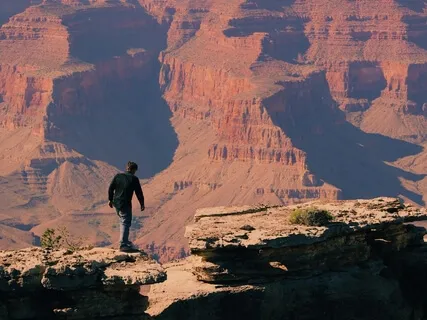
Because I live in California and the Grand Canyon is only one state away,
I've had many wonderful trips to visit the Grand Canyon.
If you haven't been there,
What happens is you're driving or walking along and it's just normal flat ground and then you see before you this huge vast canyon that seems to go on for miles and when you walk right up to the cliff it kind of takes your breath away.
It can be actually scary because it's just straight down and if you fall over that cliff you're not going to survive it.
One of the most remarkable things about it is it's just like I said it's just so flat all around it just normal ground wherever any of us live and then all of a sudden is this vast canyon.
I mean if you think about mountains there's the foothills and then there's the slopes going upward and then there's the peaks.
It's like there's stages going up to the top.
With the canyon it's like this gigantic hole that just drops.
There's no warning.
There isn't anything telling you it's coming.
It's just you're walking along and there it is.
Well for me the Grand Canyon is a metaphor.
A metaphor for one of the things I've discovered about life which I call the cliff.
Let me start with an example to illustrate what I mean by the cliff.
Over the years I've worked with many couples who come to me because they want to save their marriage.
But this is what I often see and I've talked to other therapists and they've experienced the exact same thing.
So what it is is this.
Two people fall in love.
They get married and along the way for whatever reasons they begin to have problems.
Well they're both very committed to their marriage maybe because they have children maybe for religious reasons but they really want to stay in the marriage no matter what and they're completely convinced even though they're having problems right now that they're not going to leave.
They're not going to get divorced and there's no way this marriage isn't going to make it.
They're very convinced of this.
Now mind you they may not be doing anything to make the marriage work but they're convinced that nothing could keep them from staying in this marriage.
Nothing.
And then all of a sudden one of them approaches the cliff and off they go.
And that's when they often reach out to me for therapy because what happens is the other person realizes they're not arguing anymore.
The other person is done and though the other person may have asked a hundred times to get into therapy the other person realizes this is far more serious because the other person,
Their partner,
Isn't acting the same so they get scared.
They go to therapy hoping they can fix it but the other person has gone over the cliff and they're done and there's pretty much nothing to bring them back from what they've gone over.
It's not impossible but it's a lot more challenging.
If they'd come in earlier when they were having tough times and they needed help they would have done better and they could have been helped but because other things in life were taking priority and they didn't get help one of them went over the cliff and now it's too late.
And this is my example of the cliff.
And here's what I mean by the cliff.
We're doing things that we know are pushing ourselves,
Things that probably aren't good for us or we're just pushing it too hard but things in our lives seem to be going well.
So instead of making changes we ignore it.
We just go on as if we can go on like this forever and then one day out of nowhere apparently we come to the cliff and sometimes we go over it and once we go over the cliff it is very hard to come back.
A very concrete example of this is a substance.
Think of someone who smokes.
They start when they're in their teens and at first they don't notice any differences.
They've been told of the consequences of smoking but they figure well I'm young and I don't seem to have any problems right now so they keep smoking.
And with time there are hints that there may be problems that perhaps they should quit before they go over the cliff but they again they ignore it.
They continue and then the cliff comes and over they go when they've been diagnosed with cancer.
Once you begin to think about it there are a lot of examples of the cliff.
Someone may be going along but not eating the best and not making the best choices in regards to food and then one day they get their blood work back and they now have type 2 diabetes and they have to deal with that for perhaps the rest of their lives.
Or someone who goes off to college and really enjoys the experience of being with his friends and having a good time and partying and when college is done he really misses that life so he keeps it up.
He may have new friends now that like to party and go out with them and drink a lot and just have a good time.
But then it continues and he's drinking more regularly and at some point he realizes he needs help because he has become an alcoholic.
Or the one I've been seeing more recently over the past 15-20 years is that some kids spend a lot of time watching shows that are violent,
Playing games that have a lot of disturbing images in them,
Watching YouTube videos that truly are emotionally disturbing.
They find them interesting,
They find them fun,
They're just entertaining and they keep watching them and they keep watching them and then at one point they have a panic attack or at one point they go into a severe depression or fill in the blank.
Sometimes I've even seen schizophrenia.
I'm not saying that these things cause that.
It's just that when we push ourselves and we expose ourselves to negativity,
Particularly negative images or interactions that get fried on our brains,
This isn't good for our soul,
For our spirit,
And so much exposure just isn't good for us.
And then sometimes all of a sudden we just pop,
We go over the cliff,
And now we're living with a mental disorder like panic attacks,
Like schizophrenia,
Like so many things that if we had been more careful,
If we had taken better care of ourselves,
We may have avoided this cliff.
I think what makes us not think about the cliff,
Or at least that we won't go over the cliff,
Is that we look at others and we feel that they're weak.
If they had just tried harder,
They would have done okay.
But I think,
To be honest,
It's more like this.
What happens is we all have something that called our weak joint,
Something within us that genetically predisposes us towards a disorder,
A illness,
A psychological issue,
An addiction.
We have genetic predispositions.
And when we push ourselves really hard,
Sooner or later,
That weakness in ours,
That genetic predisposition kicks in.
And now we have to deal with the consequences of this disorder based upon our genetic predisposition.
Think of it this way.
Imagine we're a Honda Accord or a Volkswagen Jetta,
And we drive each of them super fast,
Super hard.
Everywhere we go,
We're slamming on the brakes,
We're turning corners as fast as possible,
We're flooring it.
Well,
The Honda Accord may have their brakes go off because that's their weak point,
And the Volkswagen Jetta may have its transmission go off because that's its weak point.
We,
Like these two cars,
Have genetic predispositions that when we push ourselves in any situation,
There are consequences.
And our minds are really good at ignoring that because often things that kick in that are negative for us are like the cliff.
And once we go over that cliff,
It's very challenging to come back from it.
Well,
Of course,
I want to end on a good note and give us hope because we don't have to go over the cliff.
We can avoid a lot of cliffs in our lives if we do one thing really well,
And that one thing is self-care,
Taking care of ourselves.
We have a tendency to do things,
Of course,
That aren't very healthy for us,
And they have consequences,
But because the consequences are in the future,
We just don't think about them.
We don't worry about them.
We don't even think they're coming because we can't see them,
But they are.
The cliff is coming.
But if we do self-care,
If we take care of ourselves,
Then in many ways what we're doing is walking away from the cliff.
We don't have to go over the cliff,
But we have to think about,
Is what I'm doing today going to have consequences a week,
A month,
A year,
10 years from now?
Usually,
There are ways we can figure this out.
It's fairly obvious.
What happens is,
Though,
We ignore these warning signs.
We say,
I'll do it differently.
I can handle this.
It's worth it.
I'm,
In the long run,
Going to turn out fine.
I mean,
Probably one of my most extreme examples of this is people that work really hard to save a lot of money so that they can put their kids through school or retire comfortably.
But often they sacrifice so much for this end goal that perhaps their kids don't want to have anything to do with them in the future,
Or they have all these health problems because their body now is wracked with pain and suffering because they pushed it for too long and weren't taking care of themselves.
Now,
Of course,
Not everything that happens to us is because we weren't taking care of ourselves.
I mean,
Sometimes we just get diseases because we were just predisposed to get these diseases.
It had nothing to do with our lack of self-care.
Sometimes we're in the most beautiful relationship and we are an excellent spouse,
But our other partner goes down a different path and either they don't want to be in the relationship anymore or we don't.
So it isn't about blame.
It's about realizing what we're in control of and what we're not in control of.
And what we're in control of is our response to what happens.
What we're in control of is making good choices today.
We can't control what other people do,
But what we can control are the choices that we're making throughout our day.
And so if we make good choices,
If we take care of ourselves,
If we keep the stress down,
If we find joy and play and pleasure throughout our day and not waiting until someday I'll live,
Then what will happen is our stress will get less.
And turning down our stress level is like backing away from the cliff.
And then when life stresses do come,
Because they do come,
If we're doing self-care,
If we're taking care of ourselves,
We're a long distance away from that cliff.
And when we realize we're headed for it,
We can then even do more self-care,
Take better care of ourselves.
But when we ignore that the cliff is there,
Then we just go over it.
And we're so often surprised.
But when we look back on our lives,
There are usually things that we can identify where we weren't doing good self-care.
So let me end with this.
Think of the cliff as this.
The cliff is something that we're going to go over and it's going to have severe consequences in our lives.
So what we do is we try to keep ourselves away from the cliff.
And the further we're away from the cliff,
When there are stressors,
Then we have a lot of choices to renegotiate our position next to the cliff and pull ourselves away.
So when we do self-care,
Self-care is removing ourself from the cliff.
It's getting a huge space between us and that cliff.
And so again,
When stressors come,
There's so many different things we can do besides going over the cliff.
But if we're not doing self-care,
If we're already making choices that are really hard on our spirit and our bodies,
Then it doesn't take much to push us over the cliff.
So pretending that the cliff isn't there,
Wishing it weren't there,
Hoping it will never come,
Those are the paths we don't want to go down.
We want to go down the path of realizing that the cliff does exist for all of us.
It may look different for how we're going to go over the cliff or what the cliff looks like,
But the cliff exists.
And if we know that,
Then what we're going to do is commit towards creating our lives that are beautiful,
That are peaceful,
That are filled with joy and happiness each step along the way.
That's what keeps us away from the cliff.
And if we're not sure what to do,
There's now approaching 300 episodes on how to keep ourselves away from the cliff.
And the great news is,
Even if we've gone over one cliff and then another and then another,
We can still do self-care and take really good care of ourselves so that even when we go over the cliff,
We have beautiful lives.
Thank you for joining me on the happiness podcast.
Until next time,
Accept what is,
Love what is.