Hello,
My name is Dr.
Brett Wade.
Thank you for joining me in this guided meditation where we'll explore the concept and the practical experience of time.
In a way,
This might be the most important meditation of your life because if we can pay attention to time,
We might capture and be able to slow down the relentless and ceaseless passage of this entity which contains the entirety of your life.
I've always been fascinated with the concept and experience of time.
I can think back to being a kid and remember the blissful feelings of long summer days with nothing to do.
I'd spend countless hours playing in nearby forests and streams and it seemed the days would last forever.
I wanted them to.
I also remember how time could drag on endlessly while I was sitting in school when all that I wanted to do was be outside.
Into my teens,
I remember complaining to my dad that how I wished I was older so I could get my driver's license or move out and get my own place with my own rules.
I remember my dad saying,
Brett,
Don't wish your life away.
One day it'll go by so fast you will wish for it to slow down.
Boy,
Was he right.
As I now watch my own kids gain their independence and race forward with youthful exuberance and a dash of impatience,
I try to share my dad's wisdom with them too.
Unfortunately,
When we are young,
It is difficult to really hear those words and fully understand the concept of time and the reality that we have one life to live and we have no idea how long it will be.
Having worked in healthcare most of my life,
I've spent significant periods of time talking to patients who,
At the end of their life,
Generally wish they had more time and wasted much less of it.
The space in which we experience life is bound by the ultimate reality that from the moment we take our first breath,
The clock starts ticking.
And for most humans,
If we're really lucky,
We might be on this earth for 80,
85 years.
I obviously don't know how old you are,
But I'm assuming if you're listening to this meditation,
You too have thought about how time seems to be slipping away at an ever increasing rate.
And maybe you too wish you could slow it down.
So with some exceptions,
Such as being able to travel through space at the speed of light or passing through a wormhole,
We are all bound by the same physical constraints of time here on this earth.
The earth revolves around the sun at roughly the same rate each year and rotates about its axis the same rate each day.
Since we mark time with clocks and calendars that are based on these astrophysical variables,
And everyone in the world essentially uses the same clocks and calendars,
There does not seem to be a lot of wiggle room to make more time.
So if we can't actually change the amount of time,
But most people would agree that it is going by too quickly,
And we'd like more of it,
What can we do?
We can change our perception and experience of it.
This isn't some woo woo mystical stuff,
But actually a practical thing we can do at any moment to essentially buy back some time or appear to slow it down by simply capturing it.
The only way to slow time down is to be consciously aware of each moment of time.
You've heard the expression,
A watched pot never boils.
Time slows when you become conscious of it.
I'm sure you've noticed how time can slip away when you're daydreaming or mindlessly scrolling through social media.
This kind of behavior is our unconscious mind operating.
Of course it's fine,
And in fact necessary,
To be on autopilot for many of our daily activities.
We would be fully exhausted if we were to pay attention to every task at every moment.
The breaks from full attention are necessary for our brain to recharge.
We just need to make sure that we are paying enough attention throughout the day so we don't miss out on having enough time in our lives.
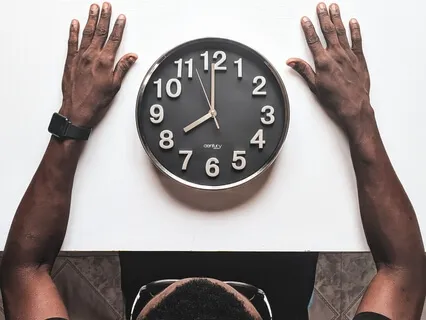
By now you've probably been aware of the sound of my ticking clock in the background.
Normally when I record my meditation,
I take this clock out of the room as my intention is for you to focus on the words,
Instructions,
Or perhaps background music.
But for this meditation we're going to focus entirely on the ticking sounds of my clock.
By noticing seconds we can fully account for the minutes and be aware of time.
So if you're ready,
Let's begin.
Start by finding some physical balance and symmetry in your body.
I recommend sitting,
But if that's not available to you,
Standing or lying down,
That can work as well.
Match your hands.
This might mean interlacing your fingers on your lap or having them resting on your lap or on your belly.
Or perhaps you have some preferred mudra or hand position.
Do the same with your legs and feet.
That could mean cross-legged sitting or it just might mean resting your feet flat on the floor.
Just find some symmetry in your upper and lower body and also between your right and left sides.
If you're sitting or standing,
Try to align the natural curves of your spine,
Respecting an inwards curve in your low back and a similar inwards curve in your neck.
If you've done that right,
It should feel as if your head is floating.
Now begin to close your eyes if you haven't done so already.
You may also choose a defocused downward gaze.
During this meditation,
You will only be listening to the sound of a ticking clock.
The meditation from this point will last 10 minutes.
I'll check in with you every two to three minutes to remind you to bring your focus back to the sound of the ticking clock.
Remember,
It's very normal that your subconscious mind will elevate above the chatter or the sound of the ticking clock.
When this happens,
Just return your attention to the sound of the clock.
It may help you to count the ticks,
But if that doesn't work for you,
Just focus on the sound of time.
I'm going to now bring in the sound of the clock a little bit more clearly.
I'm going to leave you to focus your concentration on the sounds,
And when you lose your concentration,
As you will,
Just bring it back to these sounds.
As your mind wanders,
Just gently bring it back to the sound of the ticking clock.
Just remember you have nowhere else you need to be,
Nothing else you need to do,
Just paying attention to time.
As your mind wanders,
Just remember that this is normal,
But keep coming back to the sound of the ticking clock.
You have nowhere else you need to be,
Nothing else you need to do,
Just pay attention to time.
Meditation means to concentrate.
In fact,
The practice of meditation is more than just concentration.
It's accepting that your concentration will be disrupted,
And then it's bringing it back.
It's that continual process of bringing it back for the next one minute.
See if you can concentrate,
And then bring your attention back when it gets disrupted to the sound of the clock for one minute.
Congratulations,
You have just bought back 10 minutes.
By paying attention to time,
We've essentially captured it.
Begin to wiggle your fingers and your toes,
And this just signifies to your body that you're coming back to your space-time.
If your eyes have been closed,
You can gently allow them to flutter back open.
Just notice how refreshed your eyes feel.
It's almost perhaps as if your eyes are seeing a new day,
A new moment.
Anytime you feel that time is slipping past you,
You can return to this meditation to bring back and capture some time.
I wish you well for the rest of your time.
Peacefully,
Brett