Hi guys,
I have interviewed almost 100 people in the last 3 years and I have never been more excited than I am right now because Dr.
Edie is a hero of mine.
I have to say that so much of the work that I've been able to do in the last 3 and a half years since listening to her can be attributed to much of what she said.
I have such a huge place in my heart for Dr.
Edie and I'm going to bring her on pretty soon here.
All right.
It is such an honor to meet you.
I am so grateful to be here with you today.
Very mutual.
I don't ask people,
How can I help you?
I'm not humpty dumpty and putting people back together,
But I do ask the question,
How can I be useful to you?
Dr.
Edie,
I want to thank you first and foremost.
I don't think I would be doing the work that I'm doing today if it weren't for you and your life has now touched millions and millions of people.
Thank you for having us.
Great.
Dr.
Edie,
Today you are 95.
You are now a New York Times bestselling author,
Having written two books in your 90s.
You've now gone on to produce courses and speak around the world as a pioneer in the field of psychology.
What does that feel like?
I am very invested in teenagers because they're no longer children,
They're not adult yet.
And I think many times we overestimate or underestimate,
And I am very much involved in how can we be good role models,
Because it's not what you feel,
It's what you do.
You know,
Love is not about the feeling,
It's about doing.
It's about hopefully being a good role model,
That they look at you and they say,
When I'm 95,
I'm not going to retire,
I'm going to work as long as I live,
Just like Edie did.
So I'm doing that,
And I don't look at chronological numbers at all.
If I have a date with a guy and he asks me how old I am,
I'm going to ask him to take me home.
He's not my guy,
Right from the beginning,
And I know that the first 10 minutes.
So,
But I know that with you,
You're curious,
You want to learn,
You know,
You're wanting me to hopefully be convincing you that I say what I lived.
And you cannot argue with that,
Because Auschwitz was a classroom,
And some people just gave up.
And today I beg parents,
Don't spoil your children,
Because spoiled children don't master anything on their own.
Everything is external,
The Gucci and the Pucci,
And whatever American mothers want their girl to be.
Dick Frum,
I think,
Talked about American mothers,
That they dress their children about like role models in fashion.
And I think,
Hopefully,
I can convince mother to examine the brains of herself,
Where she is,
And how she would like to be remembered when she's maybe reaching the age as I am doing it at 95.
So,
I'm happy to see you.
I like your dimples.
You have very cute dimples.
Thank you so much.
Thank you.
I really appreciate that.
Well,
I love so much what you're saying about being a role model for our teens.
And speaking of teenagers and family,
Jordan and Dr.
Edy,
Can you tell us a little bit about your relationship,
And how the two of you came together to produce your recent courses?
Edy,
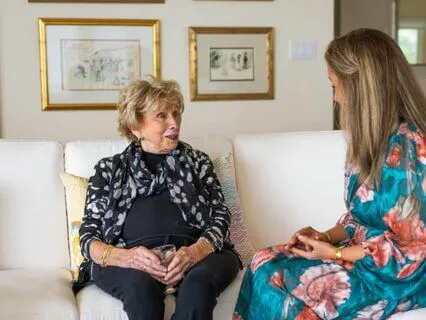
So the home we're in right now,
Was actually the home that I grew up in.
And this was until I was eight years old.
So,
They moved here,
And then my parents moved 10 minutes away,
Just down the street.
I grew up very involved and very much with Edy and Leila in my life.
They were consistent,
And she would come and cook dinner for us.
And I grew up eating a lot of Hungarian food.
Her goulash is always one of my favorite meals.
I had a lot of exposure.
And there was something that always felt really connected about us.
Before we ever did any work together or anything like that,
There was something where I looked at you and I said,
There's something about this woman that I see in me.
I think we are both curious,
And curiosity that brought us together,
Because you wanted to speak to me and test me whether I'm really real,
That I say where I live.
And yes,
That's where it is.
Dr.
Edy,
I've been following you around everywhere.
Since I first heard you,
I've heard you on everyone's podcast.
I read your book 17 times.
I know you're the real deal by now.
Great,
Great.
You are the ambassadors for the young people.
They come to you,
And knowing that they can do many,
Many more things than smoking pot.
And I think you may be saving a lot of lives as well.
Because young people in America,
I find very low frustration,
Tolerance level.
They want one thing,
They want it now.
I don't want to wait for anything.
And I think it's very important to put money aside,
So you can buy a bicycle,
Not in June,
But wait until it's Christmas Hanukkah time,
That you learn how to be patient and not to rush life so fast.
I like to reach young people and ask them how to not ever waste a minute with anything that may be affecting their brain.
Because the best power is the brain power.
That's what my mother told me.
She told me everything can be taken away from you,
But no one can take away,
No one can rob you from your mind.
And that is always in my mind.
My mother must be smiling now and winking and saying she's got it with a British accent.
I don't know how to do it.
That's not bad.
I said,
You got it.
So to follow on this,
What we are working on now is Edie's next book,
Which is a book which will either be the choice for young adults,
Or we'll have a different title,
But it is a book for teenagers.
And Edie has always wanted to connect deeply with that audience.
To start with us to Simon and Schuster.
And Simon and Schuster is publishing and it's coming.
It is really going to be groundbreaking.
And I want to bless you with so much success and that this is going to get into the hands of every young person.
I'm going to share with you that I experienced depression from a very young age.
And I know firsthand how difficult it can be to be a teenager.
Look back and I wonder what would have happened to me if I had your teachings at that age?
And I think it would have made all the world of difference.
They grew up in Carlsbad.
Yes.
You went a long way from there.
Indeed.
Yes.
We're over here in the middle of Israel right now.
Interesting.
Is it a small town?
You are both cordially invited here.
Let's talk about this next question because this is about your life as a teenager.
Your life as a teenager was cut short.
And after you and your family were abruptly taken from your home and boarded onto cattle cars,
As you mentioned,
Your mother gave you advice that has formed the basis of so much of your work and your life today.
What was it that your mother shared with you and why is that so important for everyone,
Especially teenagers,
To keep in mind?
I think teenagers are very important to me because they're no longer children and they're not adult yet until you're 25.
I don't think it's important to forget about really age appropriateness with teenagers and acknowledge that they're no longer children but they have yet to be adult or treated like an adult,
That they're financially and emotionally independent.
So really we need each other,
Hopefully,
To empower each other that you can be you and I can be I,
But together we're going to be much stronger.
And that's what I learned in the schoolroom of Auschwitz.
All we had was each other there and all we have is each other now.
Can you tell us the story about what your mother said to you in the cattle car?
My mother told me the following and I quote,
We don't know where we're going,
We don't know what's going to happen.
Never forget what you put in your own mind and the key is in your pocket.
That's what you say,
But she said it a little differently.
Want me to help you?
No one can take from you what you put in your mind.
Yeah,
Your quotes have become so famous that we know them as well as you know them.
That's when you know you've made it.
I want to tell you the evening that I make my famous chicken paprikash and after dinner I asked him how he liked the dinner and how I was able to be called by his mother to sit in her lap and I asked what would it take for me,
For you to sit in my lap and he said it very quietly,
Very strongly,
Look pathetic.
It has become a family saying.
That's my quote.
If you want something,
Love it.
I'll teach you how to say look pathetic.
My mom had a nice way of saying it.
She's like,
Can you sit on my lap?
And so Edie was like,
But I want you to sit on my lap too.
But she didn't look pathetic enough so I didn't feel like I had to do it.
So she asked,
What do I have to do?
And I said,
Well,
This is the.
.
.
Jordan,
When you think back about that memory and you say that she didn't look pathetic,
How did your grandmother look in your eyes in that moment?
She always had a confidence about her.
I remember saying to my sister,
Do you understand everything that,
That grandma did too?
And grandpa Baylor saying,
I can't understand everything.
I was just fascinated by them because they were from this other world and Baylor had a stutter and it was a dramatic stutter.
And Edie was always dressed in bright colors and,
You know,
Everyone had grandparents,
But nobody was like Edie and Baylor.
And they were just striking humans.
And when I got a little older and I could have real conversations with Edie,
I understood that she was somebody I could really talk to about what was actually going.
Edie not only was a psychologist,
But she was the grandmother and had this deep wisdom that I didn't understand exactly what all was going on.
I get up sometimes at night and when I come back from the bathroom,
I wonder how did I get out of Auschwitz?
People go there to die.
And I beg parents today not to spoil their children because they were the first one to die.
They gave up soon.
I had very low frustration tolerance level.
So I think suffering makes you stronger.
This topic of teenagers keeps coming up and three out of four of my children are teenagers right now.
So I'm curious to hear from you.
You mentioned earlier in our talk about delaying gratification,
Helping children to save for the new bicycle.
And now you're speaking about not spoiling our children and Jordan shared about how he was able to speak with you in a way that he couldn't speak with his mother.
So if you could Edie share with us,
How can we embody your teachings in our parenting?
The word genocide was coined.
It wasn't there and it was coined by these people like me who survived the worst.
Because when you get up four o'clock in the morning and it was called the appell and we stood outside while they were counting heads.
And they told you also if you don't feel well you can stay back in the barracks because you're gonna go to the hospital.
Soon we found out there was no hospital,
There was a gas chamber and we held on to each other.
God forbid because you stay behind we never see you again.
So you learned very quickly how to learn to be able to do everything in our power,
Not to give in and not to give up.
And I think that was the school room where I learned the most and it was Auschwitz.
I always ask myself does anyone know that I'm here?
I kept asking that curiosity was in me.
So today I tell the woman if the guy leaves to say to herself one word next,
Let him go.
He wasn't meant for you anyway,
Just say next.
Love is self-care,
It's not narcissism.
Yes.
Self-love is self-care.
Dr.
Edie,
Hearing you speak about your experiences and your work as a psychologist,
When your patients would come to you and feel like their suffering wasn't as big as yours.
And the way that you explained that really hit me in my core and it woke me up in so many ways.
So I was wondering if you could share a little bit with us today about why this idea is so important.
Dr.
Edie,
You've been through the most horrific experiences known to man,
And yet you have so much validation for the suffering of everyday people.
Tell us about that.
There are lots of defense mechanisms that we use,
But one of them is minimization.
Oh,
That wasn't a big deal.
Everybody else did.
And not to use these kinds of defense mechanism to be able to repeat verbatim what you hear.
And I,
That's what I do.
I hear you say,
And then I say everything.
And is this what you said?
Yes.
I want to be sure that we are on the same page.
And I think Jesus was a Jewish boy who became a rabbi and he died as a Jew.
But I remember when he was able to just teach us how to live in the present and see how we can acknowledge that there is one thing we cannot change,
And that's the past.
So my schoolroom in Auschwitz was probably the best teacher.
The most obnoxious patient is your best teacher.
And all you have to say,
Tell me more.
You speak about one of your patients who was a member of a hate group in your book.
And somehow in your heart,
You found a way to work with him.
You went through so much and here you were faced with someone so hateful.
How did you have compassion?
I look at people where they are so I can be with them and stay in the present,
Not where they were or where they're going,
But in what way you live in the present.
You can think young.
You can make a decision for tomorrow or next year what is the best for you to become a good parent to you.
So if your doctor tells you that you have diabetes,
You can just look at all the sweets in the world and don't reach for it and don't put it in your mouth rather than what you say.
Just this time,
Nobody's gonna find out.
But there is that voice within us.
Just this time,
Nobody's gonna find out.
Well,
Your body is going to find out what you put in there.
So your body is a temple and the body is important how you become a good mommy to you.
You know what I was thinking,
Edie?
When you saw that boy and he came in and he said what he said in front of you,
You also were at that moment practicing being a psychologist and you are a good student,
Right?
Always been a good student.
Yes.
The most obnoxious person is my best teacher.
And you had an instinct when that guy was talking to be like,
I can't believe this is the problem.
I have the problem right in front of me.
Killed my parents,
Ruined my life.
But then you realized,
No,
I am a student and I have been told that my job is not to put my personal beliefs into this room.
It is to be a compassionate listener and help this person to decide to change themselves,
Right?
To create an atmosphere for him to be comfortable.
That people can feel any feeling without the fear of being judged.
So maybe if you hadn't been in the process of becoming a psychologist,
You would have said what you felt,
But you were doing your work.
You take a deep breath and you say,
Tell me more because love is time,
T-I-M-E,
The four letter word.
I think it's very important for you to keep a diary.
And you look at Friday,
What you said Monday,
And you find that you look at that from a very different perspective.
It's very important for you to have good therapy with yourself that you are.
You don't have to pay me or anyone else.
The first therapist is right here.
Okay.
This is really fascinating.
Can we talk about this for a little while,
This idea of therapy with ourselves?
What does that look like,
Dr.
Edie?
Well,
I found out that dependency breeds depression.
So the opposite of depression is expression.
What comes out of your body doesn't make you ill,
What stays in there does.
And when I came to America,
I never ever said to anyone that I was an Auschwitz.
I wanted to be a Yankee doo-doo dandy.
I wanted to be like you.
And Edie,
What was the effect on you of keeping it inside?
Well,
You know,
What comes out of your body doesn't make you ill.
But I had migraine headaches.
All I had to do is have a dark room,
And I was able to cope with that.
But your body,
Your body talks to you.
And now you don't have migraines,
Right?
I have no migraines whatsoever.
I tell you how I feel.
I tell you what I want.
And it's okay to talk about with me,
Knowing that this is as far as it goes.
So when did the migraine stop?
Was it when you went back to Auschwitz?
Or was it when you got your PhD?
I do have backlashes.
And I am able to just say,
That was then,
And this is now.
Now.
Wow.
Dr.
Edie,
What kind of therapy do you do with yourself?
Choices therapy.
The more choices you have,
The less you're going to feel like a victim.
It's not all or nothing,
Life or death.
I know there was a girl with me from Yugoslavia,
And we were very proud of our country.
I was really a deep,
Very respectful Hungarian.
And she told me about her country.
And she also told me that we're going to be liberated at Christmas,
By Christmas.
And Christmas came and went.
She was dead the following day.
Don't be rigid.
Be more flexible.
Have a plan B,
And no left and right,
And all or nothing,
Life or death.
Don't be rigid.
I also have a handout on that,
And I'm happy to send it to you,
How to be a survivor and not a victim.
Because when you're a victim,
You are weak.
Thank you.
And you have the victim,
You are victimized.
It's not my identity.
It's what was done to me.
There's a big difference.
Because yesterday's victims can easily become today's victimizers.
I think I call it the Stockholm syndrome.
I was thinking about what I see from Edie in terms of her psychological,
Like her self-psychology.
And you take a lot of time by yourself.
You're not afraid of quiet time by yourself.
I like to be in good company with myself.
And you don't do a lot of small talk.
Not too much chit-chat.
She likes to talk.
Not good in small talk.
Don't take me to a cocktail party.
I'll be out of there in no time.
But you'll look fantastic until you go.
Yes,
I sure do.
She'll look amazing.
And then half an hour,
45 minutes later,
She's ready to go.
My father told me I'll be the best dressed girl when I grow up.
And you know,
Papa,
Just see me in my Escada clothes.
And thank you,
Honey,
For doing what you're doing.
And it's not what we do.
It's how we feel afterwards.
I know when I'll be in my dead bed,
I'm going to feel so good that I took time out today to get up a little earlier to do my hair,
To put a little makeup on,
Look at my eyes.
Because my boyfriend told me I have beautiful eyes and beautiful hands.
So I would do many times ways asking everyone in Auschwitz,
Tell me about my hands,
Tell me about my eyes.
Because they could put me in a gas chamber any minute.
I didn't know what's going to happen next.
Listening to you speak about Eric and his talking about your eyes and your hands,
What is it about that that inspires us to keep going through the most difficult times in life?
You don't seem to appreciate until you lose something.
And when I was in a place,
In a hospital,
And every day I was hoping I'm going to see my parents come in,
And they didn't.
So I learned how to be disappointed,
But not to be discouraged that I was left here to be able to carry the word.
My mother told me that everything can be taken away from me,
Except the way I choose to respond,
Not to react.
When you react,
You don't think,
If you slap me,
I'm going to slap you back.
Revenge is not the answer.
Forgiveness is a gift that I give myself to be able to not judge another person.
And that's what I did with the boy who got up and told me he was going to kill all the Jews.
If I would have reacted,
I would have dragged him in a corner.
I would have stepped on him,
Probably,
And tell him that my mother went to the gas chamber.
But I spoke.
In Hungary,
We call it Ishtar.
I spoke to God that was with me in Auschwitz,
And it was inside me that was able to change my judgments to compassionate listening.
You cannot go wrong by repeating verbatim what you hear.
No one can really fight with their own words.
So don't try to explain anything.
I just said something like,
I have an opinion about that.
Ask permission that you can really speak.
You can only speak for you.
But if you want to talk about you and the relationship that you have,
Is to explain right from the beginning what you are all about,
And what you're doing,
And how far do you go,
What are the limits.
Like,
I cannot really touch you and hug you unless,
You know,
You create that kind of an atmosphere.
I don't touch my patients.
I do shake hands.
Sometime invite them over for chicken paprikash,
But that's after a year.
It's good to be in my age.
I can do anything.
At 95,
You can think whatever you want.
I know what I'm doing,
And I don't ever take advantage of my freedom.
I respect anyone for who they are,
And pre-judge is good to examine.
Edith,
I asked you recently,
I said,
What is unique about you as a psychologist?
I lived it.
I say what I lived,
So you can know that I'm not making up anything.
I just tell you how I was able to accept my situation,
Live in the present,
And to be able to find my inner self.
That's why we call it,
You know,
The spirit.
It's my spirit voice that I usually take with me when I see a person.
I call them patients because I was trained clinically.
They're not my clients.
I'm,
You know,
I'm not a lawyer.
I respect people for who they are and age appropriate,
And I will not talk to a 10-year-old and talk about cognitive dissonance.
They don't know that.
Edith,
When I asked you about the psychologist question,
One thing you said to me that I thought was so interesting and useful is you create an atmosphere where they feel comfortable saying whatever they feel,
And they know that you won't judge them for it,
And I think that's such a powerful way to connect with somebody.
I just create the atmosphere that you can feel any feeling without the fear of being judged.
I'm not a judge.
She'll tell you what she thinks,
Though.
Tell you how I feel.
Right.
When I hear you telling me that you really don't want to live anymore,
You want to take your life,
I like to really guide you to look at all the other choices that you can think about and make a decision that you're going to do what's humanly possible and then hand it over to God.
So beautiful.
Dr.
Edie,
You've mentioned something in the past,
Speaking of God,
That I've heard you say that you found God in Auschwitz.
Yes.
What does that mean?
My babysitter's name is Moses,
And Moses took them to the desert to walk,
Walk,
And walk,
Maybe 40 years later,
And walking is still very good to make a decision that you're going to not revive,
But evolve.
My chair has to do with butterflies.
It's full of butterflies.
You go through the metamorphosis,
And then you shed the chrysalis.
So my definition of love is the ability to let go.
The ability to let go.
The ability to let go of the need to judge anyone,
Get rid of the us and them mentality.
We're all humans.
We get rid of perfectionism,
Get rid of procrastination.
You just kind of clean up your little backyard and be a take charge person of your thinking,
Feelings,
And of course your behavior.
So powerful.
Well,
I had such a transformational experience in the course.
I was telling Jordan that the North Star in the beginning of your course was such a powerful idea for me.
And even though I have done so many future meditations,
There's something so special about you and about Jordan that has the power to help anyone transform.
You have sisters and brothers?
I have one older brother.
So you're a baby in a family?
You know how we call that?
Charming manipulators.
You're laughing.
Talking to you?
I used to go ask money from my father when he was playing billiards with his cronies.
I knew he's going to be generous.
I could not do that with my mother.
I guarantee you.
Very different mentality.
To be the youngest in the family.
Men give up much sooner than women do.
If I can get in the front door,
I'm going to look at the side door or even the chimney.
I don't settle for just either or.
I think we are very complicated people here.
And the more we have really in common,
We can meet each other,
That you can be you,
I can be I.
But together we're going to be much stronger.
And that I learned in a schoolroom of Auschwitz.
So much wisdom,
Dr.
Edie.
You have so much wisdom to share.
Thank you for your tears.
You're a very sensitive,
Beautiful human being.
Thank you.
Mother,
Your father,
Hopefully,
Were able to demonstrate and learn how to fight and not to blame.
Because while you blame,
You're still a child.
Children blame adults.
Look at the issues.
Separate them from the topics.
The topics,
There are issues.
And I think it's very important for us to be on the same page.
It's actually my fault.
And I will take responsibility.
I then don't beat myself up for my first instinct.
I say,
All right,
I see what you did there.
You kind of like threw it on,
You know,
Your wife,
Your kid,
Your friend,
Your business partner,
Whatever,
Their fault.
And you're like,
But is it really their fault?
No,
It's actually your fault.
And here's why.
And you're going to write about it.
I didn't go to Auschwitz though.
So we'll have to put that in context.
You don't have to know a cow to know milk.
I like what you said about not beating yourself up for how you feel or for your instincts.
I can sit with you all for the rest of my life,
But whenever Dr.
Edie is tired,
You just let me know how you feel.
I am totally yours.
You know,
You are my hero.
Literally you changed my life.
Dr.
Edie,
I've struggled so much with mental health and I have to tell you,
You're someone who's helped me the most on my journey.
And it was really what you've said to people,
The fact that you've been through what you've been through and you don't compare your struggles to other people's struggles.
Why is it so important for us to lean into our lives and just how do we heal from our challenges,
No matter what size they are?
The word why,
The way I see it,
Is a past oriented word.
And I can always say,
If I knew then what I know now,
I would have done things differently.
That's the end of that.
That's the end of that.
Don't blame yourself.
You did the best you can at the information,
At the time where you were.
Stop blaming anything or anyone at any time.
Only children blame.
So while you blame,
You're still a child.
And that's why when you work with teenagers,
You want to teach them you can be childlike,
But not childish.
What's the difference?
The childish people will blame.
The childlike person can be more,
Much more playful,
Much more flexible.
And I like to play a game and I want to be five years old,
Nine years old.
So,
You know,
Our brain does not develop the seed ego and the superego.
That superego doesn't develop until we are seven or eight years old.
And it's in a front row that it's important you know who you're talking to.
How far did they develop in life?
And so when you work with teenagers,
You are in a most difficult area because they're no longer children and they're not adults yet.
So find out the limits and the limitations that you're operating in so you can meet them.
So love thy neighbor as thyself.
Everything begins and ends with you.
So you meet a person as they are,
But you treat them as if they were what they're capable of becoming.
This has just been such a joy.
So anything else you want to share today,
Dr.
Edie?
We're listening.
Don't change anything.
Don't change anything.
You're the kindest person with the kindest voice and a deep thinker.
You are a deep thinker and you're able to be human.
I love your tears.
Thank you for your tears.
Next time we cry together as we hug each other.
Let's make a date when you can come here.
I'm coming right over to give you a hug.
I hope to be alive and well.
Hi,
Dr.
Edie.
I love you so much.
I thank you so much.
And Jordan,
Thank you so much.
If there's anything I can do to help either of you in this work,
I'm here.
Well,
We're so glad that it's helped you.
It was the most beautiful day today.
We'll never forget that.
Thank you.
Thank you so much.
God bless you both.
Thank you for your wonderful questions and you're putting your hearts.
I love your little blouse and the little sweater.
Thank you.
It means the world to me.
We'll be in touch.
Bye.
Thank you.
Bye-bye.