So,
Today and tomorrow,
We will be discussing jhanas,
The different elevated states that you will experience as you progress deeper in this practice.
So today I'm going to focus on discussing the first four jhanas.
When we say jhana,
Jhana really is the Pali for Sanskrit,
Which is dhyana.
And dhyana really means a level of attention,
A level of understanding that the mind experiences.
These are elevated states because they are outside of the scope of ordinary sensual experience.
So what do we mean by sensual experience?
That is experience that is related to the eyes,
The ears,
The nose,
The tongue,
And the body.
These are the five cords of physical stimulation.
But the mind,
Which is the sixth sense space,
Is outside of the scope of the ordinary world because it's through the mind that you can experience elevated states.
It's through the mind that you experience memories of past lives or memories of this life.
It's through the mind that you're able to project out into the future and visualize and so on and so forth.
And that has no connection to any of the five physical sense spaces.
So when the Buddha talks about there is this world and the other world,
Really this world is the world steeped in sensual pleasure connected to the five sense spaces.
And the other world is the world of meditative states that you experience through the mind.
So that's why when we talk about jhana,
It's really levels of understanding,
Levels of experience,
Levels of cessation.
And I'll explain what that means as we go through each of the four jhanas today.
But I'm going to read a short portion from a sutta just to give you some context and introduction to what we're doing here.
So this is from Majjhima Nikaya 111.
It's the Anupada Sutta,
One by one as they occurred.
Thus have I heard on one occasion the Blessed One was living at Savati in Jeta's Grove,
Anathapindika's Park.
There he addressed the Bhikkhus thus,
Bhikkhus,
Venerable sir,
They replied.
The Blessed One said this,
Bhikkhus,
Sariputta is wise,
Sariputta has great wisdom,
Sariputta has wide wisdom,
Sariputta has joyous wisdom,
Sariputta has quick wisdom,
Sariputta has keen wisdom,
Sariputta has penetrative wisdom.
During half a month,
Bhikkhus,
Sariputta gained insight into states one by one as they occurred.
Sariputta was one of the Buddha's two chief disciples.
The other one was Mogllana,
Maha Mogllana.
Now Mogllana and Sariputta were the best of friends since childhood and they lived in the same village.
And the story goes is there was an announcement that there would be a festival taking place at the village,
Something like a month-long festival.
And there would be a circus and a troupe of entertainers and plays and musical shows and all of these interesting and wonderful enticing things for the senses.
And being enamored by that they said,
Let's go check it out.
And they made it a point to go to those shows every single day of that month.
And the first day that they saw it,
It was wonderful.
It was amazing.
It was astonishing.
They enjoyed to the fullest.
The second day when they went,
The second night,
It was still enjoyable but not as exciting as the first time around.
The third time,
Third night,
It wasn't as enjoyable.
And so on and so forth it went and they became disenchanted and they realized this isn't all life can be about,
Just indulging in sensual pleasures.
There must be a way out of this.
And being disenchanted,
They basically left the home life,
The lay life,
And became wanderers.
And they joined a person named Sanjaya,
Sanjaya Bela Taputa,
Who was the leader of the skeptics,
The philosophical skeptics.
And they let go of all kinds of views.
Both of them were very sharp in their mindset,
In their ability to have incisive wisdom and insight into the nature of things.
But they remained unsatisfied,
Staying with Sanjaya and his group.
And one day Sariputta was going for alms and he saw this person who was glowing and shining and his faculties were serene,
As it's put.
And he was walking with complete and utter mindfulness.
And this being was called Asaji.
And he was one of the first disciples of the Buddha.
And as he was walking,
He went for alms and then he sat down at one place and he was eating his food.
Now Sariputta didn't want to disturb this person while they were eating their food.
So he waited until they were finished.
He was finished.
And once he was finished,
He then approached Asaji and he said,
You look like you're glowing.
There's something about you.
There's something that you know that is otherworldly.
There's something that you possess that is insight that can penetrate to the core of existence.
What is it that you know?
And so Asaji tells him,
What I know and what I've been taught is by the Buddha.
He is my teacher and he speaks of causality and conditionality.
So he gave Sariputta this stanza.
And the story goes,
As Sariputta was listening to the first half of the stanza,
He entered the stream.
He became a stream enterer with path.
And as he listened to the second part of that stanza,
He became a stream enterer with fruition.
And then he started glowing.
And so now he had experienced the first level of enlightenment,
The first level of awakening.
And he went to see Mogllana and Mogllana saw him,
That he was serene and tranquil and something had happened to him.
So he went to his friend and he asked him,
What have you done?
Where did you go?
What did you learn?
And he said,
I met with Asaji who told me these two stanzas.
And in the same way,
Mogllana experienced stream entry.
Now both of them went to approach the Buddha.
And the Buddha at the time was with his handful of disciples.
And he saw Sariputta and Mogllana from afar.
And he said,
There come my two chief disciples.
He recognized them for who they were.
And they came and they learned under the feet of the Buddha.
And the Buddha trained Mogllana and the Buddha trained Sariputta.
It took Mogllana about a week to attain arahatship,
That is to say,
To become fully awakened.
There is a passage of suttas somewhere in the Anguta Nikaya or the Samhita Nikaya,
I believe,
Where the Buddha is actually guiding Mogllana through each of the jhanas up until cessation for Mogllana.
But for Sariputta,
It took him two weeks.
He was a bit of a slow learner.
So it took him two weeks to become fully awakened.
And the understanding here is that Sariputta is the foremost or was the foremost disciple in wisdom.
Mogllana was the foremost disciple in psychic faculties.
So he had all of the attainments,
All of the psychic faculties,
And was able to do all kinds of things.
And so Mogllana would teach students to get all the way to stream entry.
Or I should say,
Sariputta would teach students to get all the way to stream entry.
And Mogllana would finish their training to get to arahatship.
This is how they taught together.
So what were the states that Sariputta went through to achieve this experience,
These two weeks in which he experienced the jhanas?
So the first jhana he experiences,
That's the first jhana that we'll talk about first.
There it says that quite secluded from sensual pleasures and secluded from unwholesome states of mind,
He entered upon and abided in the first jhana,
Which is accompanied by joy and happiness,
Born of seclusion.
So what does that mean when we talk about the first jhana?
So in the first jhana,
What's going on is first when you sit down,
You do the body scan,
You relax the mind and body,
And then you bring up a image,
Or you bring up a verbalization.
This is vittaka and vichara.
This is thinking and applied thought,
Or thinking and examining thought.
This is the process through which the mind brings up an object of meditation and then stays with that object of meditation.
But before it can do that,
It needs to be secluded from unwholesome states of mind and quite secluded from sensual pleasures.
So what does that mean?
When you sit down for practice,
When you sit down to meditate,
What are you doing?
You close your eyes and you direct your mind towards an object,
Which means what?
Your attention is no longer dispersed,
No longer divided by any of the physical sense bases.
Your attention is not going to the sound of the birds.
Your attention is not going to the color of the flowers or the smell in the room or the breeze of the air conditioning.
Your attention is going to the intention to bring up an object.
In this case,
Let's say it is loving kindness,
Metta.
And so that process of bringing up the metta is the vittaka,
That is the intentionalizing of bringing up something through verbalizing or imagery.
Once you do that,
You have to stay with that object,
Which means you apply your mind towards resting on the feeling of loving kindness.
This is the thinking and examining thought.
As a result of this,
Because you are relaxed and you've let go of any hindrances,
You experience what's known as secluded from unwholesome states.
When we talk about unwholesome states,
Unwholesome states are basically distractions.
Unwholesome states are hindrances.
We spoke about the five hindrances yesterday.
The five hindrances are sensual desire,
Aversion,
Restlessness,
Sloth and torpor,
And doubt.
And there are subsets of these as well in different ways.
And so when the mind experiences these hindrances,
It cannot become collected.
The attention cannot be undivided,
Cannot be undispersed or non-dispersed.
The attention is diffused.
It's in different directions.
But the moment you bring up the intention to collect the attention,
Now you are letting go of those hindrances.
How are you letting go of those hindrances?
Using right effort,
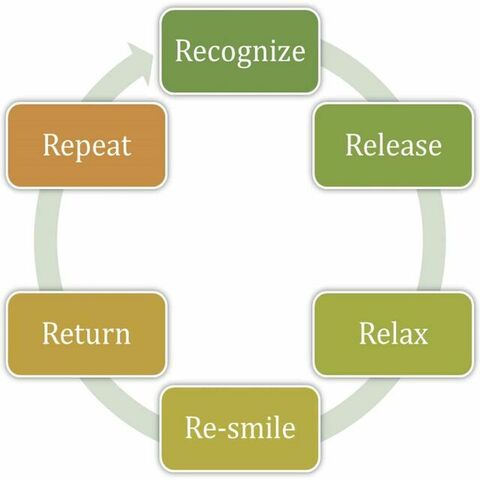
The six Rs.
The moment you notice a hindrance,
What do you do?
You stop that hindrance in its tracks.
You release your attention from that hindrance.
You relax any tightness intention.
You bring up an intention of happiness through the smile.
And then you return back to the feeling of loving kindness.
As you keep doing this,
Your mind becomes more and more collected.
And therefore it is secluded from unwholesome states.
Because of the fact that it is secluded from unwholesome states,
That is the distractions.
Remember what distraction means first.
A distraction is anything that takes you fully away from your object of meditation.
If there are thoughts in the background,
If there are images in the background,
But the mind remains with the feeling of loving kindness,
Then you do not need to six Rs.
It's only when those thoughts or those images pull your attention fully away from the object that it is said that you are distracted.
And so you recognize,
Release,
Relax,
Re-smile,
Return.
You let go and come back to your object of meditation.
The more you do this,
The greater degree of mindfulness you have.
The greater degree of clear comprehension you have,
Sati and sampanjana.
And as you do this,
Your mind gets more collected and experiences relief.
That relief from the hindrances brings up joy and happiness.
This is the joy and happiness that is born of seclusion.
When we say seclusion,
What does that mean?
We can say seclusion can mean isolation.
We can say seclusion means you go into your cabin and you sit and you meditate.
But that's one level of seclusion.
There's another level of seclusion,
Which is discernment.
Because the word seclusion is actually translated from viveka.
Viveka means to discern.
What are you discerning?
The fact that the mind is free of hindrances.
As a result of the mind being free of hindrances,
It experiences joy,
Piti.
And this joy manifests as different kinds of experiences.
It can manifest as heat in the body,
As warmth coming from your hands.
It can manifest as vibration,
Vibratory experience in the body.
There is a clear,
Uplifted state of mind that you experience.
And you experience happiness or sukha.
Sukha here is really a sense of comfort and tranquility.
It's where the body remains steady and free of any kind of discomfort.
It's where the body remains free of any kind of pain.
So the bodily formations are tranquilized or beginning to become tranquilized as you experience this joy and happiness or comfort born from understanding that the mind is free of hindrances.
So these culminate into the first jhana.
Now in the second jhana,
Which Sariputta goes through,
What happens?
Now there is a certain level of self-confidence in the mind.
The mind realizes,
Oh,
This is fun.
This is actually enjoyable.
I'm having a good time.
And it's able to stay with the feeling of loving kindness without having to bring up any kind of verbalizing thought or any kind of imagery.
The mind does away with that.
That's why the first jhana is the first level of cessation.
And it is the cessation of distractions.
That's the first level of understanding you have.
My mind is free of distractions.
The second jhana ceases any kind of vittaka and vichara.
So that means it lets go of any kind of verbalizing and any kind of imagery.
Now the mind fully rests in the feeling of loving kindness and that feeling is not dependent upon the imagery or the verbalizing.
That feeling is now dependent upon the attention being on it.
Because whatever you put your attention to,
That is what it continues to fuel.
If your attention stays with loving kindness,
Then the loving kindness will continue to permeate throughout the body,
Throughout your mind.
So now there's a sense of being on autopilot.
The mind feels like it can do this and it feels even more steady.
There's a greater degree of clarity.
And so this is why it's said that the second jhana is the level of cessation which ceases any kind of verbal formations.
So for those of you who are new to that term,
Verbal formations,
When we talk about formations they come from the word sankara or samskara.
And verbal samskaras are essentially those components of the mind that allow you to think and reflect and ponder before you express it in speech.
And so that is the verbalizing and imagining that goes on.
That intentional verbalizing and intentional imagining goes away at the second jhana.
And so this is the cessation of verbal formations in that regard.
But now you experience greater degrees of pithi and sukha.
What does that mean?
It is now pithi and sukha born of concentration,
Born of collectiveness.
Which means that the mind becomes further attentive.
Now the mind,
As I said,
Is just gliding through this experience of loving kindness.
And you may experience the pithi starting to rise up.
You may start to experience this joy coming up in greater degrees and more frequency.
You may notice that the mind experiences greater degrees of comfort.
Now the mind has no hindrance at all and has gone completely away.
So in the second jhana,
Pithi and sukha are born of collectiveness.
Now the mind's attention is so steady that the sukha,
That is the steadiness and comfort in the body,
Becomes immovable,
Unshakable.
And the experience of happiness and joy that you experience through pithi becomes even greater.
It becomes so great that the smile that you have on your face might become elongated.
Because this feels so wonderful.
It feels so good.
Now what can happen is people can alternate between metta and pithi.
That is to say,
Their attention then goes on the experience of joy.
But if that happens,
Then when you get to the third jhana,
People feel like there's something going wrong in the meditation.
Remember the pithi is an experience that happens automatically,
Happens naturally.
This is what you have to understand about these states.
These are not states that you construct.
These are states of deconstruction,
Of letting go.
And as a result of letting go,
These states arise.
So you're not trying to construct the pithi.
You're not trying to construct the sukha.
You're not trying to construct the tranquility that will arise later.
They are happening naturally and progressively as you go through these stages.
So what happens in the third jhana?
When you get to the third jhana,
The mind lets go of joy.
That is why I'm saying that if the mind mistakes the pithi,
The joy as loving kindness,
As metta,
Then when the joy disappears in the third jhana,
The mind feels like something is wrong.
I'm not able to feel the metta anymore.
That's because the attention is now on the pithi.
So in the third jhana,
What ceases is joy,
And you have greater degrees of tranquility.
So what is that tranquility?
That is called tranquility due to mental unconcern.
There is greater degrees of equanimity in the mind,
And there is an even larger degree of sukha.
When you get to the third jhana,
What you will feel is that the metta starts to become a little bit more prevalent in the sense that it starts to feel a little bit more expansive.
It feels like the metta is ready to kind of radiate outward,
And you will experience lightness of body,
Or on the flip side of that,
You might experience a hard,
Heavy steadiness of the body.
This is different from sloth and torpor.
What you experience is the tranquility in the body.
The body formations are starting to become further and further tranquilized.
So some people will experience like they're floating.
Some people will feel like they're losing sensation in different parts of the body.
And some people experience a certain gravity to the body,
A certain steadiness,
You know,
Like a rock,
Totally immovable.
And if you're experiencing this,
Then this is one of the sure signs that you're experiencing the third jhana.
Now when you get to the fourth jhana,
What happens?
Your mind starts to experience the loving kindness become even more expansive.
Now it feels like loving kindness goes from the heart up into the head.
But before that,
There's also that tranquility in the third jhana that starts to become even deeper.
So there's the equanimity and tranquility where the mind remains completely unconcerned with what's going on.
It is in such happiness,
In such contentment,
That's the quality of the third jhana,
In such contentment that it doesn't want to do anything.
It just wants to rest in that experience.
And then in the fourth jhana,
That tranquility goes even deeper where there is what's known as purity of mindfulness due to equanimity.
And so what ceases in the fourth jhana?
Any kind of joy and happiness,
So the joy ceased in the third jhana.
Any other levels of happiness cease in the fourth jhana.
At the forefront,
That seems like a terrible thing,
But actually,
Joy is overrated because joy is short lived.
When you think about joy,
There is an analogy used between joy and happiness.
Joy is like a candle flame that continues to flicker.
It's very unsteady.
Whereas happiness is a flame that is completely still.
It doesn't waver from one place to the other.
In the same way,
The sukha is more steady than the pithi is.
And then the purity of mindfulness is even more steady than that sukha.
So we say purity of mindfulness due to equanimity.
What does that mean?
Purity of mindfulness due to equanimity.
What's going on under the surface,
In the engines of your mind,
So to speak,
When you're progressing through these four jhanas,
Is your mind automatically starts to bring up what is known as the seven awakening factors.
What are the seven awakening factors?
Mindfulness,
Investigation of states,
Energy,
Joy,
Tranquility,
Collectedness,
And equanimity.
So these different factors start to appear in different degrees in each of the jhanas.
In fact,
It could be understood that to be in a jhanic state of mind means first and foremost the disappearance and non-reappearance of any hindrance,
And the appearance and sustaining of the enlightenment factors.
So how do you bring up these enlightenment factors?
You could intentionally bring them up,
But actually they happen to arise quite naturally due to the right causes and conditions being there in place.
Now when you do right effort,
When you use the six R's,
You are actually bringing up these enlightenment factors.
So what is the first enlightenment factor?
Mindfulness.
Remember mindfulness means remembering to observe how mind's attention moves from one thing to the other.
This happens as soon as you recognize that the mind is distracted.
What happens?
Your mindfulness is regained.
And in tandem to that,
You bring up automatically,
As a result of recognizing,
The investigation of states awakening factor.
Investigation of states.
This is from the words dhamma vijaya,
Which means the understanding of phenomena.
That's really what it means,
The investigation of states.
Investigation means that you have to analyze and reflect,
But here really what it means is you just understand and comprehend what states are present and what states are not present.
So when you see that your mind is distracted,
What's going on?
First and foremost,
You have mindfulness,
And second tied to that,
You understand mind is distracted.
The understanding that mind is distracted itself is the investigation of states.
Now when you release your attention from that distraction,
You are bringing up the balanced energy,
The balanced amount of energy required.
And that is the third enlightenment factor,
The viriya,
The energy,
The power,
The strength.
That doesn't mean you have to force and push your way through it.
It just means that there is enough energy for the mind to remain alert.
And then when you relax,
What are you doing?
You're bringing up the tranquility factor.
By relaxing and letting go,
You are experiencing a mundane form of nirvana in that moment.
By tranquilizing the bodily formations,
You are bringing up the tranquility factor.
As a result of that,
You experience joy quite naturally,
Which is anchored by the smile.
So here the joy and the tranquility are interdependent.
When you are joyful,
Your mind is naturally relaxed and tranquil.
When you feel tranquility,
Your mind is naturally uplifted and happy.
And then when you return back to your object of meditation,
Your mind becomes collected.
And as you're doing this whole progression of the six Rs,
You have what is known as equanimity.
What is that equanimity?
That equanimity is being able to see things as they are without getting affected by them one way or the other.
Just seeing things as they are.
So what happens when you go through these jhanas is you cycle through these enlightenment factors.
So the mindfulness leads to investigation of states,
Which leads to energy,
Which leads to joy and tranquility,
Which leads to collectedness,
Which leads to equanimity.
But then that equanimity further strengthens the mindfulness.
And so these cycling through of the enlightenment factors,
The awakening factors,
Further strengthens your experience of the jhanas.
That's why you have more steadiness in the second jhana.
That's why you have more joy in the second jhana.
That's why you have more tranquility in the third jhana.
And that's why you have more equanimity in the fourth jhana.
And so the main signature of the fourth jhana is this mindfulness and equanimity.
At this point,
It's understood that the bodily formations cease.
Now,
In some schools of thought,
That means that the in-breath and the out-breath stop.
The way I would look at it is that the mind becomes so quiet,
So tranquil,
And the body becomes so still that the breathing also becomes quieter.
And the rate at which you breathe becomes softer and more prolonged.
In other words,
You don't need as much oxygenation,
Let's say,
As you would in the lesser states.
And the other thing is,
When we talk about the cessation of bodily formations in the fourth jhana,
Is that contact with the body becomes less apparent.
If a fly lands on your hand,
You will feel it if your attention goes there.
But for the most part,
When you are in the fourth jhana,
You are fully in the mind.
And that's why it's understood,
Or that's how people interpret this experience of the feeling of loving-kindness moving from the heart up into the head.
Because what's going on is that,
First and foremost,
The energy of the loving-kindness becomes more radiant.
It becomes more expansive.
And secondly,
Because the attention to the body becomes diminished,
What is really felt here is up in the head.
And so it feels like the loving-kindness has moved up to the head.
And oftentimes,
A guide or a teacher will know somebody is in the fourth jhana,
When you speak to them and you ask,
How is everything going?
And they'll say,
Oh,
Everything's great.
Everything is fine.
There's a certain flatness to their voice.
It's not like they're depressed,
It's just they're very calm,
Very collected.
And you'll ask them,
Do you feel happy?
Yeah,
I feel happy.
It's very relaxed.
So these are the four jhanas that a person will go through as they start to develop the practice of loving-kindness.
Now,
From the fourth jhana,
They are also essentially known as rupa jhanas,
Which means jhanas that the body experiences,
Or within the form realm.
There's the arupa jhanas,
Which we'll talk about tomorrow.
But it is from the fourth jhana that you experience the arupa jhanas.
It is also from the fourth jhana that you're able to experience supra-mundane faculties.
So in the case of the Buddha,
On the night of his awakening,
How did he go through his process?
He recalled a time when he was happy.
He remembered a memory of when he was a small child with his father during the harvest season,
During the harvest festival.
And he was sitting under the rose apple tree,
And he remembered being quite happy and joyful.
And then,
Remembering that,
He said,
Perhaps this is the way to cessation of suffering.
And he took that memory,
And he continued with that feeling,
With that experience.
And he progressed through the jhanas,
The first jhana,
The second jhana,
The third jhana,
And then the fourth jhana.
Now from the fourth jhana,
His mind became quite malleable.
So what does it mean when the mind is malleable?
Your mind is able to be directed in any direction,
Anywhere,
At the snap of a finger.
If your mind wants to go to experience joy,
It can experience joy the next moment.
If it wants to experience tranquility,
It can go and experience tranquility in the next moment.
So in the same way,
When his mind was in the fourth jhana,
Completely steady,
And he had mastered the fourth jhana,
He inclined his mind to past lives.
So he looked back into the memories of his current life,
As the bodhisattva,
And then he looked into previous lives before that.
And as he did this,
He gained insight and clarity on the nature of self,
And the nature of existence.
He started looking into the understanding of dependent origination,
When he saw how one thing leads to the other,
Causality and conditionality.
That's the first fold,
There's a three-fold knowledge,
As it's known.
That's the first aspect of the three-fold knowledge that he experienced.
Then from the fourth jhana,
His mind inclined to the second knowledge,
Which is the knowledge of the arising and passing away of various beings.
So he inclined his mind to see the arising and passing away of beings according to their karma.
He saw that when beings were in this state of mind,
With these kinds of actions and intentions,
It led to these states of mind and existences.
And so he was able to see that there is a world beyond just what we see in the form of the five sense experiences.
There's something beyond that,
Which is outside of that scope.
And seeing the arising and passing away of beings according to their karma,
He got insight into the nature of karma,
And a greater understanding of dependent origination,
Of how this process unfolds and causes the creation of and the renewal of further karma.
And then finally,
In the third-fold knowledge,
His mind inclined from the fourth jhana to understanding through insight and wisdom,
How this whole process works through dependent origination,
As a result of which he understood the four noble truths.
And so the third-fold knowledge is understood as the destruction of the taints.
What does that mean?
He let go of all sensual desire.
He let go of all craving for being and non-being.
And he let go of all ignorance,
Which means he came to the full understanding of what suffering is,
The complete dissolution and abandonment of all sorts of conditions for that suffering,
Like craving for sensual pleasures,
Craving for existence,
Craving for non-existence,
Conceit and wrong view.
And as a result of which,
He realized fully nirvana,
The cessation of all suffering,
Through the insight and cultivation of what's known as the eight-fold path.
So the eight-fold path is encapsulated in right effort,
Because it's through right effort,
Which is the heart of the path,
That you go from the wrong factors to the right factors.
And so he used right effort,
Which is essentially preventing the arising of further unwholesome states of mind,
Which you do when you recognize,
Abandoning already prevalent unwholesome states,
Which is what you do when you release and relax,
Generating wholesome states of mind,
Which is what you do when you come back to your smile,
And maintaining those wholesome states of mind,
Which is what you do when you come back to your object of meditation,
When you return.
So every time you do the six-hour process,
You're doing a few things.
You're coming closer and closer to the understanding of the Four Noble Truths.
You're coming closer and closer to the activation and sustenance of the awakening factors.
And you are naturally walking the eight-fold path,
Which allows you to then experience these four jhanas.
So the way the Buddha discovered this whole process shows that this whole thing is very much interconnected.
If you do one element,
Everything else is also taken care of.
No matter from which angle you approach,
You are,
In a sense,
Fulfilling all the other factors of the path.
So it was from the fourth jhana that he was able to experience these three-fold knowledges.
It's also from the fourth jhana that it's understood that a person can develop psychic faculties.
So psychic faculties include seeing into past lives,
Seeing into the future,
Doing different kinds of manipulation of material aspects,
And so on and so forth.
But the greatest gift that the fourth jhana can give you is full awakening.
Because it's from the fourth jhana you experience what's known as panya-vimutti.
So there's two kinds of freedom.
Freedom by wisdom and freedom of mind.
So panya-vimutti is freedom through wisdom.
And that occurs because from the fourth jhana you start to understand how the self is made.
How the sense of self arises and how it really is just a process that results in suffering.
And as I said,
From the fourth jhana you can then experience the ayatanas,
Or the arupajhanas,
Which we'll go into further tomorrow.
But I just wanted to give you an introduction to these four jhanas,
Which at some point in the next couple of days you will experience if you are developing loving-kindness in the way that it's been instructed to you.
Thus ends the lesson.