Today we will practice breath meditation in a little different way than you are used to.
This is the practice of Tranquil Wisdom Insight Meditation,
Or TWIM,
But it's unique in that it uses a relaxed step.
There is not the focusing on the breath.
There is not the drilling down into the sensation.
There is only knowing the breath.
So let's begin.
And of course find a comfortable position.
You can sit in a chair or sit on the floor,
Whatever is most comfortable.
But keep your back straight and your head up and down to the ground.
And take a few moments to relax.
Relax starting at your head,
Down into your shoulders,
Relaxing any tension or tightness.
In your body,
The lower part of your body,
Your legs,
Letting all of the tension flow out into the ground.
The instructions in the Anapanasati Sutta and the Satipatthana Sutta are that he knows when he is breathing in and he knows and understands when he is breathing out.
So put your mind on your breath and just notice the breath coming in and out without any control.
He knows and understands when the breath is short or he knows and understands when the breath is long.
All this really means is you simply know that you're breathing without a wandering mind thinking about lunch or some other thought.
You are here in the present moment,
Knowing.
And that's all.
Now take a long breath and let it out.
And in and out.
You knew that you were breathing in and you knew that you were breathing out.
Don't focus on the breath in the belly.
Don't focus on it at the nose tip.
Just back away from the body in a sense and know that you're breathing.
Know that you're sitting in your chair or on the floor.
Know that you're in the room.
This is the mind's perception.
It knows.
It is conscious.
It is aware.
Now let the mind come back to the breath.
Don't control the breath.
Just know that you're breathing.
If your mind is particularly active,
You might just say lightly to yourself,
I know that I'm breathing.
Just to come back.
And on the in-breath,
Relax.
And on the out-breath,
Relax.
Relax on the in-breath.
Relax on the out-breath.
Relaxing your whole breath,
Breathe in.
Relaxing,
Breathe out.
You can add a little bit of a smile,
Just bring an uplifted feeling to the breathing.
Relaxing on the in-breath,
He feels happy.
Relaxing on the out-breath,
He feels happy.
There's nowhere to go,
Nothing to do.
Just sit and breathe and relax,
Knowing that you're breathing.
When you breathe in,
There's a little gap,
And then you breathe out.
At that gap,
Be especially mindful that your mind will want to wander.
Relax.
The sutra says he tranquilizes the bodily formation.
That means relaxing any tension and tightness or thought.
When the breath comes in and goes out,
If the mind wanders,
You tranquilize the bodily formation.
And in the Anapanasati Sutta,
It says he relaxes the mental formation.
What are mental formations?
Thoughts,
Desires.
Not being here in the present,
The mind is going off,
This is craving.
This is what we're here to see,
To follow.
The definition of mindfulness is not watching sensation or drilling down,
It is watching mind's attention go from one thing to another.
The breath comes in,
The mind starts to wander.
Tranquilize that bodily formation,
That mental formation.
Come back,
Redirect,
And breathe out.
When the mind wanders,
Relax for a few moments and notice the quiet,
And come back.
Don't jerk your mind back,
Don't try to rush back to the object.
Simply know that you are not on the breath,
And that's okay.
Simply know that you have wandered.
A monk knows when he is walking back and forth.
A monk understands when he is full of joy.
A monk understands when he is eating.
A monk is simply in the present,
Understanding what is happening right now.
Breathing in,
Relax.
Breathing out,
Relax.
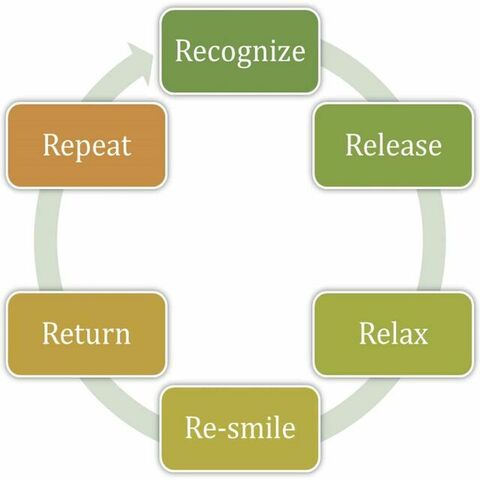
Using the breath meditation as prescribed by the Tranquil Wisdom Insight meditation technique is using the six R's when the mind wanders.
That is,
You recognize that you have wandered,
And that's okay,
You accept it,
You've wandered,
You're not there anymore.
Don't beat yourself up,
Don't get angry.
Release,
Second R,
Release.
Just stop wandering,
Stop thinking,
Don't force it,
Just let it go.
And relax,
The third R.
And bring back a little smile,
Just to uplift that mind,
And return to the breath.
Relaxing on the in and relaxing on the out,
Being mindful to see if the breath is still there and that the mind has not wandered.
You will wander.
Once you recognize it,
Release,
Relax,
Re-smile,
And redirect,
Return to just knowing that you're breathing.
Sometimes the breath will be very subtle,
Just understand that it is subtle now,
It's barely noticeable.
Sometimes you'll take deeper breaths,
And it's all part of just understanding that you're breathing.
Sometimes you can have happiness arise,
Let that happiness be there.
Know that it's there and understand it,
But don't follow it,
Don't concentrate on it.
Just let it be and redirect back to the breath.
It might take 15 or 20 minutes just for the mind to calm down,
And that's okay.
Don't get upset about it,
Just let it be,
It will calm down by itself.
There is a thought that my breath is calm and my mind is still,
Then simply know that there is that thought,
And come back to the breath.
There might be a loud sound,
There might be something that distracts you,
Notice how that feels.
If it's distracting,
It might be a painful feeling,
Slightly painful.
And then thoughts start,
I don't like that feeling.
Try to see just the feeling and release and relax.
All is just feeling.
The Buddha said that feeling is just what can be felt,
And when you know that feeling,
If there's reaction,
You tranquilize the bodily formation and the mental formation.
And then come back to the breath,
Always relaxing.
If the mind wanders,
Just release,
Relax,
Soften.
Don't get upset,
Don't jerk your mind back,
Just let go of whatever pulls you away from being in the present.
If your sitting is going well,
Please continue to sit longer,
Otherwise the sitting is finished.