Good morning.
Thanks for joining me for this meditation.
Hopefully after this session you'll be equipped with some of the tools that I find useful to help you have a more peaceful day.
We'll be doing this by asking ourselves just three questions.
First of all,
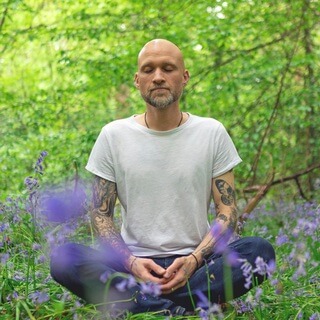
Find yourself a comfortable position.
Ideally sitting upright,
If that's manageable for you,
With a straight but not rigid back.
A relaxed body,
Bringing focus to all those muscles that we often forget to check in on.
Starting with your face,
Your brow,
Around your jaw,
Even your ears.
Try and let those muscles just soften and relax.
And your shoulders,
Let them drop.
Let them be soft,
Loose and relaxed.
Now bring your attention to your breathing.
When was the last time you made a conscious decision to take a full deep breath?
Expanding your stomach and the muscles in your lower back.
Try it now and really feel all of those areas of your body move and gently stretch.
Hopefully that feels good.
We can only notice those feelings when we pay attention to what we're doing right in that moment.
Now I'm not going to ask you to continue taking deep breaths or even to breathe in any particular way.
All I ask is that if you feel distracted at any time,
You ask yourself the first of the three questions.
What is my breath doing right now?
And with that,
There's no request or need to change anything.
Simply ask yourself and pay attention to the moments after.
There is no right or wrong answer to this.
If you haven't already closed your eyes,
Allow them to gently close.
And take a few moments.
Spend some time with that question,
What is my breath doing right now?
If you can ask yourself that question,
What is my breath doing right now,
Even just once today,
You'll be on your way to having a more peaceful day.
Large parts of our day are spent lost in thoughts,
Running on autopilot.
We've all had those times when we've driven or travelled somewhere,
Only to arrive at our destination having no memory of the journey.
Or those occasions where we've left home in a hurry and worried that we've left the oven on or not locked the front door,
Only to return to find we need to unlock the door and we had actually switched the oven off.
But we couldn't remember because we were on autopilot and not fully present.
If we were present,
We'd remember.
You can practice this theory by narrating the action to yourself as you perform it,
Switching off or locking the door.
This will keep you in the moment,
Creating a clear memory of the action.
And you should find that you don't then worry about it later.
We already do a lot of narrating throughout a day.
When we're lost in thought,
We're usually narrating to ourselves,
And more often than not narrating a fictional tale,
Ignoring facts and making judgments.
If we allow ourselves to listen to those stories,
We'll find it harder to be in the present moment.
And the present moment is the only place we can find peace.
The second question we can ask ourselves during the day in moments of distraction,
Especially when we are judging or narrating,
Is,
What do I actually know about this?
What do I actually know about this?
What do I actually know about this?
And that's whether it's someone cutting in front of us in traffic or on public transport,
Or an email that we've read and decided someone's being a bit off with us.
Whatever it is that causes a judgment or a moment of stress,
Just ask,
What do I actually know about this?
We don't know if the person cutting in front has seen us.
They may be in a hurry.
We don't know.
Does it matter that they've cut in front?
Not really.
Have we completely misread the tone of the email perhaps?
Or did the sender intentionally write the email this way?
We don't know.
So let's just spend a few moments to think of some of those times from yesterday or the previous few days where you may have felt stress or anxious or even angry and ask yourself,
What do I actually know about this situation?
Watch your emotions and feelings whilst asking that question and allow them to soften as you consider,
What do I actually know about this?
The third question to help you have a more peaceful day is,
Am I being kind?
This should be first addressed to yourself.
More often than not when we're judging a situation or other people,
It's with negativity.
And these negative stories we tell ourselves can cause the opposite effect of what we're trying to do here.
If we're to find peace,
We first have to be kind to ourselves.
And actively being kind to others is one of the most efficient ways of enjoying a more peaceful day.
Spend a few moments now revisiting those situations you thought of earlier and ask yourself,
Am I being kind to both yourself and others?
As this recording comes to an end,
I hope you take with you those three questions and use them throughout your day.
They don't all have to be used at once.
Each one on its own can help you.
What is my breath doing right now?
What do I actually know about this?
Am I being kind?
I'd love to hear how you get on.
Please come back and review or leave me a message to let me know.
Thanks for joining me this morning.
I hope you enjoy a more peaceful day.