Welcome to this talk and breathwork practice on building nervous system resilience.
This session will help you cultivate the adaptability to handle the ups and downs of life.
By working with the nervous system,
You'll understand how the condition of your body impacts your mind.
And our breathwork practice will help you strengthen your capacity to handle challenges from a place of calm,
Inner steadiness.
The principles of resilience that we will be talking about are similar to the principles found in the children's story of Goldilocks and the Three Bears.
If you're not familiar with this story,
It goes like this.
A little girl is walking through the woods and comes to the home of the three bears.
She knocks and no one answers,
So she goes inside and finds three bowls of porridge.
She tries one and it's too hot.
She tries another and it's too cold.
She tries the last one and it's just right.
The perfect temperature,
So she eats it all.
Feeling capable and strong within yourself happens when your energy is in a moderate state.
Not too high where you might be scattered and anxious.
Not too low where you might be withdrawn and numb.
The middle ground is a place of steadiness where you are able to handle what comes up and take on challenges without being thrown off balance.
The body has a natural mechanism to help you find and moderate this middle ground,
Your nervous system.
The major function of the nervous system is to regulate your body's stress response.
In stressful times,
The body activates survival mode,
Often called fight or flight.
In peaceful times,
The body shifts into a relaxed state known as rest and digest.
A healthy and resilient nervous system is able to come back into balance after stressful events,
Moving out of fight or flight,
The stress response,
And into rest and digest for relaxation.
If we're not able to come back to the middle ground and end up staying in a stress response longer than needed after the threat is complete,
We might experience nervous system dysregulation,
Where we have too much or too little energy.
In a state of too much energy,
You might feel overwhelmed,
Like you can't think clearly,
Which could show up as very rigid thinking patterns or with scattered thoughts where it's hard to focus.
You might feel anxious and panicked,
And it can feel like your stress patterns are taking over so that you become emotionally reactive,
Acting based on your impulses that are coming from emotion and fear.
When this is happening,
Your mind is focused on survival and not available to learn or fully process your experiences.
Some signs that you are in a state of excessive energy are physical or mental tension,
Feeling defensive,
Angry,
Or enraged,
Experiencing racing thoughts,
Anxiety,
And hypervigilance,
Or emotional flooding,
Where you feel like you're being inundated with strong,
Overwhelming emotions.
This state can cause you to be aggressive,
Have emotional outbursts,
Or end up blaming and shaming maybe yourself or other people when you don't truly want to be acting this way.
On the other hand,
In a state of too little energy,
You might feel immobilized and zoned out or numb.
You might isolate or withdraw from social situations,
And it's hard to connect with other people in this kind of state.
You don't have much control over your reactions because your brain is kind of stuck,
So you might shut down or neglect your basic self-care,
Maybe be lethargic and sluggish so that you're not moving much.
And it can also be very hard to focus and keep track of conversations or events.
Again,
Here your mind is focused on survival,
So you're not able to learn new things or process what is going on.
If you're in this low-energy state,
You might be feeling dull and disconnected,
Maybe feeling not there or like you have a lot of brain fog because there's a very low level of cognitive processing happening.
You're not moving your body much,
Very little physical movement,
And you might feel kind of passive in your life,
Not reacting to what's going on in your environment.
People are telling jokes,
You're not smiling or laughing,
And it could almost seem like you're uncaring and not very responsive to other people.
You can feel emotionally numb when this is happening and feel like you don't have very much awareness of your body and sensations,
Which can make it hard to keep track of conversations and events as well.
So those are the extremes,
Having too much energy or too little energy.
But what about when you're in the middle ground,
That Goldilocks zone,
Where there's a sense of in-between,
Balance?
Well,
When this is happening,
You can feel calm,
But not too tired.
You're alert,
But not anxious.
You're able to manage the general up and down of your emotions and think,
Rationalize,
And make decisions,
Function generally,
Without becoming too overwhelmed.
Your energy is just right,
So your stressors don't bother you too much.
They're still there and they come and go,
But without you getting mentally stuck in them.
You're able to handle what comes up and respond appropriately.
So you're experiencing a range of emotions while feeling rather in control and flexible.
Your mind is calm,
Alert,
And adaptable,
And you can self-regulate your emotions and from that place be able to connect with others.
Your mind is able to learn new things because your brain doesn't process stress as threats to your survival.
Your survival needs are met and your brain has space available to allocate to learning new things.
So some signs that you're in this middle ground,
The Goldilocks zone,
Is that you're able to be aware of the present moment,
Being right here,
Right now,
And let your current experience be the center of your focus.
You're able to tolerate your feelings,
Even the unpleasant ones,
And be open and curious to how you feel and your experiences.
You're also able to think with empathy,
So understanding and connecting to someone else's emotions and experiences,
Which helps you deepen your connections with other people.
And your reactions to what happens in your day-to-day life are pretty appropriate to the situation.
So the Goldilocks zone,
Where things are just right,
Might sound like a great place to be.
Why would we ever leave?
Well,
Leaving isn't a conscious choice.
We would all want to be well-regulated and resilient as much as possible.
But it's usually stress,
Anxiety,
And anxiety that we're most likely to have.
But it's usually stress and trauma that push us outside of this middle ground and into nervous system dysregulation,
Where our stress response is heightened or gets stuck.
Your brain's first focus is to help you survive.
But stress and trauma make it harder to concentrate and stay calm because your brain becomes focused on your survival needs.
When this happens,
You're more easily thrown off balance.
This can come from fears of unconscious thoughts,
Maybe feeling like you are lacking control,
Maybe having a fear of abandonment or rejection.
There might be beliefs that you've learned and developed from trauma responses that were coping tools.
And now that you no longer need them,
They might continue to cause emotional dysregulation.
So luckily,
Being in and staying in the Goldilocks zone of resilience is a skill,
Something that you can learn and practice so that when stress and challenges come up,
You're able to meet them with a calm,
Grounded,
And adaptable mindset.
Mindfulness is a key tool to staying in this middle ground.
When you're focused on the present,
Your mind isn't getting swept up by anxious thoughts.
You're able to stay connected and engaged with your life,
Moment to moment,
By meeting what's happening with acceptance and curiosity,
Allowing the feelings of positive and negative experiences to come to the surface without judging yourself or attaching shame,
And then exploring where the feelings are coming from and what they could mean.
You have a clearer mind to see the thoughts that are limiting you and challenge them with new perspectives that help you have a more positive view of yourself.
This type of thought awareness practice builds the mental muscles needed to tolerate discomfort.
Every time you move away from limiting thoughts and choose a more positive path,
You're creating a new mental pattern,
One that is more self-affirming and resilience boosting.
One of the most accessible and effective tools we all have for building resilience is the breath.
By gaining control of your breath,
You can manage your energy,
Manage your stress responses,
And regulate your nervous system.
Conscious breathing exercises work to clear away the physical and emotional obstacles and balance your energy.
Breathing with awareness can act like a natural blood pressure reducer,
Easing stress-related conditions in the body and mind,
And helping you to get centered and focused,
As well as steadying your mood and emotions.
Our breathwork practice is designed to bring you into the middle ground and expand your capacity to stay in a balanced state.
The more we're able to meet challenges and stress with a calm,
Steady mind,
The more we are less knocked off course by challenges and the more resilient we become.
The technique we will use works toward having equal parts to the inhalation and exhalation.
Whether your energy is too high,
Too low,
This will bring you balance.
Also,
If your energy is feeling pretty centered and grounded,
This practice will help you expand your capacity for resilience.
So let's begin.
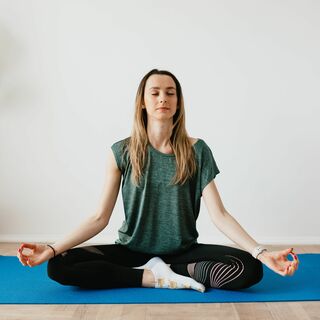
Find a comfortable seat with your spine upright and low.
You can sit on the floor,
Maybe with support under your seat like a blanket or cushion,
Or you might choose to sit in a chair.
Take a moment to arrive,
Physically and mentally.
Allow your shoulders to soften down your back.
Release any tension or holding in your abdomen.
Let your hips and legs begin to relax.
Invite your mind to join you into this state of presence by following your breath.
Simply sensing the natural flow of your breath just as it is.
Finding the natural inhalation,
The natural exhalation,
And the natural pauses between each breath.
Notice what's happening in your body as you breathe.
There are changes in specific parts of your body that take place with the inhale.
The chest rises.
The ribcage widens.
The abdomen expands to the front,
Back,
And sides.
Observe what happens with the exhale.
The gentle drawing inward as you release the breath.
Your abdomen lightly contracts.
Your ribcage hugs in toward the midline.
The chest softens.
See if you can find the slight space at the top of the inhale where your body is full of breath.
Feel the expansiveness in this brief moment.
Then find the slight space at the bottom of the exhale.
When your body is empty of breath,
Sensing the hollowness within,
We'll use words to bring deeper awareness to this flow pattern.
So as you say to yourself,
Breathing in as the inhalation comes,
Identify the space at the top by saying,
Pause.
As you breathe out,
Note to yourself,
Breathing out.
And the space at the bottom is another pause.
Using the pattern,
Breathing in,
Pause.
Breathing out,
Pause.
Breathing in,
Pause.
Breathing out,
Pause.
Keeping the slow,
Continuous flow will bring evenness to the inhalation,
The pause at the top,
The exhalation,
And the pause at the bottom.
We'll start with a count of four.
If you find that a count of four is too long for you,
You can adjust to meet your needs with a two or three count.
And if your breath is a bit longer than a four count,
You might lengthen to a five or six count.
Take a regular breath to prepare.
In through the nose,
Pause.
Out through the nose,
Pause.
Inhaling,
One,
Two,
Three,
Four.
Pause,
One,
Two,
Three,
Four.
Exhaling,
One,
Two,
Three,
Four.
Pause,
One,
Two,
Three,
Four.
Inhaling,
One,
Two,
Three,
Four.
Pause,
One,
Two,
Three,
Four.
Exhaling,
One,
Two,
Three,
Four.
Pause,
One,
Two,
Three,
Four.
Inhaling,
One,
Two,
Three,
Four.
Pause,
One,
Two,
Three,
Four.
Exhaling,
One,
Two,
Three,
Four.
Pause,
One,
Two,
Three,
Four.
Continue like this,
Counting to yourself,
Making sure that your breath smells smoothly without any strain.
Take one more round and then release the counting breath,
Ending with the pause at the end of the exhalation.
Take a few still,
Quiet moments to experience the effects of the practice,
Savoring the results of the steady breath count,
The internal balance.
Allow these feelings to soak into you,
Creating an internal imprint.
As you recognize your capacity for boosting your internal strength and resilience with your breath,
When you feel ready,
You can begin to move your body,
Bringing yourself back into awareness of the space around you,
Letting your eyes come open if they were closed,
Beginning to transition yourself back into your day.
I thank you for being here,
For your presence in showing up to take care of yourself and improve your well-being by cultivating greater resilience.
Thank you for taking the time to practice with me.
I wish you steadiness and resilience in your days ahead.