Okay,
Then welcome to our mindfulness session,
Mindfulness for Climate Stress.
And I invite you to find a comfortable position.
Yeah,
Either seated,
Or if you prefer standing,
Just signaling to your body to shift into a different mode,
To a mode where you can pause and pay attention to your experience in a more conscious way.
So for me,
This usually includes bringing some stillness into my body,
Making any last movements that I need to make,
Stretching my back a little bit,
Lengthening.
And it's really that grounding in the present moment can be so valuable,
And be a reason why we meditate.
And this is where it starts,
Bring your body or physical activity to a pause.
And then just as a reminder,
That anything I share with you as an invitation,
That really the next 15 to 20 minutes are an invitation to practice in a way that I've been taught by the UCLA Mindful Awareness Research Center,
Namely Diana Winston and Marvin Belzer.
And this practice is secular,
It's evidence-based,
And at the same time,
It's rooted in ancient mostly Eastern traditions,
Buddhist traditions of mindfulness,
But it's available to anyone.
There is no prerequisites,
You don't need to do anything to know anything.
It's really this capacity that we all have as humans to know what is going on in our experience,
To know what we see,
What we hear,
What we smell,
And to pay attention to our present moment.
And so feel free to make your own adaptions,
To accommodate your needs,
Whatever they are.
And then arrive in your meditation posture,
And engaging in meditation can make a difference in your human experience,
Can help reduce stress in all parts of our lives.
Today you're here,
Practice mindfulness,
Maybe get a sense of,
Can reduce stress that we feel around the climate,
Around the state of our planet.
Engaging in meditation can also be measured both physically and psychologically.
And what we do in meditation are really two things.
First,
We focus on something that is actually happening in our experience,
Something very ordained,
Ordinary,
Can be a sound,
Or our breathing,
Or a body sensation.
And the reason we spend time doing this is not to actually change the experience in that moment.
That is actually to cultivate a clarity of mind,
Some calmness,
Some stability,
To be okay with whatever is happening in our experience in that moment.
So to start to begin meditating,
We don't have to change anything.
And in the midst of what it's like for you now,
Wherever you are in this world,
Whatever your climate looks like around you,
Your environment,
I'll soon invite you to direct your attention to the sounds that you can hear in your environment,
To what you can feel in your body,
To what the breath feels like.
So we use our ability to direct our attention.
It's very manageable,
It's doable,
And we don't have to clear our minds to begin.
It's often a myth that doesn't hold true because that's just not possible as humans to clear our minds.
So this is the first thing we do in meditation.
And the second thing is that once we try this for a while,
Directing our attention to something ordained,
Something doable,
But eventually our attention will drift.
Our minds are by nature very active.
And yes,
Some minds are more active than others.
And our ability to focus,
To concentrate might be different.
No matter what your ability to focus is,
Your mind is active.
And even for the most experienced meditators,
At one point your mind will drift.
And so at this point,
You will know you're drifting,
You will be drawn into some patterns of thought,
Maybe just an ordinary to-do list for the day,
Maybe a random memory,
Maybe no emotions you notice,
Daydreaming,
Planning the future.
Whatever it is you're being pulled into,
Once you become aware,
You can gently return your attention.
So that's the second activity we do.
And when we deepen this practice,
We're giving ourselves permission to be real,
Just to experience what is happening.
We don't have to pretend it's happening.
We don't have to pretend it's not happening.
We don't have to counteract some solution,
Beat ourselves up for not saving the planet in this moment.
And we certainly don't have to perform to please others.
In itself,
Meditation is a free space.
And this has also been very helpful for managing the flow of experience a lot better.
So it's always helpful to return to the basics of meditations,
The two things,
Activities we can do to ground ourself in the present,
To regulate our emotions,
If possible.
And then some research suggests that while doing this,
We can have clarity around our values and actions.
Instead of getting overwhelmed by the future or worries,
We can gain clarity what is possible,
What actions are possible,
And what's important to us.
So there's an indirect effect.
If we practice mindfulness and engage in this inner transformation,
It might have an impact on the outer transformation that we're all hoping for.
In response to this climate crisis that we're finding ourselves in.
So with this,
Let's practice together.
And even though practicing is a very personal activity,
I won't be knowing what your mind engages in,
What you choose to do in this time,
And that is okay.
Yet we're all in this together.
So the invitation is to practice in community,
While still holding your personal space.
So again,
Notice your body seated here,
Your feet on the ground,
Your hands resting where they're resting,
The earth supporting you,
And taking a breath into your body.
And with the exhale,
Relaxing deeper into your seat,
Or if you're standing into your feet,
Letting the earth hold you.
And this might be a moment to acknowledge the land that you're on,
Whatever that looks like for you.
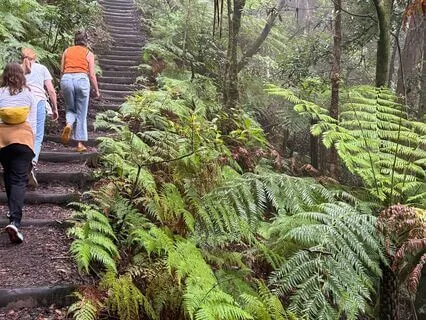
So I'm on Darug and Gandhangara country,
In the Blue Mountains,
Sydney,
Australia.
And with this acknowledgement,
Come back to your body,
To your physical experience.
And as I mentioned earlier,
You have some options now.
Using something very simple,
Like a sound,
So you're listening.
If you're able to hear,
Just tune into the listening,
What are you hearing?
Without adding a story or wanting to make sense,
Or trying to understand,
Just tuning into the physical experience of hearing,
And staying with that as long as possible.
And if that works for you,
Continue to do that.
And the second option to rest our attention is the breath.
It's the most common object of meditation.
There is no right or wrong here,
So you can stick with the sound,
Or you can move to the breath.
And then again,
Try to observe the physical experience of breathing.
Where do you notice it in your body?
Where does the breath begin?
Where does it end?
It happens if you just let the breath flow and observe it with a sense of openness,
Curiosity.
And there's also a third option,
If those two don't work for you,
You can choose a body sensation.
So,
For example,
A sensation in your hands,
Your fingers,
Or in your feet.
And the practice,
No matter which object you choose,
Is the same.
So,
Resting your attention,
Noticing,
Observing,
Paying attention,
Without wanting to change the experience,
Just noticing the experience.
What is happening for me in this moment?
No need to judge whether it's good or bad,
Just diving deeper into it,
Like a scientist,
Trying to understand ourselves,
Gaining some insights,
And not getting too attached.
So,
If that's not happening for you right now,
That is also okay.
Rest assured that you're planting some seeds.
Something difficult is happening for you,
Just tap into that.
What is it that I'm experiencing right now?
That might be something to learn here.
So,
Choose your object of meditation now,
And then let's practice together in silence,
Just for a short while.
If your attention has drifted,
Which is very normal,
Just delight in that moment of awareness.
Just notice what is happening for you in that moment.
What is your response?
And then gently return your attention just for one more minute to your anchor.
And then,
Coming to the end of our practice today,
Just notice if anything is coming up for you around clarity of values or actions,
Your present moment experience,
Whatever that looks like.
Let that be here too.
And now,
For yourself,
Some appreciation,
Just some kindness to pay attention,
To being more connected with yourself,
Which will automatically lead to more connection to others and to the planet,
That we all may experience life with more ease,
And clarity,
And happiness,
And peace.
So,
With this,
You can slowly start moving your body again,
Giving your kid a time to end this practice,
To reconnect with the world around you.
If you want to shake off anything that you don't need anymore,
Shake it off.
Anything you want to remember,
Take a mental note and do that as well.
And then,
Thank you for practicing today.