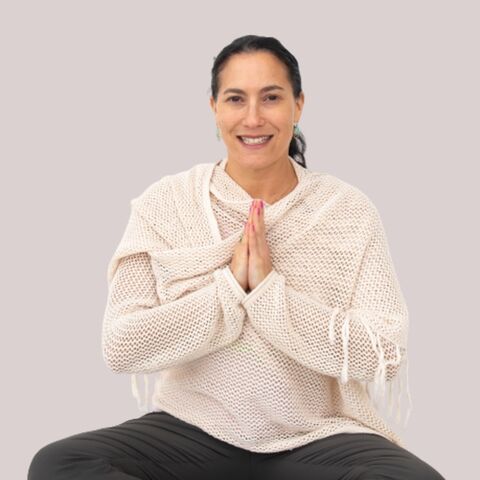
So sitting comfortable and tall for meditation,
Let the head be centered now over the spine.
So rock your head like you're shaking your head no and yes.
And then now like a flower over a stem,
Feel the head centered over the spine.
And then you can imagine a string pulling you up from the middle center of the head.
As you breathe in,
Lift the spine almost like someone's pulling you lightly from the middle of the center of head skyward.
But as you exhale,
Feel the buttocks,
Legs and feet relax into the earth.
Just try a few more rounds of breath like that,
Imagining the spine lengthening on inhale,
Relaxing and grounding the lower body as you breathe out.
So feeling very connected to the earth or the chair or the ground wherever you're sitting,
But also feeling a nice lift to the posture,
Shoulders relaxed,
Top of head rising.
And then just take another moment with eyes closed,
Start to scan your body.
It's called the body scan.
So just mentally go through your back body,
Shoulders,
Your neck,
Just paying attention now and noticing.
If you just act the dance class or exercise changes how you feel.
Sometimes it feels better after exercise,
But you can also meditate even five minutes first thing in the morning.
So you just notice how does the body feel?
Notice the arms and the hands,
And it's called mindfulness.
Just notice whatever sensation you feel in the hands.
Could be your fingers touching each other,
The sensation of the hands on the legs.
Notice the temperature of the body,
Just becoming aware.
So the legs,
The feet can always wiggle the toes and then relax the toes and sense all 10 toes.
And then lastly,
This body scan or mindfulness meditation.
Notice the stomach and the front of body,
The chest and the ribs.
Just start to notice the movements without necessarily changing the breath or deepening it too much.
Just notice where does the body move when you breathe in and out.
And it's no right or wrong.
Notice your stomach,
The ribs,
Side ribs,
Back ribs,
Upper ribs.
From this mindfulness body scan meditation,
And if you practice any of these at home,
You could just do that part for 10,
20 minutes,
But we're going to shift to a few other techniques to kind of sample a few ideas to take these centering meditative breaks you can do throughout the day.
So now we're going to shift to the breath and with eyes closed,
Start to count the breath now on your own.
I'll let you count so there's no strain.
You're going to count four seconds in through the nose if that's comfortable,
Four seconds out.
So now purposely take a little deeper inhale,
A little longer exhale,
But if you're wearing the mask and it's not comfortable to deepen it,
Just do your best.
No strain.
It's called equal length breathing practice.
It's a pranayama,
A breath practice to help us concentrate and relax.
So on your own,
Four second in,
Four second out slowly.
And if that feels really comfortable,
You can increase it to five second inhale,
Five second exhale.
So we're turning the awareness inward to the breath.
This teaches us when we feel stressed or need to focus,
We have this right within us all the time.
You don't need anything outside of you to help create more feeling of calm and relaxing the nervous system.
Okay,
Now we're going to try one more same exercise sort of,
But we're going to extend the exhale.
This will be for calming and easing anxiety and more relaxing.
So you're going to count four second in,
Six to eight seconds out on your own.
If you have a little,
Need more air on the way out,
Say count six or seven,
You can pull the navel towards spine to get the last second of air out.
And just try that for three more rounds.
Four second in,
Six to eight seconds out.
When you feel complete with that,
Without moving the body,
Eyes closed,
Just notice the breath without changing it now.
As you watch the breath,
If you get distracted,
Just like clouds floating by,
Think of the thoughts like clouds.
Just let it float by,
More will come in,
They'll float away.
Keep going back to breath.
As you do that now,
Just last part of this,
Bring attention to your heart.
You can imagine your physical heart or just focus around the heart area and then watch the breath,
Just a few more rounds.
Without judging where we are,
We're just noticing and being present with our breath.
Noticing as thoughts arise,
Noticing any body distractions,
Whatever arises.
We're just allowing it and noticing and breathing.
When you feel you want to kind of release this,
I call it a sampler meditation,
Trying a few different ways to focus and meditate and relax the mind.
Just take a few slow breaths with eyes closed to kind of ease out.
And then even with eyes closed,
You can start to move your body,
Stretch the arms up overhead like a wake up stretch.
If you want to move,
You can interlock your fingers,
Stretch your arms up or a little side bend,
Any movement that feels good.
Sometimes faking a yawn feels good,
Stretch the jaw.
And I'm going to keep it on the shorter but sweet side.
That was little kind of few minutes each.
We did just first centering,
Becoming aware of our posture.
Then we did a mindfulness body scan,
Noticing where we hold tension,
If any.
Often that alone helps us relax.
Again,
You could just do that 30 minutes a day.
You can do that laying down if you're really stressed or even sick.
It's recovery when you're exhausted.
Then we did for concentrating,
A little more active for the mind for stress management and focusing,
Equal length breathing.
And then we did longer exhale for anxiety,
Calming the mind,
Great for helping you sleep.
And if you get insomnia,
You can do that laying down in bed too,
Any of them.
It will be great and you'll probably fall back asleep.
When you sit and meditate,
It's a little more alert.
You don't want to fall asleep.
If you feel sluggish,
You feel tired,
That happens in the beginning.
You also,
If you just worked out,
That can be more tiring.
If you notice your body's not comfortable in a chair or cross legging,
Guess what that means?
Do some yoga poses called the asana.
Take those yoga classes that you can do down dog and stretch and then that'll help you because yogis originally did a lot of those poses so they could sit and meditate for long,
Long hours and do these breathing exercises.
So these were kind of samples and these are your tools.
You don't have to do all of them.
You can do three minutes a day,
10 minutes,
Maybe build up to 20.
Make it convenient morning or night,
But I promise you it'll help you.
Life on the outside may not change,
But it will help you manage how you react,
Which is the idea.
So