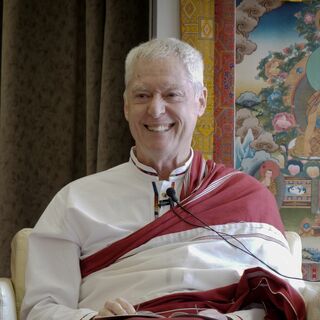
Let's settle the body in its natural state,
Imbued with the three qualities of relaxation,
Mindfulness and vigilance,
Rounding this off by taking three slow,
Deep breaths.
Let's settle the body in its natural state,
Imbued with the three qualities of relaxation,
And then let's settle the body in its natural state.
Then settle your respiration in its natural rhythm,
And let your awareness as before permeate the whole field of tactile sensations while attending especially to those sensations correlated with the in and out breath wherever they arise within the field of the body.
Let your awareness be diffuse,
Contained within the field of tactile sensations.
Let your awareness be diffuse,
Contained within the field of tactile sensations.
So in this first phase of mindfulness of breathing,
The primary emphasis is on allowing the mind and allowing a sense of ease,
Comfort,
Relaxation to arise in the body and the mind.
And we facilitate this especially with relaxing,
With each out breath relaxing excess muscular tension,
Immediately releasing any involuntary thoughts and images that arise in the mind,
Releasing them and immediately letting the awareness descend back into the field of tactile sensations.
Let's settle the body in its natural state,
Imbued with the three qualities of relaxation,
Clear and resilient and.
.
As we shift now to the second phase of this practice,
We continue to relax more and more deeply with each out-breath.
But now,
By somewhat more narrowly focusing the attention on the rise and fall of the abdomen,
We also introduce the element of stabilizing the attention,
Deliberately cultivating a continuity of unwavering mindfulness that does not get caught up in thoughts or carried away to other sense fields,
But maintains an ongoing flow of mindfulness,
Engaged with the ongoing flow of sensations of the rise and fall of the abdomen with each in and out-breath.
.
.
We note the duration of each in and out-breath,
Whether it is short or long,
And continue relaxing with each out-breath,
Thereby overcoming the agitation,
The excitation of the mind.
But with each in-breath,
Arouse your attention,
Thereby overcoming laxity and dullness.
So in this way,
Each full cycle of the respiration is like a complete meditation session in itself,
Designed to overcome excitation and laxity,
Or to cultivate stability and vividness.
.
.
.
As the mind becomes calm,
The attention more and more stabilized,
You may find this enhances the degree of relaxation of looseness in the body and mind,
And at the same time,
The greater the sense of relaxation in body and mind,
The easier it is to stabilize the attention.
There's a synergy between these two qualities.
.
And finally,
Let's introduce now the element of vividness.
For this,
We move into the third phase of this mindfulness of breathing,
By elevating the focus of attention to the apertures of the nostrils,
Or the area just above the upper lip,
Wherever you most distinctly discern the sensations of the breath flowing in and flowing out.
.
You are focusing your mental awareness on these tactile sensations of the breath,
Not your visual awareness.
Keep the muscles of the face soft,
The eyes soft,
The forehead spacious.
See that you're not directing your eyes to the tip of your nose.
We'll just give rise to tension,
Maybe even headaches.
So keep all of the face soft,
Relaxed,
And focus just your mental awareness on the sensations of the in and out flow of the breath at the apertures of the nostrils.
.
.
.
Out of sheer habit,
It's bound to be the case that involuntary thoughts will come tumbling out one after another.
The mind will keep on rambling on.
In order to stem this involuntary flow of thoughts,
Images,
Memories,
You may find it helpful once again to count the breaths,
To break up that involuntary flow of thoughts,
With one count at the end of each inhalation just before the exhalation begins.
Crystallize your attention.
And then mindfully attend to the sensations of the breath throughout the whole course of the out breath.
Even if there's a pause at the end of the out breath,
You may still detect sensations there at the apertures of the nostrils.
Continue attending to them.
And then the sensations of the whole course of the inhalation.
And then a brief count.
So to the best of your ability,
Maintain an ongoing flow of mindfulness.
Engage with the ongoing flow of sensations at the apertures of the nostrils.
In this way,
You exercise and enhance the faculty of mindfulness.
.
.
.
.
.
.
.
.
.
In the practice of shamatha we not only enhance,
Develop the faculty of mindfulness,
But also introspection,
Which is our ability to monitor the state of the mind,
To monitor the meditative process so that we quickly discern or recognize when the mind has been caught up in thoughts and carried away,
Or when the mind is simply slipping into dullness,
Laxity,
Perhaps on the way to falling asleep.
As soon as you recognize with your faculty of introspection that your attention has become agitated,
Carried away,
Caught up in thoughts,
That your first response be to relax deeply,
Release the thought,
And immediately re-engage with the sensations of the breath.
As you all relax,
Loosen up.
And as soon as you recognize with your faculty of introspection that your mind is losing its clarity,
Falling into laxity or dullness,
That your first response be to arouse your attention and take a fresh interest in training the mind,
Refocus on the sensations of the breath.
In this way,
Balance your attention,
Overcoming the proclivities,
Retention deficit,
As in dullness,
And attention hyperactivity,
As in agitation or excitation.
Let's continue practicing now in silence.
.
.
.
.
.
.
.
.
.
.
.
.
.
.
.
.
.