Wilderness Contemplative Prayer is a Christian mystical practice that uses nature imagery to help us move into the depths of our being where we rest in God,
Who dwells at our deepest core,
With a gaze that magnetizes us as though we were an iron filing drawing us into deeper union in love.
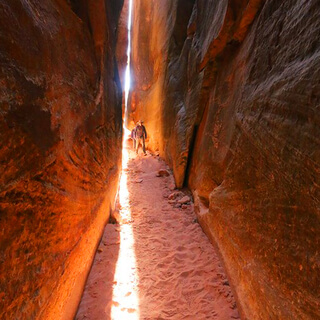
In previous sessions I used imagery of a canyon and of an old growth forest.
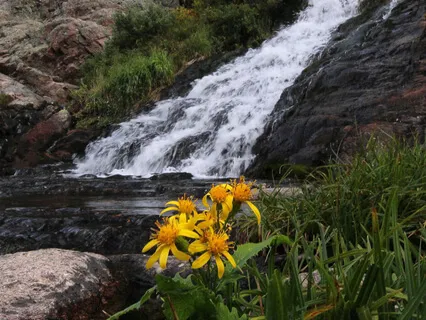
In the present session I'd like to use imagery of a trout resting in a deep and still pool at the bottom of a turbulent rocky mountain stream with white water and cascades.
Early on in the Judeo-Christian tradition there was a verse in the Psalms that goes like this.
Abyss calls unto abyss.
In the roar of your waterfalls all your breakers have rolled over me.
This was the beginning of a long history of viewing the soul,
The core of our being,
As a kind of abyss where the uppermost layers involve our neuroses and our defense mechanisms.
Below that is our personality,
Our uniqueness,
And at the very core lies the presence of God,
Our true self united to God who is this kind of magnet drawing us like an iron filing into deeper union in the loving gaze of that great beyond.
In this verse it says abyss calls unto abyss so that the infinite abyss of God lying at our core calls to the more superficial layers of our personality,
Calling us into deeper union with that abyss.
The verse also says that there is the roar of God's waterfalls.
These would be our thoughts above the shallow layers of our being.
They might be turbulent,
They might be quite emotional.
The point here from a contemplative perspective is that even when our thoughts might seem disoriented,
Even when they are afflicted,
Even when they are untransformed,
At the root lies something that comes from God.
We might think that our thoughts are like echoes of a divine love word of God,
A word that never had a chance to be spoken because the divine presence lost itself in bliss before the word could ever be spoken.
Nevertheless,
Our thoughts echo with this never spoken divine love word.
Thus,
Even when our thoughts are twisted and unintegrated,
There's a desire for love and happiness at their root,
Which is an echo of that divine love word.
The verse also says that all your breakers have rolled over me.
This is our thoughts,
Which have a kind of flow to them and are often turbulent,
But from the perspective of contemplative prayer,
We dwell in a deep layer of our being,
And our thoughts roll over us.
We're not on the same level as they are.
Hence,
In contemplative prayer,
There's a sense that there are two levels of awareness.
One is the bulk of our attention is moving into the presence of God,
Who serves as a magnet at the core of our being,
Drawing us into rest.
And second,
There is the level of our being up above that is viewed from the side or peripherally where our thoughts,
That is the waterfalls and the breakers,
All occur.
It's pretty interesting because there's a long and storied history of this use of the abyss in the Christian mystical tradition.
For example,
Madame Guillaume in the 17th century talked about an ocean that we descend into into deeper and deeper levels of union with God.
Thomas Keating talked about our awareness being like the calm water in a harbor,
And our thoughts are like the boats that are resting on it above that.
And often we can't see the harbor.
It's as though we could step from boat to boat because our thoughts are so crowded together.
In contemplative prayer,
We allow the boats to space out so that the water is able to emerge from under that.
Thomas Merton as well talked about entering into his innermost depths,
Which were like a watery ocean.
John Muir as well spoke of the ocean of God's presence that has unlimited depths.
I'd like to use the imagery of a Rocky Mountain stream because it applies so well to this verse from the Psalms that speaks of the abyss that calls to the abyss.
So let us imagine ourselves as a trout in a Rocky Mountain stream.
This is a whitewater stream with lots of cascades on top,
A place loved by fishermen and by kayakers.
However,
There's a depth to the stream,
And there's a pool beneath that is very still and quiet.
Picture that you're a trout.
If you want to survive in this stream,
You're not going to want to stay up on the surface where the breakers are rolling and where there's white water.
In terms of thoughts,
You don't want to stay up on the surface and beat yourself against the thoughts,
Trying to get rid of them,
Trying to jostle with them,
Trying to answer them.
You'll simply get beat up in the process.
What do you do instead?
You sink into the depths of that pool like that trout.
You find that calm and that rest as you move deeply into the pool.
The breakers and the waterfalls and the cascades,
Of course,
Are still there,
But they're up on the surface.
So it's like you have two levels of attention.
One moves into the depths,
And you are magnetized by the depths of that pool,
Which in the case of the soul is endlessly deep,
Having God at its core.
From the side,
Though,
In your peripheral vision,
You experience the sound of those waterfalls and cascades up above you.
However,
You are not on the same level as they are.
You are inhabiting a deeper level.
So you are enjoying that calm and deep stillness of that pool as a trout.
But what happens?
Well,
A hook comes down into that deep pool with a tasty bait on it.
For somebody's up on the surface fishing.
In terms of contemplative prayer,
This bait might be an emotionally turbulent thought,
Some kind of self-castigating thought,
Some sort of thought of,
Why did I do that to that person?
Why did I say that?
How stupid I was.
Or anger at another person.
Why did they say that to me?
Don't they respect me?
Or perhaps a fear for the future,
Or a regret for the past.
In any case,
Instead of resting in the pool,
What happens is we bite on that hook.
And whoever's up on the surface yanks us up out of the deep waters.
And so we come out of them,
And we're up on the surface jostling and gasping for air.
Fortunately,
Though,
In the context of wilderness contemplative prayer,
The hook has no barb on it.
So as soon as we realize that we have been hooked,
And that we are ascending up out of the depths into the area of the cascades,
We simply remember the depths,
We let go of the hook,
And we descend back into the depths.
In order to facilitate this,
We use a sacred word.
It could be descend,
Or depths,
Or love,
Or God,
Or abyss,
Or peace,
Or love,
Or whatever word suggests itself to you.
So when we are lured into biting onto that hook,
That tasty thought,
And we realize we are being yanked up out of the depths,
We simply allow that word to say itself,
Let go of the hook,
And descend back into the depths.
We don't need to keep on repeating the word like a mantra,
But simply allow ourselves to have the word appear,
And then let go of the thought,
And rest back in the depths.
Sometimes a memory of the depths and of the loving gaze of God that is luring us from those depths like a magnet is enough simply to let go of the thought.
But in any case,
We descend back into those depths.
The interesting thing is that we never get rid of thoughts in this prayer.
They still keep on chattering,
Like the roar of the waterfalls,
Like the breakers rolling over us on a superficial level.
The interesting thing is that these thoughts,
Even though we don't identify with them,
They serve a purpose.
In their movement,
In their roar,
They actually give us an awareness,
By contrast,
Of the depths and the stillness and the quietude into which we are sinking.
And so,
As the thoughts go chattering on above us,
They give us a sense of the depths.
So they serve a function as long as we let them go and see them as though from the side,
Hear them from the side while we sink into the depths.
If you want to put this prayer in Trinitarian terms,
You could say this,
The absolute depths,
The abyss of your being,
The still pool,
Which actually is endless and infinitely deep,
Is the presence of the Father,
The source of our being,
The great beyond,
The great mystery.
The uppermost parts of that pool are the sun,
That is,
The perceivable part of the abyss.
But also a part of the sun are the waterfalls and the breakers above.
They are the word or the echo of the never-spoken word of God.
They seem turbulent when they are untransformed,
But at their root each of these breakers is still an expression of the water,
The stillness of the pool.
But the desire for love and the desire for happiness is at the root of each thought,
And each of these is actually a kind of mirror in which we are able to see the depths of the pool.
So they too are the sun.
In the middle between these two,
Between this absolute abyss and the relative abyss above us and the thoughts that are roaring in the waterfalls,
We dwell in this place in between in the Holy Spirit,
Aware of both at the same time.
On the one hand we are sinking into the Father.
On the other hand we are aware of the thoughts of the sun that are serving as a kind of mirror or echo of the never-spoken love word that arises from the depths.
So we have this fascinating situation in which we are immersed in the inner Trinity.
If you want to add a Sophianic dimension,
You realize that the flow up on the surface is a participation in Sophia,
The sacred feminine.
In fact,
If you didn't have that sense of flow,
You could never be aware of the stillness of the depths.
In other practices,
I'll be sharing ways to get in touch with that Sophianic dimension with union with the sacred feminine.
But in this particular practice of Wilderness Contemplative Prayer,
We are fostering our awareness of deep union with the presence who lies at the deep center of our beings in that still pool.
And so,
In this practice,
We bring up this image of the Rocky Mountain stream and of ourselves as a trout,
Sinking into the depths,
And of our thoughts as flowing above us.
Every time we feel hooked on a particular tasty thought,
We bring up a sacred word which enables us to let go of that hook and drop again into the depths.
And we simply enjoy the fact that we are dwelling in the depths and that our chattering thoughts,
Like those cascades,
Are actually giving us an awareness of the deep stillness.
In the Holy Spirit,
We are aware of the chattering of the thoughts,
That is,
Participation in the sun above us,
And we are aware of the stillness of the Father deep within us.
And so,
I will ring the bell three times,
And you can time yourself for 20 minutes,
Allowing yourself to rest deeply in the presence of God while your thoughts flow overhead,
Like the roaring cascades in beautiful white water.