So the practice that we are doing here is called shamatha,
Which means the development of peace.
And since we all want to have a peaceful life,
One that's not filled with conflict and struggle,
Then it would be helpful for us to have a practice that we can use to learn how to settle our minds,
So that into a sense of,
Basic sense of peace.
And this is not something that we are trying to get from somewhere else,
But actually this peace is,
We are by nature peaceful.
And we are by nature,
We have clear mind and we are full of love and compassion.
This is who we are as a human being.
But not always do we feel like human beings.
A lot of times we find ourselves in the workplace or in family situations where we have a lot of conflict.
And we don't always know how to work with our state of mind in these situations.
And the practice of meditation is coming to see how everything originates from our own mind,
From our own existence.
We are in effect the creators of our world.
And if that's so,
If that's really true,
Then how can we fully take command or how can we control our life?
And take full kind of responsibility for our happiness and the happiness of others.
So this is the practice of meditation.
Meditation practice is coming back to ourselves.
And if you think that you are going to get something from somewhere else,
Or if you think that if I just do hundreds of hours of meditation practice I'm going to be okay,
No,
It's not going to happen like that.
We actually have to learn how to make ourselves available to ourselves.
We have to learn how to look at our own mind,
Our own experience.
And this is something that a little bit goes against the grain.
That we are always,
We have learned from birth to look for our happiness outside of ourselves,
Haven't we?
First from mummy and daddy,
And then from our friends,
And now from Zara,
And the Mac store.
And we are completely surrounded in our human realm by advertisements for things that we are supposed to need.
And so there is a very strong message from the world that we live in,
Is that happiness is found out there and we have to acquire it.
So practice of meditation is going against that mistaken belief about reality.
And it's saying that inside of you,
You have everything that you need.
You could simply relax,
You could go into a retreat in the forest,
And you could sit down and feel completely contented that you have everything you need,
Just by being with yourselves.
Each one of us has a tremendous richness,
And we just have to experience it.
We have to see that in our experience there is a constant bubbling up,
A constant welling up of experience,
Which is coming not from outside,
But it's coming from us.
And that experience is by nature clear,
It's by nature peaceful and blissful,
If we know how to look at it.
So the good news is that we have everything that we need,
And the bad news is that we have to do it ourselves.
And we don't like to hear that.
We like to think that if we are good boys and good girls,
That everything is going to be alright.
Right?
Right.
If we do all the right things,
And say all the right things,
And perform at our peak,
That everything is going to work out.
No.
We're all going to die.
Every one of us is going to die.
And so that's the reality,
Right?
So actually we should learn how to live our life fully,
And that means learning how to die fully.
And in the practice of meditation we are learning how to let go.
To get right to the point,
We have an out-breath,
And we follow the out-breath until it dissolves in space,
And then we let go.
And then we are in space,
In the space.
And then what?
Nothing.
We are just there with ourselves.
Each time we go out with a breath,
We are practicing,
It's a small death.
That is a small death.
And that death doesn't mean nothingness,
That we just become nothing,
But actually it means that we become ourselves.
And so in this practice of meditation we are exploring that whole vast territory of what it means to be ourselves.
We haven't done it yet.
We haven't done it yet.
And we begin to do it when we learn how to let go.
We learn how to let go,
Which is the opposite of expecting that we are going to get something.
Got it?
I know it's a very strong,
Uncompromising message.
It's completely unreasonable.
But when we begin to have a personal experience of the practice of meditation,
We go,
Aha,
That's it.
And maybe we begin to discover that we have a kind of yearning or an instinct to let go of this me that wants.
Whenever you have a me,
It also wants something.
So that me can be happy.
So we're learning how to let go of that me.
So let's just do it now.
In our particular practice lineage,
Which comes from the Tibetan Buddhist tradition,
We don't spend a lot of time philosophizing or psychologizing.
We jump right into the practice.
And then we have a discussion based on that,
A discussion based on real experience.
So we should do that now.
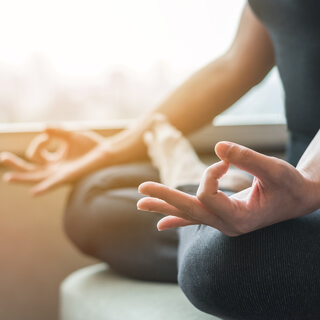
So the first point is to establish a good posture,
The posture of a Buddha.
And we cross our legs in front of us loosely,
In whatever way is comfortable for you.
And best if your knees are not higher than your hips.
And if they're in the same level,
It's probably OK.
And if you press down on your thighs and make your arms straight,
Make your back very straight,
Then slowly release and place your hands on your thighs and leave your back straight.
And your head is upright as if a string is coming out of the top of your head and lifting you up.
And I like to call this posture tiramisu,
Which means lift me up.
So it's very uplifted.
You know how when you have a tiramisu,
Even if the meal is very bad,
The tiramisu is usually very good.
And you feel kind of good,
You know?
So lift me up.
So the same with the practice of this good posture.
It's upright and helps us to naturally feel good.
And our gaze is directed downward with our eyes open.
About one and a half or two meters in front of us.
And your mouth is slightly open as if to say,
Ah.
And your tongue is pressing on the palate or resting in the middle of the mouth.
And we begin,
Before we actually start the practice,
We just feel our bodies as we're sitting on the ground.
Feel the weight of the body.
Notice the space around you.
And noticing also that we have sense perceptions that are functioning.
Our eyes that see and ears that hear.
A body that feels all kinds of sensations and so forth.
And we also have a mind which is,
Has different kinds of feelings.
We might be happy or sad or agitated or excited,
Whatever.
Curious.
So just noticing whatever state of mind you have,
Noticing that.
And then we begin to work with our breath.
So here's the main part of the practice.
Notice that you're breathing and the breath is coming through the mouth,
The nose.
It doesn't matter.
And as you breathe out,
You place your attention on the out-breath.
So as you breathe out,
You feel the breath going out.
Place a light touch of awareness on the out-breath.
You can say,
Identify with the breath.
Feel the breath.
Become one with the breath going out.
Each time coming back to the out-breath.
The idea here is we're not trying to concentrate on the breath.
We're really trying to identify with it,
Feel it.
You and the breath are not two.
You breathe in,
The breath comes in automatically.
No need to focus on the in-breath.
And then again on the out-breath,
Place a light touch of awareness on the out-breath.
The breath dissolves and you let go.
Just be.
Let's do this for a couple of minutes.
Let's do this for a couple of minutes.
Let's do this for a couple of minutes.
Now the third aspect of our practice,
Of our sitting practice,
Is knowing how to work with our mind when we're distracted.
Let's say we are following the breath,
But then all of a sudden we are gone.
And we are thinking about something,
Fantasizing,
Caught up in emotion.
And at some point we remember that we are here.
We go,
Oh,
My breath,
I forgot.
And at that point you can mentally say to yourself,
Thinking,
And simply go back into the breath.
So that act of mentally saying,
Thinking,
Is a way of making a cut.
From the mind that was distracted back to the focused mind.
And also when you say thinking,
That applies to whatever kind of experience you have.
Good thoughts or bad thoughts,
Extremely aggressive thoughts,
Pornographic thoughts,
Anything,
Doesn't matter.
It's all just thinking.
If you hear somebody coughing,
It's just a thought.
Label it thinking.
So also sounds and sights are just considered to be thinking.
So once again,
When you realize that you're thinking,
You say,
When you realize you've been distracted,
That you're not here,
That moment you're already back.
It happens automatically.
Then you say thinking and you go back into the breath.
Let's do that for about five minutes.
Keep coming back to the breath.
Placing just a light touch of awareness on the out-breath.
Placing the light touch of awareness on the out-breath.
.
.
.
.
.
.
.
.
.
.
.
.
.
.
.
.
.
.
.
.
.
.
.
.
.
.
.
.
.
.
.
.
.
.
.
.
.
.
.
.
.
.
.
.
.
.
.
.
.
.
.
.
.
.
.
.
.
.
.
.
.
.
.
.
.
.
.
.
.
.
.
.
.
.
.
.
.
.
.
.
.
.
.
.
.
.
.
.
.
.
.
.
.
.
.
.
.
.
.
.
.
.
.
.
.
.
.
.
.
.
.
.
.
.
.
.
.
.
.
.
.
.
.
.
.
.
.
.
.
.
.
.
.
.
.
.
.
.
.
.
.
.
.
.
.
.
.
.
.
.
.
.
.
.
.
.
.
.
.
.
.
.
.
Coming back to the breath.
.
.
.
.
.
.
.
.
.
.
.
.
.
.
.
.
.
.
.
.
.
.
.
.
.
.
.
.
.
.
.
.
.
.
.
.
.
.
.
.
.
.
.
.
.
.
.
.
.
.
.
.
As you work with your breath.
You will find that we're trying to place just the right amount of concentration,
Let's say.
We're trying to stay with the out breath.
But not be too strong in our focus.
Not too rigid.
We each have our own style of how we approach our breath.
Sometimes we might be too strongly focused on the out breath.
We say,
Oh,
I've got to stay with the breath.
The result of that is that our mind will eventually escape.
It will rebel.
We're sort of working with the breath but it's kind of distant.
Maybe too relaxed about our concentration.
Then nothing happens.
We're just kind of hanging out.
The breath might be far away or whatever.
We're constantly working with a sense of getting the tension of our practice just right.
As if you had a musical instrument and you were tuning the strings.
They're not too tight and not too loose.
That's how we work with our practice.
Then at the beginning,
You might find that your mind is very much too tight or very much too loose.
Then as you go along,
It becomes more subtle.
We begin to have a much more refined sense of just the right tension on the out breath.
You can remember that.
What is the result of this practice?
What is the benefit?
We can talk about benefit even though we're not trying to get anything out of it.
The benefit is that we have the occasion to make friends with ourselves.
We can become our own best friend.
Which is to say that we begin to relax our struggle with ourselves and with the world.
For example,
Sometimes we might be critical of ourselves from morning to evening.
We might be very hard on ourselves.
Here we're learning how to just be.
To let that whole sense of struggle,
Competition,
Letting that go,
We can just be.
I think it's very difficult for us to learn this,
To be friends with ourselves.
You could actually sit down in an empty room and just enjoy being there forever.
Let's say it's difficult to learn that.
But if we can just for one moment let go and feel our breath,
In that moment we let go of our struggle.
The struggle is going on all the time.
Subconscious gossip.
Mind is running constantly.
But if we can let go a little bit and just feel the breath,
Identify with the breath.
In that moment we actually feel a sense of our mind settling into itself,
Relaxing.
That's a very important moment for us.
It may only last a very brief time,
But in that moment we recognize something about ourselves.
This practice is very available and accessible to you right now.
It's just up to you.
Let's say you decide to do a 10 minute session in the morning of practice.
I recommend this every day.
Just having the intention,
I'm just going to work with the breath.
Then in one moment you feel the breath and you go,
Ah-ha,
That's it.
There's a sense of relaxation,
Of a shift in our attitude towards ourselves.
We feel a sense of softness.
A sense of comfort with ourselves.
It's very important for us to have that moment.
It won't last,
Not at the beginning,
But then gradually slowly we become used to the moments.
Then we have more and more moments.
Then working with a subtle tension,
Not too tight,
Not too loose on the breath.
Then slowly we become more familiar with that state of mind just based on a simple peace.
That's it.
Then our path of awake,
Of developing peace begins at that point.
Then what happens is that we begin to change fundamentally.
It doesn't mean that our life is going to become easy.
No,
It won't.
But we are beginning to shift our relationship to our life.
We're beginning to approach it not from the point of view of struggle and trying to always get the next cookie,
But actually it's based on seeing clearly every situation.
That clarity is the beginning of non-referential compassion.
At that point we're beginning to not center so much on ourselves and we're beginning to radiate out to others.
That's a very fast tour of the whole thing.
First we start with just feeling the breath,
Sense of peace.
Out of that comes clarity and then out of that clarity we begin to radiate out compassion to others,
To our world.
That's our path.
As the Buddha taught,
Happiness comes from love to others and misery and suffering comes from concern only for ourselves.
It's fine to say that,
But how do you do it?
How do we actually learn to live that way?
Practice of meditation is the path.
Therefore we should do five more minutes.
Again,
One more time,
Taking good posture.
You can do this many times in a day.
We're very busy,
Most of us,
And so we need to do short meditation sessions,
Mixing them with our daily life.
Five minutes here,
Ten minutes there.
Good posture.
Straight back.
Having the intention just going to come back to my breath.
That's all I need to do.
I'm just going to do when thoughts arise,
Label them thinking,
Come back to the breath.
Good.
Good.
Good.
Good.
Good.
Good.
Good.
Good.
Good.
Good.
Maybe we have five minutes for questions.
What questions do you have?
Are you supposed to breathe through the mouth or through the nose?
You can breathe through the mouth or the nose.
It doesn't matter in this practice.
Part of the breath could also be your feeling the rise of your core.
There's a lot of movement happening with the breath.
It's also that as well.
As well as feeling the quality of the breath as it goes out the mouth or the nose.
Next question.
You said that you had to find the right amount of concentration.
Not too tight or too loose.
You know because you're trying to follow the instructions.
The instructions say be with the breath as much as you can.
There is a basic intelligence operating in the background.
A watcher of the whole situation.
Who's checking it out and seeing how's it going.
That is your basic intelligence.
That which knows what's going on.
There's something that knows I'm following the breath.
There's something that knows I'm distracted.
That's your basic sharpness.
Try it.
I recommend trying to do 5 or 10 minutes in the morning.
Make a relationship a connection to sitting practice.
Be curious about that.
That open space after your breath has gone out.
What then?
You can set up a nice comfortable place at home.
Maybe get a cushion.
Meditation cushion.
Set up a flower arrangement.
Maybe a stick of incense.
A place that's going to remind you of sitting practice.
So that when you walk by there's something that is saying okay hello.
I could sit.
Because our tendency is to put it off.
To be too busy.
Good.
Thank you very much.
See you hopefully next week.
Same time.
Thank you.