Find a comfortable seat.
Place away from distractions.
Do a short body scan.
Sometimes what happens is we become aware of maybe some imbalance,
Some tension.
Just be aware of any tension in your feet,
The arches of your feet.
Then move up to your calves and your knees and just notice if there's any aching.
Sometimes it helps to just kind of wiggle a little bit.
And then your thighs.
Lots of times we hold tension in our hamstrings.
So get a little wiggle there.
And then in your hips,
Sometimes you just kind of move the hips a little bit.
Shift the weight back and forth.
And then find,
Locate possibly any tension in your lower back and do a few twists.
And then take a deep breath and see if you feel any tension in the front of your chest,
Or even in the back,
Your thoracic spine.
You exhale and let that out.
And notice tension in your shoulders.
Just allow them to kind of move around a little bit to a couple of shoulder shrugs,
Shoulder shrugs.
And then let them drop.
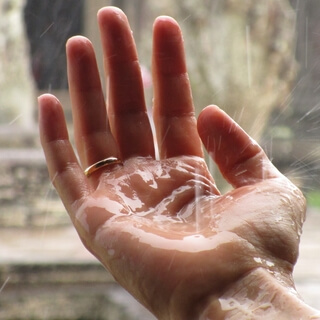
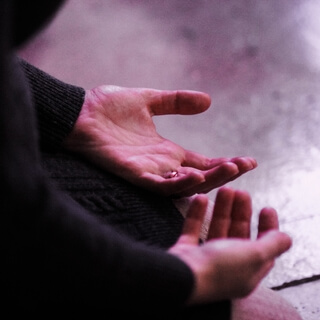
Then your hands.
So between your thumb and your pinky,
See if you can expand the distance between your fingers and then relax and let them go.
And then do some neck rolls.
Notice any crackling there.
And then we'll drop the tension in our jaw.
And the way that we do this is we take the tip of our tongue and like a butterfly landing on a flower,
Allow it to rest in the space just above or just behind your two front teeth.
There's a soft place there.
Just gently rest there.
For the rest of the practice,
Your mouth is closed and your teeth are somewhat parted.
This mantra meditation is so hum,
Which means I am that.
So it can be practiced anytime,
Anytime you need a moment.
And this is more of a yin practice,
So calming.
And at this point,
We don't want to focus on any particular part of the body.
But if one calls out to you,
If you're aware of the chakras,
Don't excuse it.
Get it out of your mind.
Just take note of it.
So the so hum meditation is as you inhale,
You are singing to yourself so.
So the entire length of the inhale,
You're singing so.
And then during the exhale,
You sing hum.
So this mantra,
With any mantra serves like a line in the road.
It guides you through your meditation practice.
And anytime you veer off,
You find the mantra so hum.
So you're not as much paying attention to the length of the breath,
But the so and the hum ride it.
So the inhale is as long as it needs to be,
But the soul rides it.
And the exhale falls and the hum takes a ride.
So it's energy through your fingers.
Showcased.
And then if you notice that if a particular part of your body begins to have a sensation,
You can welcome the so hum into that part of the body.
For myself,
I felt this morning the hunger,
Thirst for the so hum in the center of my chest,
The heart chakra.
So I didn't question.
I didn't say why is this part speaking to me.
I just breathed through it.
So the mantra speaks for you.
It encapsulates any desires that don't need to be spoken or thought.
It all echoes in the mantra.
So hum.
And then.
.
.
You can let go of the mantra and.
.
.
And then open your eyes.
And then do a brief body scan now.
See if anything's changed.
Does anything feel lighter?
Does anything feel softer?
So this simple mantra can be practiced at any time,
Any place.
It's important for us to not reach for a distraction during a moment of pause.
Instead,
We can pause and say,
So hum.
And just ride out that pause until the next episode arrives in our life.
Take care of yourself.
Namaste.