You can only have the meditation that you're having.
This statement is a lifesaver,
Because what it does is it enables you to detach and to step back from your meditation practice.
For you to see that no matter how you're feeling during the session,
No matter how turbulent your mind,
No matter how much you've lost focus,
No matter how many times you needed to return your focus back to the breath,
It's okay.
You can only have the meditation that you're having.
The reality is that mindfulness itself is the act of returning our focus back to the present state,
Back to the meditation object,
Observing reality for as it is for what it is.
Now,
There's this sort of perception or this belief or this desire that we should relieve every meditation session feeling amazing,
That we should feel just awakened and insightful and refreshed.
But for mindfulness meditation,
That's not the goal.
The goal isn't to quote unquote,
Feel good.
It's not really to sort of change your mental state at all,
Or at least not in that session.
Our goal is to simply observe reality as it is for what it is.
It's to see what's happening in consciousness without judgment,
Without trying to change it,
Without trying to alter it,
To simply just stay and look at it.
But unfortunately what can happen,
Particularly for beginning meditators,
Is that they will get frustrated.
They will find themselves having a bad meditation session and either think they're failing or sort of start to sort of strive and push and hope for a certain feeling at the end of their session or during their session.
But this is the opposite of mindfulness.
This isn't what we should be trying to do.
We simply should just be trying to sit,
To just watch,
To observe,
To let what happens,
Happens.
If it's good,
Let it be good.
If it's bad,
Let it be bad.
Our goal is to just observe what is happening without judgment,
Without filter in the present moment.
But if this is the case,
Well,
Why are we practicing in the first place?
Shouldn't our goal be to change ourselves?
I mean,
Like it's a rare person who will do a practice or do something without any hope of gain,
Without any hope of a positive impact.
We exercise to get stronger or fitter.
We study to get smarter.
We invest our money to earn a return.
So similarly,
It feels like we should meditate to get something back,
Namely an improvement in our mental state.
And herein lies a bit of a contradiction.
At least initially for the beginning meditator,
By all means,
Meditate with the goal of self-improvement,
But not necessarily in that first session or in an individual session.
Because for example,
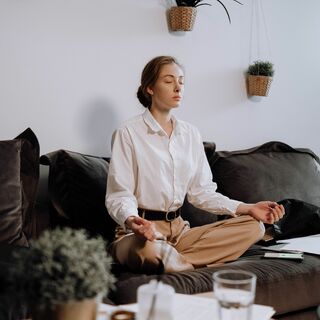
You could look at two people sitting with their eyes closed.
One person could be meditating and the other person could be lost in a daydream.
And you wouldn't be able to tell the difference from the external perspective,
But you might see that the person that's daydreaming,
They might come out of that meditation session refreshed and rejuvenated and ready to go.
And the meditator might've had a tough session and might come out a little bit frustrated or a little bit confused or a little bit even drained.
And you might be able to conclude from that that the person's meditating incorrectly or that meditation isn't working.
But I feel that that's a little bit of a short-sighted approach.
I prefer to,
Particularly for beginning meditators,
To take a bit of a longer-term approach.
Is meditation improving you over the long-term?
Are you more functional?
Are your relationships improving?
Are you more calm,
Less angry?
All of those sorts of things.
Is it producing a upward trend in your life?
Because once you find that it is helping,
You won't need that sort of external motivation stimulation to keep going.
You'll simply sit down and practice.
But that leads us on to this contradiction that our desire to improve,
Our desire to feel better,
Our craving for a particular state,
Like if we go into that idea or that concept of enlightenment itself,
If we're practicing to get enlightenment,
The traditional texts and the gurus suggest that you're less likely to attain it because you are indeed striving.
There's an analogy here that I like to employ that goes along the lines of,
If you find yourself with a thorn,
Like a splinter stuck into your thumb,
The only way to really get it out is to use another thorn or a splinter to dig it out.
But now you've got two thorns in your hand.
So what do you do?
You chuck them away,
Let them go.
And the same idea can be applied to our practice.
We start practicing to get rid of mire,
To remove delusion,
To start seeing reality as it is for what it is.
But once we've attained that state,
Once we're grounded in the present moment in reality,
Once we're mindful,
We may no longer need the practice.
We just simply are.
Now we will continue to meditate,
We will continue to sit,
But that act of sitting is just sitting.
When we sit,
We sit.
When we eat,
We eat.
When we move,
We move.
We are in the present moment.
We are here now.
So from a long-term perspective,
From a deeper practice perspective,
We should approach our mindfulness meditation practice as just something that we do each day.
We get up,
We get ourselves ready,
And we sit.
Without expectation,
Without an assumption,
Without hopes to attain some specific state.
Because really,
The likelihood that an enlightened state is anything other than complete and total immersement in the present moment seems folly.
It seems like the more we let go of assumptions,
Let go of those thought patterns,
Let go of the grasping and the striving and the attempts to attain anything,
We will end up being grounded in reality in the present moment as it is for what it is.
So with that in mind,
Simply sit.
Happy meditating.