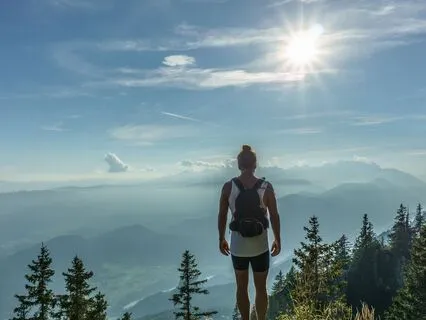
Standing Meditation In life,
You find yourself in four main positions.
Standing,
Sitting,
Lying down or walking.
As such,
This first meditation is part of a series of four meditations.
Its purpose is to help you have good posture,
Which in turn helps with making sure your body is aligned,
Makes it easier to deal with stress,
To breathe deeper and to remain composed and at peace throughout the day.
The first step in the standing meditation is,
Of course,
To stand up.
Make sure your feet are shoulder-width apart and that your toes are pointing forward.
Put your weight at the front of your feet so that they remain active and engaged,
But not too much.
Stay relaxed as well.
Make sure that your weight is balanced equally on the left and the right foot.
And once you're sure that that's the case,
We can move up to the knees.
The knees should be slightly bent,
Directly above your feet.
If having your toes pointing forward is a bit uncomfortable on your knees,
Then you can spread your toes a little bit or turn them slightly at an angle to each side.
The ultimate purpose of this meditation is that there is no more tension left in your body.
So make sure that this is the case already here with your knees,
That the energy between feet and knees is moving without tension and be as relaxed as possible.
Now we move up to the hips.
Move your hips forward so that there is no tension in the lower back.
And so that the spine extends.
Now if tension appears in the belly area instead,
Then drop the lower back backwards again a little bit.
You can move your hips to the left,
To the right,
To the front and the back a little bit just to experience imbalance.
And by experiencing imbalance,
You will know where the balance is.
Once you have found the center,
Check again that the energy is flowing through your legs without tension,
That your lower back is relaxed,
That no tension is building in any part of your lower body.
Begin breathing deeper in the lower belly as we move upwards now to the shoulders,
Making sure that the spine is extended upward.
Move your shoulders back.
You can overdo this again just to find the center.
If your weight starts being on your heels instead of your toes,
Then you know you've gone too far back with the shoulders and the whole spine.
If you have a mirror nearby,
You can check your posture from the side in the mirror.
The shoulders should be in a neutral position,
Not too far back,
Not too far forward.
Arms relaxed by your side.
Keep breathing deeply until you find the natural position in which there is no tension anywhere in the body,
And the energy is flowing downwards from the shoulders all the way to the legs without tension building up anywhere.
And now we've reached the last part,
The head.
Make sure you tuck your chin back a little bit.
So as to extend the spine upward.
Sometimes it is helpful to imagine a piece of string pulling your head upward,
Making sure that the spine is aligned all the way down to the lower back.
That's it.
That's the complete standing position.
Continue to breathe deeply.
Let your breath go to any area of tension.
And let that tension relax downwards.
Through your legs into the floor.
Remain in this position for as long as feels comfortable.
Aiming to relax deeper and deeper here,
Letting the energy flow.
As you go about your day,
You can maintain this idea of letting the energy flow down to wherever there is a surface underneath you.
Whether it is a floor,
A chair,
A bed.
Let gravity help you relax.
Find ways to also practice this position throughout your day.
Whether it is while waiting for a bus,
In a queue in a supermarket,
Having a standing desk as you work,
Or in other ways.
Thank you for listening.
I hope you have found this practice helpful.
Here I have explained the basic principles and foundations which will also apply to the other three positions.
I wish you a day of presence,
Peace,
And I hope to be with you again soon.