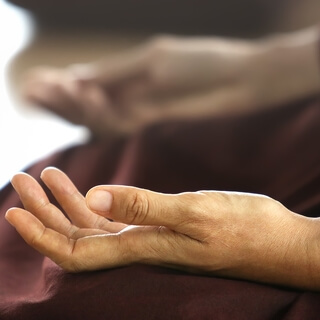
Begin by finding a comfortable seated or laying position,
Such as Sukhasana or Shavasana.
Whether your body is sitting or laying,
Ensure that the spine is kept as straight as possible and that there is sufficient space between your shoulders and your ears.
See if you can pull the shoulder blades down the back slightly so that the shoulders are not collapsing in toward the chest,
Giving yourself as much space in the chest as you can to allow for full deep breaths.
Once you are comfortable,
You can begin to arrive in the body by bringing your awareness to your natural breath.
Without changing it,
Simply witness your natural breath,
Allowing your mind to release all else and simply be present with the inflow and outflow of your breath,
Not forming any thoughts or judgments about your natural breath,
Just allowing it to be as it is and taking notice of where in your body you can feel it.
Bringing your awareness to the nostrils,
Feeling the breath rush through them,
Feeling the breath passing through the back of the throat,
Filling the lungs,
And then feeling the breath as it leaves the body,
Feeling the deflation of the chest,
Feeling the breath against the nostrils as it rushes out.
And now you can begin to lengthen and deepen the breath,
Bringing your awareness to the diaphragm,
That muscle that occupies the inches above your navel,
And using its strength to pull the breath down into the body,
Witnessing as it fills the belly,
The chest,
All the way up to the collarbones,
And then releasing it from the collarbones,
From the chest,
From the belly,
Feeling the entire body relax.
You may have heard the term breathe into your belly before,
But see if you can imagine yourself breathing from your belly,
Imagining your diaphragm as the mouth that inhales the breath,
Pulling it down your throat,
Through your lungs,
And into its opening at your navel,
Taking a brief moment to feel the body inflated with air,
And then allow the imaginary mouth in your belly to release the breath,
Releasing it from the belly,
Releasing it from the chest,
Releasing it from the collarbones,
Feeling the entirety of the lungs deflate completely before inhaling again,
Feeling the breath slowly fill the entire cavity of the chest,
Feeling the belly expand in response to the fullness of your lungs,
Taking a pause at the top of the inhale to truly feel the breath occupying the body before letting it go,
Retrace the passage through which it came in.
See now if you can lengthen your inhale and exhale a bit longer,
Aiming for six to seven counts of in-breath and out-breath,
Seeing if you can find at least one count of pause in between.
Inhaling for one,
Two,
Three,
Four,
Five,
Six,
Seven,
Pausing for one and exhaling for one,
Two,
Three,
Four,
Five,
Six,
Seven,
One,
Two,
Three,
Four,
Five,
Six,
Seven,
One,
One,
Two,
Three,
Four,
Five,
Six,
Seven,
One,
One,
Two,
Three,
Four,
Five,
Six,
Seven,
One,
One,
Two,
Three,
Four,
Five,
Six,
Seven.
Continue this lengthening of the breath as you begin to explore the sensation on your own.
How does the inhale move your body?
What parts of your body move when you allow it to fill with air?
How do they move?
What is the nature of their movement?
What expands?
What shifts?
What changes in shape?
Where exactly in your body do you feel the effects of the inhale?
And similarly,
Where do you feel the effects of the exhale?
Where does the body contract and deflate?
How does it contract?
Where in your body do you become loose and soft?
What are the sensations connected to these movements?
How do you experience the sensation of the exhale in your body?
And now begin to explore the effects of the breath on the mind.
What feelings rush to your mind on the inhale and on the exhale?
What emotions do you experience with each in-breath and each out-breath?
What mental state accompanies the inhale?
What mental state accompanies the exhale?
How does the breath affect your thoughts,
The quality,
The speed,
And the frequency of your thoughts?
Do you have any thoughts or is there this brief window where there is nothing but pure existence,
Pure experience of your breath?
Take a moment to truly explore how your mind experiences the breath.
Let's take a moment to explore how your mind experiences the breath.
If you feel the interest in physically moving with the breath and exploring that experience,
Allow yourself to do so.
And if you feel the inclination to remain still with the breath,
Allow yourself to do so.
And when you are ready,
You can begin to release the focus from your breath and bring it back to this time and space wherever you happen to be.
Taking one last deep inhale into the body and releasing it out of the mouth this time,
Lifting the back of the throat as you slowly exhale out of the mouth.
I now invite you to close your practice in whichever way feels most appropriate to you.
Let's take a moment to explore how your mind experiences the breath and release it from