Good morning,
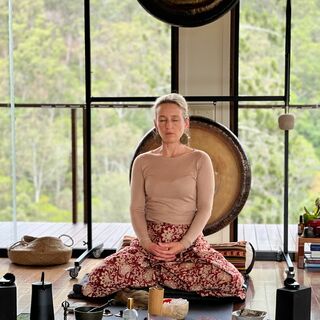
My name is Celia Roberts and today I'm going to teach you about meditation for the brain in trauma.
And so if at any time you're triggered by the practice,
Just remember to come back to your hands and feet and ground into the earth or get up and have a drink of water.
Feel free to remove yourself from the situation and practice walking meditation or something different.
I run the Biomedical Institute of Yoga and Meditation and on this training we teach trauma informed yoga and trauma informed meditation teacher training.
We'll come to the practice.
So see if you can start to bring your attention into the breath and the longer out breath will have a calming effect on your nervous system.
And see if you can notice the breath down in the belly and be aware that as you reduce your heart rate with this long out breath that you're affecting through the practice of meditation three key parts of the brain.
First the amygdala,
A small part of the brain that's involved in flight or fight.
And when we practice mindfulness for 27 minutes a day,
So the studies show over an eight week period,
We'll see a significant reduction in the activity and size of the amygdala.
So really now practice just being fully present and aware on the out breath.
Reducing cortisol in the bloodstream as you induce the relaxation response.
Reducing the activity and size of the amygdala which is often sometimes overactive or has increased in its size when we've been under states of stress or been in a period of trauma in our life.
But know you have the potential and the strength and resilience to create change.
So continue to focus on the out breath,
See if you can create softness in the belly so you're increasing your oxytocin.
Improving vagal tone,
The health of your nervous system.
Relax the eyes.
Release the amount of saliva in your mouth.
And again just recognizing that we're reducing the activity and size of the amygdala.
A small part in the brain that recognizes danger.
Flight fight,
It's our alarm system.
And so we want to retrain ourselves to be okay and feel really safe in the present moment and really safe with trusted others.
And the retraining of this,
Our nervous system,
Is a long process but a worthy one.
And so really if we can bring ourselves back into what's happening now,
So feeling into the body and the breath and just allowing that experience to be most important to you rather than futurizing our thoughts based on the past.
Okay we're going to move to a different part of the brain now,
The hippocampus,
Which is close to the amygdala.
And this has the potential to store memories and it really is helpful to us in having good memory,
But also the memories are accurate.
And so sometimes when we've been in a traumatic event or we've been under a period of difficulty in our life that caused us long-term significant PTSD,
Moving into trauma effects on brain and body,
Our memory is somewhat broken of the experience or we can't recall the state of events or possibly the memory comes back and is recurring quite frequently.
But the good news is as we practice meditation and mindfulness,
As you are now sitting in the body stabilizing with the breath and particularly the out-breath,
Grounding into body and breath in the moment,
We actually increase the activity and size of the hippocampus.
And in trauma survivors,
The hippocampus,
Its activity and size is decreased.
And so our job now is to build up the hippocampus and create neurogenesis,
Which means that we're creating new pathways in this region of the brain,
New experiences,
New memories based on what's happening in the moment.
So know that as you keep coming back to your breath and your body,
That we're improving our ability to have excellent memory and recall.
And hopefully these memories that sometimes keep recurring to remind us of these,
This event start to be more anchored in the present moment rather than taking us from the past and projecting future anxiety forward.
So our idea in meditation is to keep coming back to the present.
So I want you to really focus on your hands now and just the sensation and the temperature of your hands.
And if at all you're feeling triggered,
It might be a good time to just tap your hand.
This is an exercise from Peter Levine and you tap your hand just to feel that gentle sensation of the tapping on the hand itself.
So you're just somatically experiencing the body,
Particularly if the breath is triggering or coming into the body might be triggering.
You can just keep it really simple or maybe you just wiggle your toes and then come mindfully again into the face,
Into the body,
The face and see if you can smile even if you have to fake it,
That's fine.
You're stimulating the vagus nerve.
This is really helpful to you in developing good vagal tone.
And then I want you to wiggle your tongue and just really feel that very unusual sensation as you wiggle your tongue in all directions,
Touching top of mouth,
Bottom of mouth,
Sides of mouth and sticking the tongue out nice and wide and stretching open the jaw.
Good and then come back to that smiling meditation.
Even if you have to fake it,
Just have a go,
Just have a different experience.
Good.
See if you can involve the eyes.
Excellent.
And then come back to the breath.
Remembering that our job here is as we move mindfully and attentively into the body by just using these different experiences to guide us in that we're improving memory,
Hippocampus.
So this is also excellent in Alzheimer's disease as well.
So we've long known through the work of Dr.
Sarah Lazar that hippocampal volume increases in meditators and it doesn't take long,
Just eight weeks and on average,
27 minutes a day.
And remembering this is really useful if we've had a response to a traumatic event or we've had trauma in our lives or ongoing trauma because our memories are often fragmented.
And so we want to bring our experience,
Our attention back to this moment and create memories that are based on the truth of this moment,
Which is often difficult when the hippocampus isn't functioning to its best ability.
Okay.
So just making sure you feel safe and calm before we move on.
And we're going to move now to the front part of the brain,
The prefrontal cortex,
Which is our emotional regulator.
And the prefrontal cortex also helps us with concentration and focused attention.
And as you can imagine,
If we've had difficult times in our life where we've experienced PTSD,
Post-traumatic stress disorder,
Anxiety,
Depression,
Or traumatic events or long exposure to trauma,
Then our attention can be scattered.
Our concentration can be a little bit poor and our emotional regulation not always good because we're suffering from sometimes quite severe anxiety and depression.
And in the brain,
We see that there's a lowered gamma amino butyric acid,
A neurotransmitter in the brain and particularly in the prefrontal cortex.
So luckily we know that yoga and meditation increase this and this can help us overcome anxiety,
Depression,
PTSD,
And chronic pain.
Now,
The best thing we can do to build up the prefrontal cortex is practice attention and focused attention style meditation.
So again,
I invite you to come back into the breath and just really be fully present with that.
And remember,
If that's triggering,
You can just come back to tapping the hand,
Wiggling the toes or practicing the smiling meditation.
And now,
As we really start to focus our attention further,
I'm going to move you through a scan of the body that will induce the relaxation response.
If you're triggered,
Remember,
Come back to feet,
Tapping of hands or smiling or wiggling the tongue.
You could even get up and shake the body if you needed to.
But know that as we move through this mindfulness practice that you're safe,
You're in a safe place and you're here and fully present in the now.
Okay,
So create that safe environment for yourself,
However that may be.
And let's come to the crown of the head and relax the scalp.
And come to the forehead and unfurrow the brow,
Relax the brow muscles.
See if you can move a little bit further into the brain and see if you can reduce any activity that might be overwhelming.
So sometimes we actually feel into the brain and we might be able to feel some sort of electrical activity or prana at this region.
And so the idea is to sort of soften back,
Bring that attention or bring that energy back a little bit.
So we're not forward thinking with our mind and pressing the thoughts into the future,
Futureizing our experience.
It's an odd concept,
But see how you go with it.
See if you can bring your mental energy back.
Great.
Okay,
Now try with the eyes to bring mindful attention to the eyes.
And I want you to relax the muscles of the eyes and this will slow your heart rate.
If you can do that really well,
You want to withdraw the pupils and really bring the eyes back.
And allow the eyes to become really safe as if you're going to sleep in the most beautiful place in the world.
Good and just observe the breath at the nostrils.
And so when our breath is anxious or angry,
The nostrils will flare a little bit.
Particularly in anger,
The nostrils will flare.
So I want you to try and find an absolute softness just at the tip of the nostrils because the way we breathe affects our mental health and our states of the state of our nervous system.
And then I want you to move really gently into the muscles that orbit the mouth and the lips and see if you can almost either practice that half Buddhist smile.
And even if you have to fake it,
That's fine.
Or just relax the mouth completely,
Increasing saliva and broadening the tongue.
And then from there,
Bring your attention underneath the ears.
And I want you to really see if you can drop the top jaw and the bottom jaw away from one another.
So parting the jaw line,
But keep the mouth closed.
You want to breathe through the nostrils.
That's important to you.
To increase an anti-inflammatory molecule,
Nitric oxide in your bloodstream.
Then bring your attention into the throat.
And if there's tension here,
I want you to move right into the center of it if you feel comfortable to do so.
And if you like,
You can even hum to that tension because that will help release the vocal folds and any tension to that area.
And the hum will also extend your out-breath,
Calming you further.
So you might like to try that for your next couple of breaths.
Just humming gently.
Moving to the throat,
Humming gently if you wish.
Bring your attention into the heart space.
See if you can soften the heart.
Soften the chest,
The muscles around the chest.
And bring that same beautiful softness into the belly.
And let the body just be soft and completely at ease if possible.
And find a sense of gentle compassion towards yourself.
Really wishing yourself happiness and that you're going to be well and that you will overcome this.
And if that's difficult,
Then offer it to someone you care for deeply and then bring this back to yourself.
Because compassion can often be a really difficult thing to practice towards ourselves when we have disliked ourselves for a long period of time or we've had trauma or difficulties in our life.
So there are fears,
Blocks and resistances to compassion meditation that are well studied.
So I want you to be really aware of those and see if you can work with yourself very gently to try and overcome those resistances.
So you're moving into your body and you're really wishing yourself well.
And if this is difficult,
Wish it to someone you love and then see if you can do the same for yourself.
Good.
Let your awareness slowly travel up the spine.
And I want you to be really aware that the spine can often be very tight when we've been holding anxiety and fear patterns for a long time.
So I want you to see if you can move into the back body and do so really safely with an awareness that you have some feeling or sensation of the back body and how you can promote your own sense of safety by being more aware of your body at the back.
Because it does actually induce the parasympathetic nervous system response.
So we want to kind of bring our attention into that.
And I feel that this may genuinely happen because we're more mindful of what's happening on around our body,
Front,
Side and back.
And we're not holding the spine in fear.
So really moving into your spine,
Your back,
Compassionately,
Gently and with an ease,
A softness.
Beautiful.
Okay.
Remembering that we're training focused attention style meditation,
Moving into the prefrontal cortex.
All of your activity in the prefrontal cortex is increasing or the electrical activity,
The stimulus at this region.
And we're building up the prefrontal cortex of the brain through meditation.
Okay.
Another thing that can happen when we've been in fight or flight for a long time is that the blood flow through the limbs is often unusual.
So it can be that we've got hot hands all the time if we're holding on to anger or if we've got anxiety,
We can have cold hands and feet.
The blood flow isn't quite happening the way we'd like it to.
So one way that we can bring our attention to the limbs and try and work on creating a strong,
Healthy flow of blood in the limbs that's not sort of coming on and off all the time,
Not sweating,
Not hot and not cold is to draw attention and mindfully move your awareness down the limbs.
So I refer to the process or the science of psycho neuro endocrine immunology.
When we place our attention into the limb and then this can actually improve blood flow,
Lymphatic flow to this region.
So I want you to move slowly from your right shoulder into your right elbow and from your right elbow into your right wrist.
And then from your right wrist to your thumb,
Right wrist to index finger,
Right wrist to middle finger,
Right wrist to ring finger,
Right wrist to little finger.
And then feel into the palm of the hand and then run your attention from the palm of the hand all the way back through the elbow and up to the shoulder.
Lovely.
Let's do it on the other side.
Right shoulder,
Right elbow.
Left wrist.
Okay.
And then moving fully across now to the left shoulder.
So we're going to the left shoulder,
To the left elbow,
To the left wrist.
Let's do it slowly.
Left shoulder.
All the way down to the left elbow.
All the way down to the left wrist.
And from the left wrist to the left thumb.
Left wrist to index finger.
Left wrist to middle finger.
Left wrist to ring finger.
Left wrist to little finger.
Then the palm of the left hand.
And then move your attention from the hand back to the elbow and back to the shoulder.
Good.
And then travel your awareness just once again down that side like we did on the opposite.
Left shoulder,
Left elbow,
Left wrist.
Good.
Okay.
Right leg.
Right glute,
Right knee.
Feel the thigh as you travel your awareness from the glute to the knee.
And then from the right knee,
Travel your awareness down the shin bone,
The calf and into the foot.
And feel each toe.
Taking that same focused attention as we come over to the left side from the left glute to the left knee.
From the left knee all the way down the shin bone and into the foot.
See if you can feel each toe.
Remembering the idea is to increase blood flow,
Awareness,
Pranic flow if you believe in such and lymphatic flow.
Then bring your attention back to the softness of the belly.
The gentleness of the heart.
Prefrontal cortex of the brain,
Remember,
Is increasing the activity and size.
Hippocampus is doing the same.
So our attention,
Our concentration becomes better.
Also emotional regulation and our memory.
Our memory of this moment is based on the reality of what's going on rather than fragmented memories producing a future that we're quite anxious about or distorted memories.
So we want to keep creating memories that are relevant and true to this moment.
And then finally the amygdala is doing the opposite.
It's reducing in its size and its activity.
And this will give you long term benefit as it reduces the cortisol that is regularly pumped out through the bloodstream because of these brain changes.
So I want to wish you all the best and know that we can continue to help and support you on your journey if needed.
So please feel free to contact us if needed.
May you be healthy,
May you be happy,
May you be filled with deep compassion and may you be at peace.