Hello,
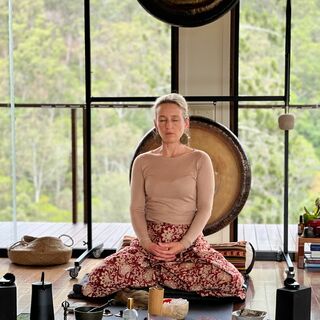
My name is Celia Roberts and this evening we'll be doing a meditation called the Soham meditation.
We're also going to link this into Shushumna breathing.
So we're mixing two yoga techniques.
One is Mantra,
Which means I am that,
Soham.
And the other is Shushumna breathing where you're breathing up and down along the spine.
Now scientifically I link the breath that goes up and down along the spine to Psychoneuro-Endocrine Immunology,
A conduit that recognises that we have top-down processing,
Our mental thoughts affect our body,
And bottom-up processing where our state or our feeling or our physiology affects our mental state.
So I try and link back to this yogic practice which is recognised that there's a huge connection between the body below and the brain above.
And I link this to what we call the Soham,
Shushumna breath.
So usually with the So part of the mantra,
This is done on the inhalation,
So we breathe in So.
And we breathe up the spine and on the exhalation we breathe Hum and we breathe down the spine.
Now this So is silent and the Hum can be done with vibration and sound.
So begin the in-breath and exhale with a Hum.
And then we take the So and breathe it from the base of the spine to the crown of the head.
And then we exhale with a Hum.
Keep going with this breathing,
The Soham breath,
But what you want to try and do is really add the Shushumna breathing.
So this means that you're breathing up and down along the energetic spine that connects the chakra system.
So essentially this is a tantric practice when we practice with the chakras.
And we take it from the base of the spine to the crown of the head.
This is the breath,
The Prana.
And then we exhale down the spine.
Now you're welcome to add the Hum,
The vibration.
This will increase the nitric oxide in your bloodstream,
Which has an anti-inflammatory effect.
You might like to add the visualization of light from the base of the spine to the crown of the head on the So.
And on the exhale,
Taking the light from the crown of the head or the Prana back to the base.
The sound will be very helpful in extending your breath and your breath ratio,
Inducing the parasympathetic nervous system response as you reduce your heart rate with a longer out-breath and the Hum.
Now what makes Shushumna breathing probably one of the most complicated Prana Yamas,
Which means the breath control practices in yoga.
Pranayama is the way we say it,
Is that we need to breathe gently through both nostrils and we breathe through both nostrils at the same time.
Now naturally we have nasal switching that happens between left and right nostril every three to six hours in a healthy individual.
But through this yogic technique,
We're asking the breath to become equal through both nostrils to stimulate the Nadi system,
Particularly Ida and Pingala Nadi.
Ida and Pingala Nadi cross through the chakra system energising each chakra as does Shushumna Nadi,
Which is the main central Nadi sitting right in the centre of both Ida and Pingala and the seven main chakras.
So start to breathe equally through both nostrils and just identify if this is possible or not possible and realise that it's a very advanced practice.
It's difficult.
Remember we were taking the prana from the base of the spine with the breath and our visualisation of light and the so.
And on the exhalation we take the prana and the light from the crown of the head back to the base with the hum and this can be used with sound to make the practice more effective.
So we'll try our last three rounds together and I'll leave you to the practice to continue on your own.
We'll take an in-breath,
Taking the breath from the base of the spine on the silent so,
Right up to the very crown of the head and the exhalation drops the light,
The energy down to the very base with the hum.
And again taking the breath up.
So exhaling with the hum from the crown of the head down to the base.
And again,
Last time.
When the light has reached the crown through the visualisation,
Use the hum to take the breath and the prana back down.
Continue on with the practice and remember as you do this you're really connecting mind and body through both top-down processing,
Bottom-up processing and a link between mind and body,
What we call in science psycho-neuro-endocrine immunology and the flow between the mind,
The body,
Nervous system,
Endocrine system and immune system.
Continue along with that hum to produce the anti-inflammatory response by increasing nitric oxide in the bloodstream.
This is done through breathing through the nostrils on the in-breath and humming on the out-breath.
The mantra so hum means I am that.
So wish you well and great success with your meditation and the journey.