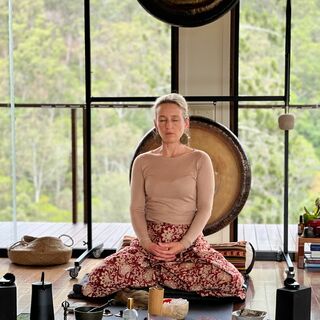
Welcome,
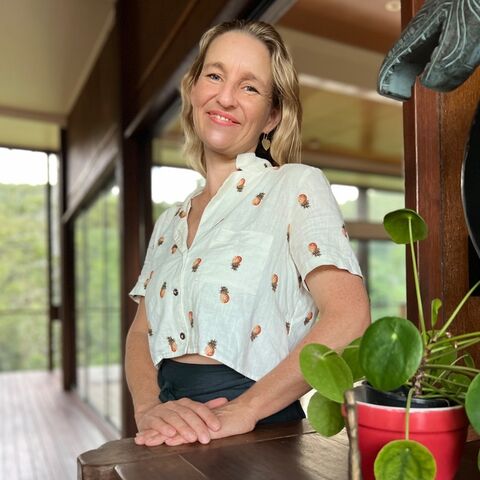
My name is Celia Roberts and today we're going to look at shaking meditation.
So shaking meditation is a wonderful way to bring us out of depression and states of shock and dissociation.
So if you're feeling a little bit lethargic or that perhaps you don't want to really do this day,
Then we want to shake the body.
Now shaking is going to really stimulate blood flow,
Heart rate and the lymphatic flow of the body.
And hopefully once we begin to shake quite vigorously we start to stimulate endorphins.
So when we've started to dissociate or shut down in any way,
One of the best things we can do is bring our body into flight or fight.
And this will then be able to allow us to come to a state of calm.
So we want to take the body from dissociation,
Shut down and freeze into flight or fight so that we can then bring the body out of flight or fight into social engagement and calm once again.
And we can't usually take someone from one state literally where they're dissociated and shut down and wanting to feign death,
Which is polyvagal theory,
Into a state of calm and social engagement.
We need to bring them out through flight or fight.
Now you might have heard me,
I've already begun my shaking meditation,
So I invite you to join me.
It is a bit of an unusual practice,
So be open to a little bit of change and just know that you're shaking your body just like an animal,
For example,
When they've been in a difficult,
Shocking situation.
They shake it off and we tend to forget to do this.
So we've had shock or trauma in our lives.
Then the best thing that we can do is try and shake it off like a human might after any situation.
And yet we've lost that ability to allow ourselves to do those kinds of things.
So let's take the time now and begin to shake the body.
And you want to shake your hands first and shake into your forearms and your elbows and then shake into the shoulders.
And we shake to the degree where our teeth begin to chatter.
This comes from some of the ancient Chinese practices.
It's certainly used in some of the yogic practices and culturally around the world.
It can be considered a shamanic practice as well.
So begin to vigorously shake and you want to shake as you begin the shake.
You want to try and move into areas of the body that tend to hold discomfort and pain and see if you can bring the shake to those areas.
You can put on your favourite music if you like.
Once you get the idea of the practice,
It's not difficult in any way.
It's almost like dancing to your favourite tunes.
But again,
If you want to deepen your awareness and your experience of the practice,
Then this is one way to awaken the Kundalini energy as well.
But the practice is vigorous.
So we can do practice shaking meditation for six to eight hours a day,
Much like we would on a meditation or a mindfulness retreat.
So consider it to be a deep practice and really move your attention into the body.
Shake it until it becomes effortless to do the practice.
Now I'm shaking vigorously now and I invite you to join me.
And you might be able to hear that shaking and you want to try and shake as much as you can.
Not to the point where you're going to feel pain tomorrow,
But just to the point where you're starting to break a little bit of the sweat and increase the heart rate.
So your endorphins are going to pump after you finish the practice and you're going to feel good for the rest of the day.
So we want to lift your heart rate high.
Bring blood flow to the limbs.
Yeah,
Really shaking to the left arm.
Good.
And then the right arm.
And even just thinking about the arms will increase the blood flow to the area.
I want you to now think about the left leg and really shake it out.
Think about the right leg.
Really shake it out.
Then into the glutes,
The spine,
The face.
Shake it out,
The head and neck,
The chest and belly.
Good.
OK.
Find a gentle flow and a rhythm with it now.
So you might still the body,
But continue the shake.
Yeah.
And then when you feel ready to release down at the practice,
You gradually stop the shake until you find that place of stillness.
And then standing in Tadasana or mountain pose or standing meditation,
You just observe the flow of blood,
Lymph,
Energy,
Electricity in the hands,
The feet and the face.
So thank you.
It's an unusual practice.
And remember,
You can keep going with the practice as many times throughout the day as you wish.
And you can use your favourite music and begin to practice a little bit differently.
Thanks for your entertainment and your fun and your kindness and joining me today.
I wish you well.