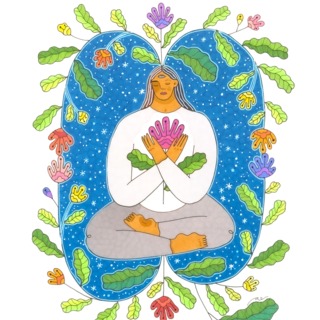
We are what we repeatedly do.
Much of our lives we are acting out habits,
Habitual ways of thinking,
Feeling and behaving.
If we aren't consciously examining and developing our habits,
Then we are likely developing our habits reactively.
This practice is about empowering through awareness.
Being able to choose what behavior and habits we want to keep,
Create or let go of.
And because our habits become more ingrained over time,
If we want to change,
The time is now.
Get comfortable,
Taking a few deep breaths.
On the inhale,
Stretch out,
Open your chest.
Feel your spine become long.
And on the exhale,
Relax.
Notice if you're holding any tension and see if you can soften it with each breath.
And now take a moment to reflect on your life,
Examining the habits you're living on a daily basis.
Focusing on your morning routine,
Your work routine,
What you do in your spare time.
Your nighttime habits and routine.
What actions have become habitual?
What thoughts have become habitual?
What feelings have become habitual?
What attitude has become habitual?
And finally,
What posture,
What way of holding yourself has become habitual?
Some of these habits may be supportive,
While others may not be serving us.
Choose one habit now that you'd like to let go of.
Notice when this behavior arises in your life,
Is there a certain trigger?
What is the experience or the feeling that leads you to acting this habit out?
We often turn to a certain behavior pattern to avoid discomfort.
So the question is,
Can you just be with the discomfort without needing to escape it?
The most important step here is awareness.
Our habits are mostly acted out unconsciously.
So if we bring conscious and compassionate awareness to this pattern,
We are well on our way to change it.
If we are hard on ourselves about this habit,
Our mind is less likely to become aware.
We go into autopilot and don't pay attention.
Self-compassion is key.
We want to bring more and more compassionate awareness to this pattern.
Imagine yourself acting out this pattern,
Continuing to observe yourself compassionately.
And now explore what you'd like to replace this habit with.
What would you rather do under these circumstances?
For example,
If your bad habit is self-criticism,
Then self-compassion may be a good replacement.
Or if your habit is to lose yourself in your phone,
Then a good replacement may be connecting with your breath,
Your body,
Or something in your environment.
Imagine catching yourself as you're going to act out this negative habit and shifting Imagine how it would feel to behave in this healthier way.
Let this feeling grow and spread through your being.
It's amazing.
Remember this feeling.
We're anchoring in this feeling of integrity and accomplishment,
Of doing what we know is best for ourselves.
Remembering this feeling makes it easier for us to make the right choices for ourselves.
And just continue to breathe here.
Gentle,
Relaxed breaths.
Imagining this feeling of acting in a healthy way,
Of doing what is best for yourself.
Creating more and more of a positive association with healthy habits.
When you catch yourself acting out a bad habit,
Remember to be compassionate with yourself.
This will help you catch yourself more often,
Leading to more opportunity for change.
This process takes time,
So be patient.
Remind yourself what it feels like to have healthier habits.
It may not be easy or feel good in the moment,
But doing the right thing for yourself or others is powerful.
Remember that feeling and let it guide you.
Thank you for your practice.