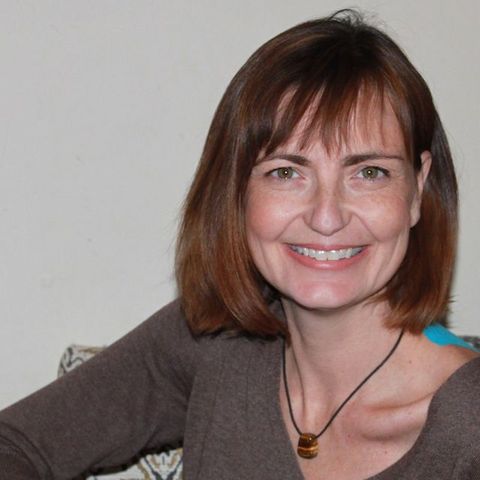
Hello and thanks for joining me.
My name is Barbara Brooks and I'm a certified health and life coach.
I'm also a consumer researcher and a mother of two sons.
And to get to the topic at hand,
I'm also a widow.
I lost my husband to cancer when he was 41 and I was 40 years old.
Before he passed away,
I was his primary caregiver and this is the first part of a series I'm presenting that focuses on caregivers.
And when I say caregiver,
I mean it broadly.
You could be someone caring for your children,
You could be caring for a spouse or your partner,
Or you could be caring for your own parents.
No matter who you're caring for,
It can be a grind both physically and mentally as you put the emphasis squarely onto someone else and away from yourself.
What I want to specifically address today is the aspect of change that I felt was thrust upon me when I took up the role of caregiver.
And specifically like how the roles in our marriage suddenly changed.
I was thinking of a small example.
I think back to those days when my husband was really sick.
My boys were about five and seven at the time and and though they were young,
They were both really heavily involved in competitive hockey.
My husband was their hockey coach and I was really used to my role as the cheering mom,
Just the spectator in the stands.
And this quickly changed to me becoming the primary driver,
Being the one to get them dressed and manage all their equipment.
And I even stood in for my husband and ran some hockey practices on his behalf when he was too sick to get on the ice.
And I'm thinking of one day in particular I was at the rink and the logistics of trying to get two kids to two different spots at the same time really caught up with me and I burst into tears in an arena washroom.
I really felt completely overwhelmed.
And there's a quote from psychologytoday.
Com that resonates with me.
It captures how I was feeling at that time and it says sudden change can take the wind out of you,
Pull the carpet from beneath your feet and make you feel totally confused and out of sorts.
Sudden change can make you doubt yourself and your ability to deal.
There's a doctor named Abigail Brenner.
She's the author of a variety of books.
One of them is called Transitions,
How Women Embrace Change and Celebrate Life.
And Dr.
Brenner talks about how dealing with sudden change requires four things.
A lot of effort,
Resilience,
Planning and support.
And the support part is where I come in with my clients as their coach.
She also talks about how when faced with sudden change your emotions can really run the gamut from confusion,
Stress,
Overwhelm,
Anxiety,
To disappointment or anger or depression.
There's really a sense of loss sometimes and a feeling of uncertainty.
And that feeling of uncertainty,
It actually,
There's a physical reaction in the brain.
It does feel uncomfortable for the human brain to be uncertain.
I hope if you've experienced any of these emotions or if you're like me,
All of these emotions,
Like that you know that you're not alone.
When I look back on that time I think about the surge of emotions I personally felt and I wanted to share some advice that helped get me through.
Back to that day when I was crying in the arena washroom,
I can see now looking back that it really was brought on by my whirling mind.
I was racing ahead to the future.
To the unknown,
To the worst case scenario.
The actual facts,
If you could see me I'm doing air quotes,
Were what was happening on that particular day.
And bringing your focus back down to earth or back to the present,
It does have a calming effect.
And what is specifically in front of you at the moment,
You have to ascertain what tasks need to be completed.
Ask yourself what needs my immediate attention.
What is true today?
I actually took a great course with Jennifer Grace.
She's a very established coach who works with other coaches and she suggests an exercise that I would love to pass on to you.
Think of it as your homework for today.
You could set alarms on your phone for a variety of times throughout the day and when your alarm goes off,
Notice where your mind is hanging out.
Are you thinking about the past?
Are you in the present?
Or have you catapulted yourself into the future?
And it's completely fine to drift to the past,
To daydream about the future,
But you don't want to be out of balance.
It's a great exercise to become aware of your thoughts and to gently remind yourself to be mindfully in the present.
This is the way to lower your stress,
Especially when you're faced with that role of caregiver.
And I wanted to finish today with a second part to that psychologytoday.
Com quote.
Sudden dramatic change can also give you the unique opportunity to really see what you're made of.
You may be very surprised and pleased.
I really appreciate that you listen today and I hope you will tune in to future episodes as I focus on caregivers.