Hello,
It's Steve here,
And in this session we're exploring some of the themes of contemplative viewing through art mindfully.
So what happens when we bring mindfulness practice to the art of looking?
It's a fascinating intersection where two powerful ways of experiencing the world come together.
Like streams joining to form a river,
Each enriches the other in ways that can transform how we see,
Not just art,
But our entire world.
Let's explore some of the contemplative themes we'll incorporate into the art mindfully sessions.
Focus and clarity.
Just as we experience our physical muscles,
Looking deeply at art helps us develop our muscles for focus and sensory clarity.
Thinking about standing before a painting,
Really standing there,
And letting your awareness move beyond the initial,
I like it or I don't like it.
When we acknowledge and quiet that immediate judging voice,
Just noting it and moving it more to the side,
Or we begin to calm the restlessness of that monkey mind that has thinking about the things to do later,
Or the events that happened earlier in the day.
When we do that,
We move those things to the side,
Something remarkable happens.
We begin to notice details we might have missed,
Colors,
Shapes,
Textures,
Possibly sensing even into emotions and feelings we hadn't felt.
The artwork becomes not just something to analyze,
But a gateway to deeper presence,
Openness,
And ease.
The possibility to create relationship with the work of art,
To lean towards a relatableness with the artwork.
A way of just being with it,
Seen by you in this moment.
Curiosity and wonder.
Mindfulness is a wonderful sandbox for us to explore the beginner's mind,
As if you're seeing these artworks for the very first time,
With a curiosity in your observation.
Becoming finely tuned sensory explorers.
There's no need for any particular expertise in art.
When we bring these qualities to art viewing,
Every viewing of an artwork is a new experience.
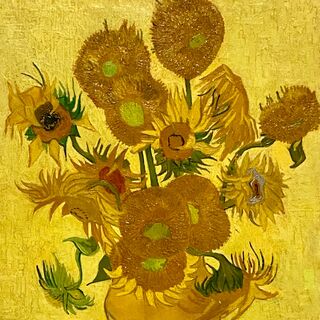
That familiar painting of Van Gogh's sunflowers that you've seen dozens of times,
Suddenly you're noticing how the paint moves across the canvas,
How the colors dance together,
How it makes you feel and how it makes your heart sing.
Let your curiosity be your guide as your gaze naturally rose across the artwork.
A sense of curiosity acts as an antidote to our habitual ways of thinking and seeing.
We can actively look for novelty,
Whereas before we might have assumed familiarity.
Instead we shift and open ourselves to wonder.
At human creativity,
At the sheer beauty of visual expression.
Feelings and emotions.
Have you ever struggled to find words for how an artwork makes you feel?
That's because we're experiencing art in a part of our brain that processes visual information differently from language.
Through mindful looking,
We learn to trust these wordless feelings,
Those harder to identify emotions,
To let them surface naturally without rushing to label or explain them.
It's about creating a space where we can be with our experience,
Whatever it might be.
Where paradox and ambiguity aren't problems to solve,
But invitations to deeper understanding.
Ease and connection.
As we develop this practice,
We find an ease settling into our looking.
The mind becomes spacious,
The body relaxed.
We're no longer forcing understanding,
We're allowing it to unfold naturally.
Ease allows us to really open and begin to develop this relationship,
Connection,
Or relatableness to a work of art.
And remarkably,
This personal practice connects us to something larger.
Whether we're standing before an artwork alone or sharing the experience with others,
We're participating in a contemplative dialogue that has spanned centuries and cultures.
This meeting of mindfulness and looking at art deeply offers us something precious,
A way to see with new eyes,
To feel with an open and even tender heart,
And to connect with both ourselves and with the vast human experience captured in so many artworks.