Namaste everyone,
I am Opinia and if you knew what an honor that our path crossed today,
I hope you are doing amazing and for my regulars out there,
I hope you are doing great.
Please know that I send you my support always.
Please don't give up to take good care of your health and happiness no matter how many times you wake up and you don't feel like it.
Forgive yourself and give it a try again.
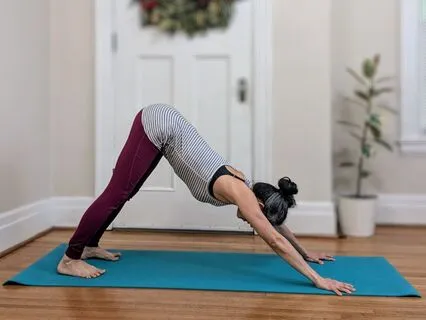
Today is about downward facing dog.
I come to you with a tutorial,
A tip to help you maybe to adjust and fix your downward facing dog a little bit just to make sure that you really get what you want in downward facing dog and stay strong in this pose.
See you on the mat.
First thing first,
You have to pay a great attention of your foundation in your downward facing dog,
Your hands and your feet and especially your hands.
Put your hand in downward facing dog with your fingers apart and when you're on the mat,
Crawl the floor with your finger pad.
Your wrist crease should be parallel to the short side edge of your mat.
Your arms should be just a tad wider than your shoulder or maybe more.
It will depend on how strong your pec major muscles are from one person to the other.
Your feet,
Have them hip distance apart.
The heel of your feet should go all the way back behind the toes.
Get that?
So focus on that first.
Hands,
Wrist crease parallel toward the short side edge of the mat.
Spread your finger,
Crawl them.
Feet,
Keep distance apart.
Your toe even spread and the heel goes straight back behind the toes.
Yes?
And when you get that down,
Now let's talk about other part of the body.
Downward facing dog can give us so many things.
It can give us this chest opening.
It can give us the stretch of the hamstring and the calf muscles.
It also can give us the stretch of the side of the body.
That will depend on how you are going to move your body to get all that benefit when you are in downward facing dog.
So let's talk about,
Okay,
If you want to really use downward facing dog to opening your chest more and more,
What that is feeling or looking like from,
You know,
Looking into a person doing it.
So in downward facing dog,
If you focus on the chest opening,
Your armpits go up toward the ear,
Your shoulder blades come together,
And then exhale,
Push the floor away from you with your hand and send your chest back toward the feet.
And you repeat that.
Shoulder blades together,
Push the floor away,
Send your chest back toward your feet.
I'm going to show you one more time.
So if that is the action,
If you want chest opening.
Now,
If you want the stretch on the sides of your body,
This is what you do.
You bend your knees and you sway your hips side to side.
And at the same time,
Keep sending your chest back toward the feet.
Your arms are strong.
And the last one,
Stretching the hamstrings,
Stretching your calf muscles.
Okay.
If you want to stretch the hamstring in downward facing dog,
You have to have your legs straight.
And use the exhale to move your chest again toward the legs.
And the more your hips go toward the leg,
The more stretch you are going to feel it.
Your heel has to go into the direction toward the floor.
They might not have to be on the floor completely,
But you should feel that the heel is anchored out toward the earth beneath you.
All right.
Now,
I'm going to keep downward facing dog.
If you want the calf muscle stretch,
You have to have the heels on the floor,
And then you bend your knees as your heels on the earth.
And you send your chest back toward your feet.
You see that?
I'm going to come down onto the knees.
There are a couple of things that I want to say and mention before I say goodbye.
I want you to look back and look at my hands while I am doing all of those actions.
My hands are always engaged.
My crawl is strong,
And on four corners of my palms,
They are anchored out toward the earth.
Most likely,
If you forget about your hands completely,
And you're going to feel that the weight of your palms is going to go more toward the outer part of the palms,
And especially the bits of your index fingers,
They are going to lift off from the floor,
And you don't want that.
Okay?
So that's one.
Now,
As you see,
When I send my chest toward the leg,
Right,
It also goes toward the floor.
With ease,
It's a natural movement of it.
However,
One thing that you should pay attention is that when your chest goes toward the floor,
Your shoulder blades themselves actually are not going toward the floor with the chest.
They go away from the floor,
And they try to be together on the back.
Okay?
If you don't keep that,
You're going to cause some back problems in the future.
So I want to show you what is the right thing to do to keep yourself safe,
And what is the wrong thing to do that you may get hurt in the future.
Back to downward facing dog.
So right here,
When I drop my shoulder blades onto the back and together,
I send my chest back.
As you can see,
My chest goes back and goes down toward the floor,
But I keep my shoulder blades on the back.
So that's the right thing to do.
Now,
The wrong thing to do is that I let go of the shoulder blades,
And you can see that,
And I send my chest back.
It actually dumps everything down.
I can start feeling something going to go wrong on my back,
And also right here,
It starts to feel unsafe.
And you are going to get hurt,
So be careful.
The last thing this is for anyone of you that have such strong hamstring muscles and tight,
Plus maybe your calf muscles as well.
When you are doing downward facing dog with straight legs,
And you can see your lower back is rounded,
Or ask someone,
Hey,
Can you look at my downward facing dog?
Because many of us cannot feel the body clearly.
Somebody can give you a clue and can keep you safe,
Especially if they're a yoga teacher.
You can ask them to help you as well.
If you want to go into like the classic downward facing dog with the legs straight and the heels down toward the floor,
The lower back,
You should ask someone,
Am my lower back rounded?
And if it's rounded,
You are not going to do downward facing dog with the legs straight.
You should do downward facing dog with the knees bent and the heels off on the floor to protect the lower back first,
Okay?
And your downward facing dog will look like this.
Like this.
So you are going to use downward facing dog to create the arch on the back.
See that?
And do everything else the same.
Armpits toward the ear,
Shoulder blades together on the back.
Yes,
You may not get the benefit of stretching the hamstring muscles in downward facing dog,
And it is okay because there are other poses that you can stretch the hamstrings muscles.
If you cannot stop yourself from straightening your leg and you keep rounding your back in downward facing dog day in and day out,
One day you are going to hurt your lower back.
I'm experiencing this with my students again and again and again,
Especially my yogi students.
You have the will,
But you don't have the awareness,
And you're going to hurt yourself.
And if your disc pops out from the spine,
It's going to be painful,
And I would love that to not happen to you.
Okay,
Everyone,
I hope it's educational.
I hope that you take the time to adjust and adapt with this tip to keep your downward facing dog healthy and using them to make your body strong and never have to hurt yourself.
Let me know what you think,
And I will see you in the next video,
Everybody.
Namaste.