11th July 1832,
Under sail.
On this day,
At half past five in the morning,
We got under way.
A few friends,
Not indeed of very long standing,
But of great and sincere affection,
Had risen before sunset for the purpose of accompanying us a few leagues at sea,
And thus defer the moment of bidding us farewell.
Our vessel blided over the smooth surface,
Limpid and blue as the water of a spring in the shade of a cavity in the rock.
Scarcely did the weight of the yards,
Those extended arms of the vessel bearing the sails,
Make the vessel slightly incline,
First on one side,
Then on the other.
A young man of Marseille,
Mr.
Autron,
Recited some admirable verses,
In which he confided to the winds and waved his wishes for our safety.
We were affected by this separation from land,
But those thoughts,
Which flew back to the shores and traversed the plains of Provence,
Reaching to the home of my father,
My sisters,
And my friends.
By those tender emotions,
Which the word farewell always occasions,
By those verses,
Which we had just heard,
By the beautiful shade of Marseille,
Gradually diminishing from our view,
And by that illimitable ocean,
Which for so long a time to come was to be our only country.
Same day,
Three o'clock,
At sea.
The wind is in the east,
Which checks out our further progress,
Has come on to blow with some force.
The waves have risen with their white crests of foam,
And the captain has declared that we must retrace our course and cast anchor in a bay about two hours' sail from Marseille.
We were not long in reaching it.
We are gently cradled by the waves,
And to make use of the expressive language of the sailors,
The sea speaks to us.
A murmur approaches from a distance,
Like a hollow roar,
Which issues from the walls of a mighty city,
Teeming with human beings.
This threatening language of the ocean,
The first which we have heard,
Sounds with a touching solemnity to the ears and bosom of those who are on the point of being associated with it so intimately,
And for such a considerable length of time.
Same day,
Eleven o'clock at night.
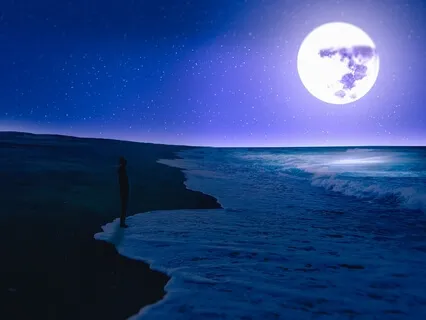
A splendid moon seems to suspend itself between the masts,
The rigging,
And the cordage of two brig of war at anchor at no great distance from us.
Between our own anchorage and the black mountains of Var,
Every part of the rigging of those two vessels is exhibited to the eye on the blue and purple ground of the nocturnal heaven.
Tomorrow,
Those apparent skeletons are to be in life in motion,
Like us to spread their hither two-furled wings,
And like the birds of the ocean,
Fly away to visit other climes and fix their habitation on other coasts.
We heard from the place where I was,
The shrill whistle of the boat's wane,
Dying away in low cadences.
The rolling of the drum was also heard,
And the voice of the officer of the watch.
The ensigns were lowered,
The small craft and boats were got on deck,
Similar to the rapid and living gesture of an animated being.
Twelve o'clock in the morning,
Under sail.
During the night,
The wind has changed and freshened.
I heard from my cabin,
Between decks,
The footsteps,
The voice,
And the plaintive chants of the sailors,
Resounding for a long time over my head,
With the strokes of the chain of the anchor,
Which they were fastening again to the bows.
The sails were unfurled,
And we took our departure.
I fell asleep again,
And when I awoke,
And opened the porthole to obtain a view of the coasts of France,
In the immediate vicinity,
Which we were on the preceding night,
I saw nothing but the immense ocean,
Void and bare.
Our ship in foaming surges with only two sails,
Two top sails,
Rising like two boundaries,
Two pyramids of the desert in the distance without a horizon.
The billows gently kissed the thick and rounded sides of my brig,
And softly prattled,
Under my narrow window,
Where the foam sometimes raised itself in light and airy garlands.
It was the sound unequal,
Varied,
Confused of the chirping of the swallows on the mountain,
When the sun rises above a field of corn.
13th July,
At anchor,
In the little Gulf of La Ciota.
The favourable wind,
Which had risen for a moment,
Has died away in our sails,
Which now lie flapping against the masts,
Giving them an oscillating motion.
Accordingly,
The sails were unfurled,
And we took our departure.
I fell asleep again,
And I fell asleep again.
Accordingly,
The sails were unfurled,
And we took our departure.
Whether it were chance or a secret manoeuvre of the officers,
But we found ourselves obliged at three o'clock to enter the smiling Gulf of La Ciota,
A small town on the shores of Provence,
Where our captain and almost all our sailors have their residents,
Their wives and children.
We cast our anchor under the shelter of a small mole,
Which projects from a beautiful hill,
All covered with vines,
Fig trees and olive trees,
Like a friendly hand,
Which the shores offer to the sailors.
The water is without a ripple,
And so transparent,
That at the depth of 20 feet,
We can behold shining brightly the flinty pebbles and the shells,
The long marine herbs waving to and fro,
And shoals of fish with their sparkling scales.
Those hidden treasures of the bosom of the sea,
As rich and as inexhaustible as the land in vegetables and animals.
Gulf of La Ciota,
14th of July,
At night.
It is a dead calm,
And no signs present themselves of any wind.
The surface of the Gulf has no ripple.
The sea is so smooth that we can discern,
Here and there,
The impression of the transparent wings of the mosquitoes,
Which flutter in its mirror,
And which,
At this hour,
Are the only objects which ruffle it.
Here we may behold,
To what degree of calmness and tranquillity that element can descend,
Which carries on its surface a three-decked ship,
Unconscious of its weight,
Which rushes in upon the shores,
Levels the hills and splits the rocks,
And breaks the mountains under the shock of its rolling waves.
There is not anything so sweet and beautiful as that which is strong.
The same day.
It is night,
That is,
What is called night in these climates.
The moon,
In her ascent,
Has left behind her a radiation,
Like a train of red sand,
Which she appears to have scattered over half the firmament.
The remainder is blue,
And becomes wider in proportion as she approaches.
In a horizon of nearly two miles,
Between two islands,
One of which has its shores steep,
Elevated,
And of a yellowish cast like the Colosseum at Rome,
Whilst the shores of the other are of a violet tinge,
Like the flowers of the lilac.
We behold the mirage of a great city.
But the eye is there deceived.
We see the sparkling domes,
The palaces with their glittering facades.
The long keys inundated with a light,
Soft and serene.
To the right and the left,
The waves whiten them with their foam,
And appear to envelope them.
It might be said that Venice or Malta were sleeping in the midst of the waves.
But it is neither an island nor a city.
It is the reflection of the moon at a point,
Where its disk falls perpendicularly to the ocean.
In our more immediate vicinity,
This reflection is the reflection of the moon at a point,
Where its disk falls perpendicularly to the ocean.
In our more immediate vicinity,
This reflection is extending and prolonged,
And rolls like a river of gold and silver between the shores of Azure Blue.
At our left,
The gulf extends to an elevated cape of the long and sombre chain of those unequal and indented hills.
At our right,
We see a narrow and limited valley,
In which flows a beautiful rivulet in the shade of a few scattered trees.
In the rear,
There is a hill still higher,
Covered to its summit with olive trees,
Which night has wrapped in its deepest shade.
From the summit of this hill down to the sea,
Some grey and dismantled towers,
And white and smiling cottages peep here and there through the monotonous obscurity of the olive trees,
And attract the eye and the thought to the abode of man.
At a still greater distance,
And at the extremity of the gulf,
Three enormous rocks rear their weather-beaten forms,
Resting,
As it were,
On the surface of the waters.
Their shape,
Strange and grotesque,
Rounded like pebbles,
Polished to the surface of the water,
Is a round pebble,
Rounded like pebbles,
Polished by the waves and the tempests.
These pebbles are in themselves mountains,
The gigantic sports of a primitive ocean,
Of which our seas are but a weak representation.
July,
Still detained by contrary winds.
A mile to the southeast,
On the coast,
The mountains are shattered,
As if they had been broken by a giant's club.
The enormous fragments have fallen here and there,
And the foot of the mountains are under the blue and greenish waves of the sea,
Which spread their foam on their base.
The sea breaks on them incessantly,
And from the wave which comes rolling on against the rocks,
With a deep and intermittent murmur,
Break forth long streaks of feathery foam,
Which hissing die away on the sands of the shelving shores.
These fragments,
Disrupted from the mountains,
For they are too great to be distinguished by the name of rocks,
Are thrown and purled with such confusion one upon the other,
That they form an innumerable number of little creeks,
Of deep vaults,
Of sonorous grottos,
Of gloomy caves,
Of caves of gloomy caverns,
The passages,
Turnings,
And outlets of which are only known to the children of two or three fishermen,
Whose huts are in the immediate vicinity.
One of these caverns,
Into which we enter by the elliptic arch of a natural bridge,
Covered with an enormous block of granite,
Presents an outlet to the sea,
And afterwards opens on a narrow and obscure valley,
Which the sea entirely covers with its smooth and limpid waves,
Like the firmament in a beautiful night.
It is a cove known by the fishermen,
Where,
Whilst the billows roar and foam without,
Shaking with their shocks the sides of the coasts,
The smallest boats are safely sheltered.
Scarcely is heard the light babbling of a spring,
Which falls into a sheet of water.
The sea there preserves that beautiful yellowish green and clouded colour,
Which the eye of the marine painters catches so happily,
But which they are never able to render faithfully,
For the eye always sees more that the hand is able to imitate.
On the two sides of this marine valley,
Further than the eye can reach,
Rise two walls of rocks almost perpendicular,
Sombre and of a uniform colour,
Similar to the dross of iron.
Sometime after it has been taken from the furnace,
Not a plant,
But a moss finds there a crevice in which to attach its roots,
And bring forth those floating garlands of tendrils and flowers,
Which are so often seen to wave on the sides of the rocks of Savoy,
At a height where God alone can inhale their fragrance,
Naked,
And unashamed.
Where God alone can inhale their fragrance,
Naked,
Black straight,
Repellent to the eye,
They appear to be only there for protecting from the sea air the little hills of vines and olives which vegetate under their shelter.
At the bottom of the cove,
The sea rather extends itself,
Takes a winding course,
And assumes a tint more clear in proportion,
As a greater expanse of heaven opens upon it,
And ends in a beautiful sheet of water,
Resting on a bed of small violet shells,
Pounded and compact like sand.
If you land from the boat which has conveyed you thither,
On the left will be seen in the crevice of a ravine,
A spring of sweet water,
Fresh and pure.
Then turning to the right,
A goat path,
Stony,
Steep,
Unequal shaded with fig trees and medlar trees,
Which descends from the cultivated lands towards the solitude of waves.
There are few sights during the whole of the voyage which have attracted and allured me more forcibly.
It is this complete mixture of grace and strength which constitutes the perfect beauty in the harmony of elements as in an animated or thinking being.
It is this mysterious marriage of the ocean and the earth,
Surprised,
As it were,
In the most intimate and secret union.
It is this image of a calm and the most inaccessible solitude at the side of this stormy and tempestuous theatre of tempests,
In the immediate vicinity of the roar of its waves.
July 14,
1832.
At ten o'clock,
A breeze sprung up from the west.
At three,
We weighed our anchor,
And soon afterwards the heavens and the waves were our only horizon,
A sea foaming and sparkling.
A gentle and measured motion of the vessel,
With the murmur of the waves,
As regular as the respiration of the human breast.
This regular alternation of the waves and of the wind in the sail is to be found in all the movements and all the sounds of nature.
Can it then be said she does not respire alive?
Yes,
Without the slightest doubt.
She respires.
She lives.
She thinks.
She suffers and enjoys.
She feels.
She thinks.
She suffers and enjoys.
She feels.
15th July,
1832.
At sea,
Eight o'clock at night.
We have seen the last summits of the great mountains of France and Italy,
Vanished from our view,
And then everything has sunk under the blue,
Dark line of the sea at the horizon.
The eye,
At the moment where the well-known horizon disappears,
Traverses the space and uncertain void which surrounds it.
Like the wretch who has successively lost all the objects of his affections and his habits,
And who searches in vain for one on whom he can repose his heart.
The heavens becomes the grand and only scene of contemplation.
The look afterwards falls on that imperceptible point drowned in space.
In that narrow vessel,
Now become the entire universe to those on board of her.
The boat's swain is at the helm.
His masculine and imposing figure.
His firm and vigilant look.
At one moment fixed upon the binnacle to catch sight of the needle.
The next on the bow-sprit to discover through the rigging of the mizzenmast his course through the waves.
His right arm resting on the helm and with a single movement impressing his will on the immense mass of the vessel.
Everything announces in him the importance of his occupation.
The fate of the vessel and the lives of thirty persons stamped at that moment on his noble,
Expanded forehead and depending on his robust and manly hand.
On the fore part of the vessel,
The sailors appeared in groups,
Seated,
Standing or stretched on planks of polished deal or on cables in huge spiral forms,
Raised between the bows.
Some of them are employed in repairing the tattered sails with large iron needles.
As the youthful girls embroider their marriage veil or the curtains of their virgin bed.
The others hanging over the sides cast a vague and indefinite look on the foaming waves.
With that vacuity of eye with which we look on the pavement of a road which has been beaten a hundred times and with the callous air of indifference throwing to the wind the puffs of smoke from their pipes of red clay.
At the extremity of the vessel,
The horizon of this floating world is the sharp prowl with its bowsprit inclined towards the sea.
This mast projects from the prow of the ship like the horn of a marine monster.
The undulations of the sea almost insensible at the centre of gravity in the middle of the deck give to the fore part of the vessel an oscillation slow and gigantic.
At one time it appears to direct the course of the vessel towards some star in the firmament.
At another to plunge it into some profound valley of the ocean.
For the sea appears to rise and fall incessantly.
When we stand at the extremity of a vessel which by its magnitude and length multiplies the effect of those undulating waves.
The youngest amongst them opened the prayer book and chanted the Avermerie Stella and the Litanies in a manner tender,
Plaintive and grave which seem to have been inspired by the middle of the ocean and by that uneasy melancholy which the last hours of the day instill into the mind.
When all the remembrances of land,
Of their cottage and their hearts flash from the heart into the thoughts of these simple men.
Darkness has again fallen on the waves and with its dangerous obscurity will until the morning conceal the track of the mariner and peril the lives of so many beings who have no other light to guide them than that of Providence and no other asylum than the invisible hand which sustains them on the waves.
In a short time elevating and rounding itself in a few minutes we discover the full moon inflamed by the vape of the westerly wind and emerging slowly out of the waves like a disk of red iron which the founder draws with his pincers from the furnace and which he holds over the water in which he is about to quench its heat.
On the opposite quarter of the heavens the disk of the sun which has just set had left in the west a track like a bank of golden sand resembling the shore of some unknown land.
Olex alternated from one quarter to the other enjoying these grand magnificences of heaven.
By degrees the clearness of this double twilight was extinguished.
Thousands of stars burst forth above our heads as if to trace the route to our masts.