The secret of life is right under your nose.
Dan Broulle Hello wonderful being,
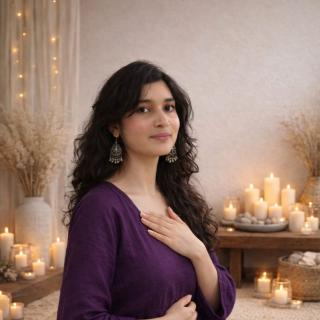
I'm Anisha and thank you for choosing me to be your guide today.
In this track we will first do the practice together and then I will explain why that tool works,
When to use it,
And when it might not be the right fit for you.
Regularly practicing this technique can help reduce stress,
Improve sleep quality,
And enhance focus and performance.
Interestingly,
This breath is also used by high-stress professionals such as athletes and Navy SEALs to maintain focus and composure during challenging situations.
So before we begin the practice,
Let's check in with ourselves.
Take a moment to turn your attention inward and notice how are you feeling right now?
Can you name the most dominant emotion present in your body right now?
Now consider the intensity of this emotion on a scale of 0 to 10,
Where 0 means the absence of this emotion and 10 means highest intensity.
So on this scale,
How would you rate the strength of this current emotion?
Very good,
It's not always easy to get in touch with our emotions.
So now that we know exactly where we are,
Let's start the practice.
Begin the practice by looking around you and finding a square shape in your surroundings.
So anything that is square shaped.
It can be a square object or the wall of the room itself.
If you can't find anything that is square shaped,
Then that's okay.
I will give you an alternative later.
And if you are able to find a square,
Then look at the square shape,
Face towards it and either stand with your feet shoulder width apart or sit upright and yet relaxed.
Now take a deep breath in,
Coming home to this present moment and a slow breath out,
Letting go of the need to do anything else or to be anywhere else.
Now look at the square shape in your surroundings and if there is no square around you,
Then Alternatively,
You can open one of your hand with your palm facing upwards and use the index finger of the other hand to slowly trace the sides of a square on your palm.
So whenever I will say move your eyes or trace the shape of the square with your eyes.
For those who don't have a square shaped object,
You can use your hands.
So you can move your index finger clockwise in the shape of a square and trace that particular side the square with your finger.
Okay,
All set.
Let's see how this simple shape can transform the way you feel.
So look at that square shape object or place the finger on your other hand and trace the top side.
So slowly move your eyes or finger from left to right.
Now trace the right side,
Moving from top to bottom.
Now tracing the bottom side,
Move from right to left.
Now trace the left side,
Moving from the bottom to top and the square is complete.
So again,
Trace all the sides of the square clockwise.
One more time,
Raise the top side,
Then right side,
Then bottom side,
And then left side.
Very good.
Now let's add breathing to this.
So each side of the square represents a part of the breathing practice which has four phases just like the four sides of the square.
The four phases are inhaling,
Then holding your breath at the top and then exhaling and then holding your breath again before we begin the next cycle.
So all we will do is trace each side of the square with our eyes or finger as we count to four and do the breathing practice simultaneously.
Don't worry if it sounds complicated.
It's very easy to do really.
So let me first share the instructions so that it will become more clearer.
And as I share the instructions,
You don't need to try to follow along this time.
Just let the instructions sink in without feeling the pressure to remember them as I will be there to guide you every step of the way,
Okay?
So as I told you,
There are four phases.
So when you inhale,
You breathe in deeply through your nose as you trace the top side of the square for a count of four seconds.
So in this phase,
I will say in two,
Three,
Four,
Okay?
And you will be filling your lungs completely with fresh air.
Then in second phase,
I will invite you to hold your breath as you trace the right side of the square for four seconds.
So I will say,
Hold two,
Three,
Four,
Okay?
Then we will move on to the third phase,
Which is exhaling the air through your mouth as you trace the bottom side of the square for a count of four seconds.
So I will say out two,
Three,
Four,
And you will be releasing all the air from your lungs.
Then the fourth and the final phase,
Where I will invite you to hold your breath again as you trace the left side of the square for a count of four seconds before starting the next cycle.
So I will say,
Hold two,
Three,
Four,
Okay?
So all we are doing is breathing in a particular way while we trace each side of the square in a clockwise manner for four seconds.
Now that we have some clarity on what to do,
Let's practice together.
So look at the square or place your index finger on the palm of other hand,
Ready to begin tracing.
Inhale through your nose as you trace the top side of the square in two,
Three,
Four.
Hold your breath as you trace the right side,
Hold two,
Three,
Four.
Exhale through your mouth as you trace the bottom side out two,
Three,
Four.
Hold your breath as you trace the left side,
Hold two,
Three,
Four.
Again top side,
Breathing in two,
Three,
Four,
Right side,
Hold two,
Three,
Four.
Bottom side,
Breathing out two,
Three,
Four,
Left side,
Hold two,
Three,
Four.
Again top,
In two,
Three,
Four,
Right,
Hold two,
Three,
Four,
Bottom out two,
Three,
Four,
Left,
Hold two,
Three,
Four.
Again in two,
Three,
Four,
Hold two,
Three,
Four,
Out two,
Three,
Four,
Hold two,
Three,
Four.
Again in two,
Three,
Four,
Hold two,
Three,
Four,
Out two,
Three,
Four,
Hold two,
Three,
Four.
Again in two,
Three,
Four,
Hold two,
Three,
Four,
Out two,
Three,
Four,
Hold two,
Three,
Four.
Again in two,
Three,
Four,
Hold two,
Three,
Four,
Out two,
Three,
Four,
Hold two,
Three,
Four.
Again in two,
Three,
Four,
Hold two,
Three,
Four,
Out two,
Three,
Four,
Hold two,
Three,
Four.
Very good.
Now,
Continue on your own for a few moments.
Now,
Take a deep breath in and out,
Letting go of this practice.
I invite you to check in again with yourself.
Take a moment to notice how are you feeling right now.
Has your emotional landscape shifted since we began?
Perhaps the intensity of your initial emotion has changed.
You can tune in and re-read the intensity of the old emotion if it is still present.
And if a new emotion has replaced it,
Then name that new emotion that has emerged as a result of this practice.
Wonderful.
Now,
To end this practice,
Bring both your hands to your heart and thank yourself for taking this time to make your nervous system feel safe and calm.
Say the word thank you to yourself.
You did great.
Now,
Let me explain what we just did.
So,
Let's break down this breathing technique step by step to understand what happened when we were going through the four phases.
So,
Firstly,
We inhaled for four seconds.
So,
This deep inhalation provided your body with oxygen,
Fueling your brain and muscles.
Then the second phase was holding our breath for four seconds.
This pause allowed the oxygen to circulate throughout your body.
It also gives your mind a moment to focus solely on the breath,
Reducing any mental chatter.
It also stimulates the vagus nerve,
Which is a key element in the relaxation response.
Then we exhaled for four seconds.
So,
This exhalation is where the magic truly happens.
As you slowly release the air,
You activate the parasympathetic nervous system,
Often referred to as the body's rest and digest system.
This counteracts the stress response.
And finally,
When you hold your breath for four seconds,
This final hold reinforces the calming effects of the exhalation,
Deepening the relaxation response.
Now,
To experience its full benefit,
You need to practice at least four cycles of this breathing technique.
And you can do it for as long as five to ten minutes in one go.
So,
Feel free to replay this track two to three times a day and practice with me.
And I would highly recommend you to practice this technique for the rest of the week because this way you will develop a habit and with habit it will become easier to use this technique immediately in times of crisis.
While this technique is generally safe,
It's essential to listen to your body.
So,
If you experience any dizziness or lightheadedness while practicing,
Then try some other regulation technique.
And also make sure that you are not practicing this or any other breathing technique just after eating.
Otherwise,
It's natural that you will feel some discomfort.
Additionally,
If you have any underlying respiratory conditions,
Then it's advisable to consult with a healthcare provider before incorporating any breathing technique into your routine.
This will help ensure that the technique is used safely and effectively in your unique situation.
Remember,
Everyone's journey to inner peace is unique.
And while this breathing technique offers a powerful pathway,
It might not be the perfect fit for everyone.
So,
If this technique didn't worked out for you,
Then don't worry.
There is a tool out there for you.
Feel free to explore any other technique on my profile to find the right fit for you.
And if you did found this track helpful,
Then please consider supporting my work with a small donation.
Your generosity helps me to create more content to guide others on their path to emotional regulation.
Thank you for listening.
You being here means a lot.
And I will see you soon.
Take care.
Bye-bye.