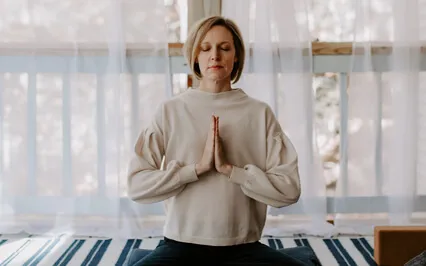
Hi,
This is Amy J.
Thanks for being my guest for MindGen at work.
This is a series of talks that takes tips from mindfulness,
Meditation,
Yoga,
And Arya Veda and teaches you how to apply them into your workspace and into your life.
If you find value at all from today's short talk,
Please consider hitting the follow button,
Rating this five stars,
Or donating.
All of those methods allow me to continue to make free content,
Including hosting live events and courses.
Thank you for your support.
Instructions on how to meditate are not really that complicated.
They are actually quite basic.
However,
What is complicated is all the excuses and stories the brain makes up about why it feels so hard to excel at this skill.
Meditation is something that can be done anytime,
Anywhere,
With no special equipment needed.
Its access is so available.
Releasing obstacles to meditation can give you permission to begin or re-engage with this amazing tool.
Today I'm going to provide six obstacles that I hear constantly when I'm working on one-on-one or small groups with people trying to establish a meditation practice,
Whether that's at work or at home.
Obstacle number one,
I don't feel like I'm doing anything.
Meditation is a tool to strengthen the brain in areas of memory,
Learning,
And decision-making.
It can help return and grow the zone of resilience by creating new neural pathways in the brain and can grow or change gray matter.
During meditation,
You might not feel anything,
But its effects will likely be noticed when you are not practicing.
You might first start to notice effects in areas of how you respond or perhaps anxiety,
Depression,
Or pain that you feel.
Through meditation,
You are learning how to have more control over your mind and body,
Its relaxation response,
And thus you're transforming your relationship with negative stress.
Obstacle number two,
I can't clear my mind.
The average person has over 60,
000 thoughts a day,
And they're not just going to start going away when you start a meditation practice.
What meditation can do is help manage thoughts,
Increase the silence between the thoughts,
And allow us to be a witness to our thoughts.
If meditating for even just a couple of minutes feels too uncomfortable,
Then sometimes moving first can be helpful.
Gentle movements such as walking or yoga,
Asana,
Can prepare the body to sit in meditation,
And these are helpful strategies when the mind seems like it is just on overdrive.
Obstacle number three,
I can't be consistent.
Oh,
Tell me about it.
Creating new habits are difficult,
But there are a few proven tricks that can make consistency easier.
Attach the time to meditate to a habit that you already do,
Something daily such as brushing your teeth or having a morning cup of tea or coffee.
Set a trigger to remind yourself such as an alarm or a note on your bathroom mirror.
Briefly reflect how you feel following meditation as well.
Especially take in the moments when you feel relaxed,
Calm,
Or overall good.
Remind yourself that the meditation practice helps you relax.
When you feel good following an activity,
The brain will more likely want to come back to it.
Obstacle number four,
I don't think I'm doing it right.
Most people have an idea of what they think meditation needs to look and feel like based on pop culture.
Start by forgetting what you think you know.
Start with these easy steps.
One,
Get comfortable,
Whatever that means to you.
It can help to have an intelligent spine sitting upright,
But if that's not comfortable for you,
Then choose a different position.
Then choose a focus of concentration such as the breath or perhaps a mantra.
When you notice that your body has different sensations or thoughts or feelings and your mind is now concentrating on those,
Redirect your attention back to your focus.
Each time you redirect your attention,
You are building mindful muscles in the brain.
Really,
That's it to start.
Obstacle number five,
I sort of feel that when I play sports,
I'm already meditating.
Maybe it is.
Meditation is generally the act of being both focused and aware.
So exercise generally feels good because it does release endorphins and other hormones.
But notice where your thoughts go when you are exercising.
Are you running but still thinking about work in your to-do list?
Then that is not meditation.
Are you in the zone and hyper aware?
You might actually be in flow state.
Some meditation practices can actually help you reach peak performance and give you the best even when you don't feel 100%.
A key here would be you can bring meditation practices into something that you already do,
But it's noticing where your mind is.
So if you're able to run and clear your mind at the same time,
You might be introducing some meditative practices into that flow you have.
Obstacle number six,
I don't have time.
Listen,
Meditation doesn't really need to take that long especially when you're just getting started.
It can be done in a few pauses throughout the day.
There are some studies out there that have shown even one minute of meditation can begin to have positive impacts on the brain and body because you're offering yourself a pattern interrupt.
It's really about learning how to self-regulate your own nervous system.
Ideally working up to about 20 minutes a day or more can really help decrease anxiety,
Depression,
And pain.
So it's really important to know why do you want to meditate?
What are you looking to get out of it?
As a beginner,
Consistency over length of time is way more critical to building a daily habit.
So take a critical look at your calendar.
Can you spare a few minutes when you wake up,
During lunch,
Before walking in the door,
Or before falling asleep?
Schedule in the time and practice it.
Try to make it a non-negotiable.