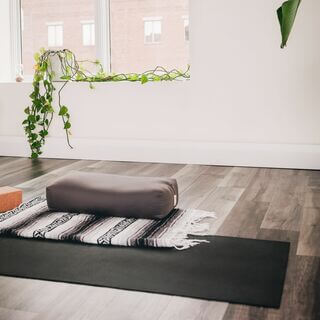
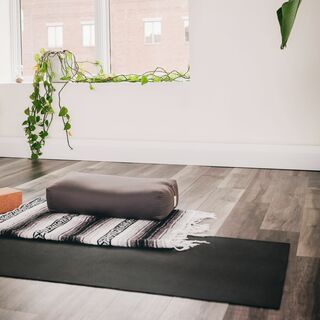
So a comfortable seat somewhere you could just find a nice long spine.
You can soften the eyes to a close or even find a soft city gaze in for the knees,
The shins,
Whatever you feel ready for in this moment.
And first take this moment to just check in.
Notice any physical sensations as your body starts to acclimate to this position.
Notice where your energy is.
Whether it's lethargic,
Whether it's energized,
Whether it's a nice balanced maybe between these two.
Notice the thoughts,
The emotions that are just right on the surface that you notice just in your awareness.
And allow that all to just fully be like you're witnessing it all but noticing that you are this vastness,
You know this pure consciousness that's just observing it.
Seeing the physical sensations,
Noticing the energy,
Noticing the thoughts and the emotions but just witnessing them and kind of like a movie playing on a screen in front of you.
And then let that go for now and just draw your awareness to your breath.
Notice even that moment when you draw your awareness to your breath.
Maybe even just the act of drawing awareness to it creates like an openness or spaciousness or a little sense of relief.
And then we're going to move into three different breathwork practices.
So we're going to start with a couple rounds of kapalbhati and then we're going to move into a more balanced box breath.
I'm going to add various elements to that within the box breath,
Holding the top,
Holding the bottom,
Different kumbhakas.
And then we're going to end with a grounding breath,
An extended exhale.
And so I'll walk you through each of these.
Before we even move into the kapalbhati,
Let's just take a few rounds of just a complete breath.
So on your next inhale,
Take a deep inhale through the nose and exhale,
Sigh out of the mouth.
Let it go.
And two more like that.
Inhale,
Exhale,
Sigh,
One more.
Inhale,
Exhale,
Gentle sigh out.
Good.
And then for our first pranayama,
Our breathwork,
Our kapalbhati,
We're going to inhale and I'll just walk you through it verbally for a second.
Inhale,
Exhale halfway and then it's a short snaps of the belly,
Navel pulling into spine.
The shoulders will stay relaxed and steady and then it's this quick exhales to the nose or the mouth,
Whatever feels most comfortable this time of year.
And we're going to do about 30 to 40 or so each round.
I'll guide you and then we'll hold our breath in between and then move into the second round,
Two in total.
So let's just take a free round of breath first.
Inhale and a long,
Slow breath out.
Let it go.
Good.
And then inhale again.
God bless you.
Inhale again,
Exhale halfway and then those short breaths out.
Good.
Continue navel drawing back towards spine.
That's five,
Four,
Three,
Two,
One.
Deep breath in.
Hold the breath in at the top for a moment and then a long,
Slow breath out.
Take a free round of breath.
Inhale and exhale.
Second round.
Inhale fully,
Exhale halfway and begin.
Last 10,
Five,
Three,
Two,
One.
Deep breath in.
Hold the breath at the top.
Another free round of breath.
Inhale and a long,
Slow breath out.
Gorgeous.
And then we'll move right into our second pranayama practice,
Our box breath.
On your next inhale,
Take an inhale for about five,
Four,
Three,
Two,
One.
Hold the breath at top for five,
Three,
Two,
One.
Exhale for five,
Three,
Two,
One.
And then hold the air at the bottom for five,
Three,
Two,
One.
Good.
Inhale five,
Two,
One.
Hold at the top for five,
Two,
One.
Exhale for five,
Two,
One.
And hold the air at the bottom for two,
One.
Good.
Inhale five,
Hold the top for five,
Exhale for five,
And hold the air out at the bottom.
Good.
Inhale,
Exhale,
Hold out to the bottom.
Good.
Continue on your own.
Inhale for about five,
Hold for about five,
Exhale for five,
And hold out at the bottom.
Good.
And a few more rounds,
Finding your own rhythm.
Inhaling for about five,
Holding for about five,
And exhaling for about five,
And holding the breath out at the bottom.
And if the mind ever starts to wander,
That's what it does.
You may even notice a wandering mind and notice you're finding this box breath still.
And every time you notice the mind wandering,
Just draw it back to the breath.
Inhale,
Hold,
Exhale,
Hold.
A couple more rounds.
After your next exhale breath,
Let that pattern go for now.
Let's return to your normal cadence of breath.
Good.
And then we're going to find a variation of this box breath where we're going to inhale,
Hold the breath at the top,
And then we're going to exhale and continue like that.
So on your next breath in,
Inhale through the nose or mouth,
Again,
Whatever's most comfortable.
And then at the top of the breath in,
Hold the breath,
Maybe even draw your awareness,
Gaze between the eyebrows or at the top of the head,
The crown of the head,
And then exhale,
Breath out.
So there's holding between the inhale,
The exhale for a comfortable amount of time.
So inhale,
Hold the top,
You can find that inner gaze,
Eyebrows or crown,
And then you exhale whenever you feel ready.
And continue on your own.
So again,
It's just an inhale,
You hold at the top for a comfortable amount of time.
And then exhale.
And same,
Same like the mind,
It's what it does,
It wanders.
It is continuously drawing it back like your muscle that you're continuously strengthened to to be here in this moment.
Inhale,
Hold.
So good.
And after the next exhale breath,
Let that breath pattern go for now.
Turn to your normal cadence of breath.
Good.
And then our final breath pattern will be an extended exhale breath.
So we're going to inhale for a count of four.
And then exhale for a count of six.
Inhale for four,
Two,
One,
And then exhale long breath out for six,
Three,
Two,
One.
Good.
Inhale for one,
And exhale for six.
One.
Good.
Again,
Inhale for and slowing the exhale for six.
And again,
Start to make this your own.
So maybe you're counting inhale for four,
Three,
Two,
One,
And exhale for six,
Four,
Three,
Two,
One.
Good.
And then maybe it's just a felt sense of an inhale and a longer breath out on the exhale.
So a few more rounds of breath,
Just like this,
Finding your rhythm,
Finding how this breath pattern feels in your body.
And once again,
When the mind wanders,
If it wanders,
We're drawing it back.
Inhale for four,
And exhale for six.
Now after your next exhale,
Let that final breath practice go for now.
And just take a moment to be,
To again,
Notice,
To feel,
To observe where you are in this moment.