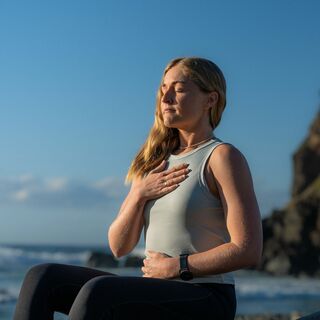
Welcome.
My name is Alexis,
Management and mindfulness practitioner.
Today we're going to be doing an exercise on perceptual repositioning.
Perceptual repositioning is an exercise that helps us to cultivate empathy.
It allows us to revisit a situation from the perspective of four different areas,
So that we're able to see from each different angle,
Putting ourselves into the shoes of another,
Becoming a fly on the wall observing the situation,
And also as a mediator of the situation.
Perceptual repositioning allows us to see a perspective other than our own.
It's a technique useful for cultivating empathy.
It's great for conflict resolution,
Compassion,
And genuinely helping us feel connected and see through the eyes of another.
We're going to start this exercise by firstly taking five big deep breaths to ground us into the situation.
So breathing in now through our mouth and out.
In through our nose and out through our mouth.
In through the nose and out through the mouth.
In through our nose and out through our mouth.
Allow yourself now to relax and settle and be present here in this exercise with nothing else on your mind other than what we're about to do.
I invite you now to remember a recent situation,
Perhaps one of conflict or one that didn't quite go to plan for you.
Perhaps it was an interaction with another where harsh words were shared or the outcome wasn't as desired.
I want you now to remember this situation vividly as yourself.
How did you feel in this situation?
What were the words that you said in this situation?
What did you do in this situation?
What were your actions?
Allow this to play through again in your mind's eye.
Visualize the situation exactly how it was from your perspective.
Allow your body to revisit the sensations you felt during the interaction.
Now,
Allow yourself to relax and settle and be present here in this exercise.
Now that you've relived the situation from your own perspective,
You've re-visualized the situation in your head,
You've relived what you said and what you did,
I want you now in your mind's eye to picture the situation and picture yourself floating up and out of your body and down into the shoes of the person that you were having the interaction with,
Looking back at yourself.
From this person's perspective,
What were they seeing in this situation?
Looking back at yourself,
What can you see?
As this person,
How is this situation making you feel?
What sensations are occurring in your body looking back at yourself from the perspective of this other person?
What were some of the things that this person said?
And what were some of the emotions that came up that made them say them?
Perhaps we can identify they were scared,
Angry,
Frustrated,
Or perhaps they were happy.
Relive the situation from the shoes of this other person.
I invite you now to re-visualize the situation in your head and as the second person,
Visualize yourself floating out of their shoes.
Visualize yourself now floating up to become on a fly on the wall,
Observing the situation of both people.
From this perspective,
You're nothing but an innocent bystander.
You're simply observing the situation for what it is.
You're seeing the situation as a third party.
You're neither yourself or the second person in the interaction.
What are you seeing?
What are you hearing?
What are you witnessing that's perhaps not being said?
Take a moment now to relive this situation visually from this third perspective.
I invite you now from your position as a fly on the wall to visually float back down and touch down to the ground.
However,
I don't want you to be yourself or the other person in the situation.
We're now going to become a fourth person.
We're going to become a mediator in this situation.
Based on what you've just witnessed from both the first and second person perspective and as the fly on the wall,
How are you feeling about the situation now?
What advice might you give to each person to resolve this situation in a way that's mutually beneficial for both and increases the connection rather than disconnection between both people?
As a mediator now,
I want you to visualize yourself resolving the situation in a fair and productive way for all parties involved.
Take a moment now and visualize the resolution to this situation.
How will we go and handle this situation now with the knowledge and experience that we've relived through this situation?
How can we go about resolving this situation and how can we go about not placing ourselves in the same situation in the future?
This exercise in perceptual repositioning is designed to help you understand what it feels like,
What it looks like to be in the shoes of another person.
It's designed to help you cultivate empathy,
To help you feel,
See,
And hopefully change the way we communicate with those around us.
Thank you for joining the session today.
If you ever have issues with conflict,
Communication,
And require resolution both personally and professionally,
I invite you to take the time to do this exercise again.