First,
Be very careful to say the meditation is when you're sitting on the cushion.
If that's the attitude,
You're in trouble.
The meditation is now.
The meditation is in this body and mind.
It's not on the cushion.
The body and mind,
They find itself in all postures,
In all activities.
And what you said is just so important.
It's exactly right.
It has to be brought into daily life.
And this is what you have the Eightfold Path for.
I didn't get that too much in this afternoon session.
But that is the whole point of the Eightfold Path.
There are path factors like right communication.
So when you communicate,
Don't say,
Oh,
Right now I have to do my emails.
Right now I have to answer the phone.
The phone is ringing.
So I can't sit on my cushion.
I can't meditate.
Instead,
Say,
OK,
I have to answer the phone.
I have to talk to another being.
I have to write my emails.
That is communicating with other beings.
So what I try to do now is practicing right communication.
And you should know what are the four factors of right communication and of wrong communication.
It's not enough time to go into details here.
And then you apply that when you write emails.
You apply that when you answer the mobile phone.
You apply that when you put the comments on some website or when you send an Instagram,
Whatever you call that,
To this and that person.
That path factor has to be applied.
And then your work,
That is part of your right livelihood.
So you're trying to have a job which is not offending the precepts which is in line with principles of Dhamma.
You plan your career in that area.
You try to bring that into your daily job.
That is part of the path factor.
It's very important.
Right intention.
Right thoughts.
So whenever you interact with beings,
Whenever you do your job,
Try to do your job with the intention of doing a service to someone.
It doesn't have to be something outrageous like saving other people's life.
We all appreciate simple things.
If someone cleans something,
If someone in the bank does our transfers,
Someone's on the computer screen,
Even monasteries have bank accounts.
So practice these path factors.
They can be applied in daily life.
Whenever anger arises,
Practice white effort,
Abandoning that anger.
It can be done.
Are you too busy when you're in your busy daily life?
Are you too busy to ever have anger arising?
The anger is quite capable to come however busy you are.
So that means you can also have thoughts of non-anger.
If it's possible to have thoughts of anger,
Why would it be impossible to have thoughts of non-anger?
That doesn't make sense.
So if you're not too busy to have thoughts of anger,
You can also have thoughts of loving kindness while you're driving,
While you're shopping.
And the mindfulness,
You already said exactly the right thing,
That a large period during the day mindfulness is not really operating.
So we have to gradually increase that.
I sometimes recommend to people when they have all their gadgets nowadays,
You can just program that,
That you get a reminder.
Once an hour,
Maybe four times an hour comes this,
Because they're constantly on their things there,
So they should actually see when the reminder comes.
Mindfulness.
Ah,
Mindfulness.
Ah,
Yes,
Yes.
Mindful.
What's happening?
What do I feel?
What kind of emotion is it?
Yeah,
And do you need another app in your heart?
Yeah,
This is what we're doing here.
You're all downloading the Dharma app into your heart.
So I hope there's no passing hours for the program.
I hope that we have a sufficient bandwidth,
That it all gets through to you,
And that the app can do its job.
So it's a gradual training.
You have to have,
In the beginning,
It's just occasional moments of mindfulness.
Then they become more and more regular,
More frequent.
Then you can maybe maintain mindfulness for even a minute,
Even in a stressful situation on some level,
And then for longer.
Just occasionally become used to,
Even when you're quite busy,
Occasionally to just stop a little bit and just look around internally.
I'm not looking around externally,
But looking around internally.
Screen your mind a little bit,
Occasionally,
Just within seconds.
What's actually going on?
What do I actually feel?
Is it a pleasant feeling,
An unpleasant?
What kind of emotion is there?
Is there aversion in my heart?
Is there stress,
Anxiety?
Am I relaxed?
Just to become used to occasionally just start screening that.
Then in this way,
You gradually increase that kind of mindfulness.
It's actually possible to,
If that quality is quite highly developed,
It's quite possible to be very busy and at the same time have an awareness.
Just like some people that can drive their car and smoke a cigarette and listening to the radio and talk to the person who is sitting next to them and then answer their mobile phone.
They can do all of that and they still have some idea what is a speedo.
They still keep the speed limit roughly.
That shows that it's quite possible.
The mind can do quite a number of things.
You will not get the same level of mindfulness like when you're on a three-month retreat in silence and you're sitting hours of formal meditation throughout the day and you're just in nature and so on.
Obviously,
That will be usually a much sharper level of mindfulness,
More continuous.
But you have to do what is possible in that situation and quite a bit is possible.
I always warn people that samadhi is not so easy in daily life.
That one,
This is not so easy.
You can do a little bit and particularly you can try to have a good time of formal meditation at the same time of the day,
At least half an hour.
That would be maybe an important part of your samadhi practice.
But the other seven path factors,
In my opinion,
Are eminently applicable in daily life.
Even in the year 2015 in Brisbane,
You're working in an office in the CBD.
Have a look at the Bodhi tree.
Can you see the Bodhi tree?
Yeah.
You can actually see it from your office?
Yeah,
I forgot.
That reminds you.
So see the Bodhi tree inside.
It's possible to do these path factors even nowadays in Brisbane in 2015.
So you had a very important insight there.
This is what has to be done.
Meditation is not when you sit on the cushion.
Meditation is your life.
As long as you're alive,
As long as you're awake.
The Buddha doesn't expect you to meditate while you're sleeping.
Although if you meditate a lot,
You will notice that even in your dreams there may be Dhamma activity going on.
But certainly you can't expect people to meditate in dreamless sleep.
But as long as you're awake and aware,
Then there should be development occurring as much as possible.
You can't separate your life and the meditation.
Many people like to do that.
Here's my life and the kids,
The jobs,
The duties,
The responsibilities,
The shopping,
My home,
My mortgage.
So now when I do meditation,
I go into a 10-day retreat.
I leave the kids behind.
I leave the job behind.
I leave the house behind.
I leave everything behind.
I take a parenthesis about my whole life.
And now I meditate.
There's some imbalance.
You have to work with your life.
And the kids and the job and all this stuff,
That is your life.
So you have to apply these path factors in your life.
Never get into this trap to think that meditation is only on 10-day retreat,
Only on your cushion.
That is a real severe limitation.
And Ajahn Chah was really good with that.
He instituted that also for the monks.
It was quite a bit of work.
And also in monk's life,
It's not like you can only sit on a cushion.
But he trained his disciples to use everything,
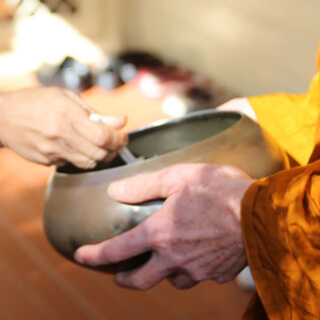
Washing a bowl,
Cleaning a kuti,
Concreting the foundation for the sala.
All of that can be used for applying and developing the path factors.
Okay,
So you better stop.
I'm sure you can't wait to wash out now and apply all these path factors into your life.
So the meditation doesn't stop when you leave here.
It only really starts.