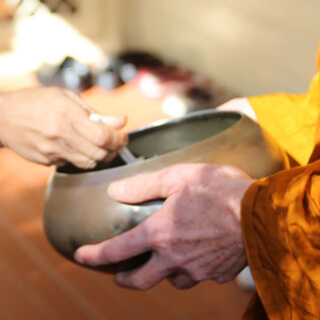
One aspect in our meditation is developing what is called Samatha,
The Samadhi concentration.
And that is often a very pleasant one.
Usually when the mind starts settling down and focusing,
Unifying on a subtle object,
There is lots of joy and happiness.
People may see beautiful light,
The body may be light like a piece of cotton down,
Like floating around,
Beautiful sensations throughout the body.
And most people enjoy that quite a bit if that happens.
On the other hand,
That may not so easily happen.
It depends on the level of parvami,
It depends how far the hindrances are already naturally reduced.
As I remember,
The characteristic like Venerable Sariputta and the very strong spiritual faculties,
Very strong faith,
Energy,
Mindfulness,
Samadhi and wisdom,
When they settle down,
Their mind goes almost immediately into a very beautiful state in terms of Samatha.
For most of us nowadays,
The paramis are not so high.
And then when we sit in meditation,
What actually happens,
We may not just get only bright light and joy and rapture and bliss,
But we may have arising what is called defilement.
We sit in meditation and anger may arise,
We may remember something that happened and we get very upset.
And instead of blissing out,
Maybe we are sitting there and there is anger,
Or maybe fear,
You sit down in meditation and then you start thinking about coronavirus and what may happen and this and that.
The economy and anxiety is quite strong or doubt.
Is it not working?
Can't I do it?
Is there something wrong with me or with the teaching or the wrong technique?
So then people often think something is wrong.
There is nothing wrong,
It is quite normal.
And one idea of the whole practice of sitting quite meditation is actually for the defilements to come up.
Because if the defilements don't come up,
How can we ever abandon them?
We will never be aware of them.
That is usually the situation with people who never take on a spiritual practice,
Who never meditate,
They are not aware of all this stuff that is going on in their heart,
In their mind.
And the whole idea of focusing internally is noticing it.
Because when anger arises,
Then we can see it,
We can become aware of it.
Once we become aware of anger,
We may notice that it is actually a lot of suffering for ourselves and also for others.
Once we see very clearly that anger causes us pain,
Disappointment,
Suffering,
It causes others also pain,
Disappointment and suffering,
And when that is clearly seen,
Then the mind can let go of anger.
The same with the desire,
The same with anxiety,
The same with doubt,
All the defilements,
Messlessness.
So there is nothing wrong when they come up.
And the point is then to use the other side,
Not samatha meditation,
But vipassana,
Insight,
Wisdom,
To investigate.
And the whole concept,
The whole technique of using the Four Noble Truths will work only well if there is some suffering.
Sometimes people complain to me that they don't really have enough time to meditate.
How can I do my meditation practice when I have to look after the kids,
They are young?
How can I do my meditation if I am just on a new job?
How can I meditate if I have just lost my job and I have to look for a new one?
How can I meditate when we are just building a new house?
How can we meditate when we are just moving?
There is endless excuses.
Once when the children are out of school,
Once I am retired and then I do the practice,
It gets delayed until people,
At the funeral it is too late.
But these are not valid excuses.
The only valid excuse I would accept is if you have absolutely no suffering.
If you can convince me that you have absolutely no suffering,
No pain,
No disappointment,
I would agree with you,
Very difficult to make much progress in the Dhamma practice.
But if you have absolutely no suffering,
You probably wouldn't have to make any progress because Bhavan has finished and you are an abhahant.
But the only ones who have absolutely no suffering.
As long as there is suffering,
It is a great opportunity to develop insight.
Because we have to dig in and look what is the defilement causing that suffering.
Where is that craving?
That is actually the underlying source of that pain.
Where is that attachment,
Where is that chilesa that is actually causing the suffering?
This is maybe a little bit harder work than just the blissing out in samadhi.
If one can do it,
And most people,
If they can do it,
If their happiness,
When it arises,
It is obviously fun and everyone enjoys that.
But working with pain and dukkha and suffering is not necessarily so much fun.
It can be hard work,
But it is incredibly rewarding.
Because with insight,
The defilements can be completely cut off.
Whereas samadhi will only be able to suppress them,
Even for a long time,
If it is strong samadhi,
But none of the defilements will be totally eliminated just from samadhi.
Whereas if the insight is strong enough,
The mind can clearly recognize that this craving now is actually causing that pain,
That experience,
That disappointment,
And then let go.
Then the experience of nibbana becomes possible,
And the destruction of the defilement becomes possible.
So it is very important not only to look out for blissing out,
But also to look out for dukkha and to see it as an opportunity.
Not to see that as something which is wrong and that shouldn't be there in my meditation.
Some people think for me meditation is sitting there watching the breath of the Buddha,
And just happiness and light and brightness.
If there is any pain and disappointment and problem,
Then something is wrong.
Don't see it as something wrong,
But see it as an opportunity to investigate the Four Noble Truths.
Then any suffering,
Any pain,
Any disappointment in your life becomes an opportunity.
And not a distraction to your meditation.
Some people think it's a big distraction.
How can I meditate if my boss is so tough?
How can I meditate if my spouse has dumped me?
This is a great opportunity so that the meditation can really go deep.
Lumpasamedhana describes an example in the early days when he was not yet a senior monk,
But just living with Ajahn Chah,
And getting used and trying to settle in in a foreign country,
Not speaking the language that way,
Slowly learning it.
Very tough food,
Very tough climate.
He is the only westerner,
Freakishly tall compared to everyone else.
It was quite difficult.
But Ajahn Chah quite deliberately made it difficult,
Not only for him,
But even for the Thai monks.
I remember even Lungpao Liem once in a Dhamma talk to all the western monks.
He said,
If you came to Lungpao Pong looking for comfort,
You will not find it.
It was never set up to keep everyone comfortable.
Because we may enjoy comfort,
But it's usually not very conducive for developing deep insight.
What Ajahn Chah had is a combination of sometimes very tough conditions.
He even used to say sometimes that he is torturing people as a technique.
Very tough conditions and at the same time encouragement and guidance how to use that to develop insight.
So that was a day in the opposite of Lungpao.
Monks would have to do the party mokka and they have all this all night program.
It starts at a certain time,
Maybe 7,
8 p.
M.
But time had not yet quite come,
So a couple of monks had assembled under Ajahn Chah's kutti,
Hanging out with Ajahn Chah,
Getting some advice and soaking up the inspiration.
But the lay people also like to do that.
So in Lungpao also made a few monks sitting there and then Ajahn Chah also got a lay visitor and was one of the local farmers.
So they chatted chatting.
Ajahn Chah was unique in his power,
Meaning he could relate to these westerners and people with PhD.
But he also could relate to subsistence farmers in those days quite remote northeast of Thailand who had only minimal formal education at school,
Maybe just a few years.
He could relate to genitals or rich people,
To poor people,
Everyone.
So this poor farmer came in and he was just chatting,
Encouraging him,
Inquiring how he is doing.
And as he grew up on the farm himself he understood the life,
What had to be done,
And how is the water buffalo settling in,
The new one as he settled in.
And while they were chatting,
At some stage the bell was going,
Which usually assembles all the monks now that the whole full moon day program has to start.
So Lumposomedo was sitting there and thought,
We should all go now,
But Ajahn Chah continues talking.
And it went on for quite a while and there was a lot of talk about that buffalo and about the other water buffalo and it didn't appear very important to Lumposomedo.
And as this farmer continued talking he started feeling that this is quite inappropriate.
He felt this guy,
This family now is holding back the teacher Ajahn Chah and all the monks are assembled in the Dhamma hall and they are just waiting there.
And it's very important stuff,
All the program and later party mocha.
And one person shouldn't hold that back.
He became a little bit irritated.
While Lumposomedo was sitting there and contemplating that it's not really right and this guy should maybe retire,
That Ajahn Chah can go there and we can all start.
Ajahn Chah would be very engaged,
Very friendly and talking to him and chatting about this nephew and this guy from the other village and how the oxen in the other village are doing.
And Lumposomedo started steaming away.
He was sitting there and he felt it's really completely wrong.
It's also different cultural conditioning.
This is more like classic American conditioning and you have to keep the time,
The schedule and cannot just keep all these people waiting.
And the more Lumposomedo was sitting there,
The more he started steaming and getting really,
Really angry.
The more engaging Ajahn Chah became with his visitor and the talk became louder and there were cracking jokes and it wasn't exactly in the deep dhamma that Ajahn Chah was teaching,
More like chit chat,
Cracking jokes.
And unfortunately because Lumposomedo has a strong wisdom faculty and Lumposomedo had the guidance from Ajahn Chah when he got really desperate and felt he has to speak out or he's exploding.
Something clicked and he started actually looking what is actually going on.
And he realized that he has intense suffering right now.
And he looked what is the cause of this intense suffering he's feeling right now.
And he realized that it's obviously not the villager who is talking there.
It's not the fact that Ajahn Chah now is too late for the scheduled proceedings for the full moon night.
It's simply his own attachment to his own view.
This is how it should be.
The time should be kept.
The sky shouldn't stay so long.
Ajahn Chah shouldn't encourage him but should end that conversation and make sure that he is in time for the full moon night program.
He realized this is the real cause of suffering.
And the moment he realized that he could let go.
It went on apparently a long time,
Maybe even two hours or something.
Two hours and a building up and more and more pain and despair.
And then finally when he got it and realized it's only his own attachment to this particular view,
Which is called losing all this endless suffering in his mind,
He could let go.
And when he let go,
He was sitting there just blessing out.
He was just so happy.
At that moment Ajahn Chah dismissed the form and said,
Let's go,
We are late for the Uposatha,
The Bhakti Mukha.
Most likely Ajahn Chah was knowing that he did some mind reading at times and he probably knew what was going on and quite deliberately held the farmer back and gave Lungpa Samedhan an opportunity to experience intense suffering,
This stewing in his own attachment to his own view of what it should be like.
This stewing in his anger and resentment and righteousness that he knows and how Ajahn Chah should be doing things in his monastery in the northeast as an American who had just recently arrived.
And he realized that.
And if Ajahn Chah had gone punctually to the Uposatha and Lungpa Samedhan had joined him and then they were sitting there at night and he might have been meditating and he probably would have felt much more pleasant feelings than during the build up of all this mental pain.
But most likely he wouldn't have had that insight,
He wouldn't have had that letting go.
He wouldn't have had that understanding of his attachment to a certain view which doesn't quite fit for northeast Thailand anyhow.
Just a view which he had built up from his conditioning in California where he grew up in the US,
Quite out of place anyhow.
But the attachment is so strong that he applied it.
So there was so much wisdom and insight which he got out of that pain and suffering.
And we may not have a teacher like Ajahn Chah.
I'm not even trying that torturing people because I'm aware that I'm lacking the quality of Ajahn Chah and some monks who had contact with him and they sometimes tried that but usually not very successfully because unless you notice that the person is doing that completely with your welfare in mind and really coming from deep wisdom and great compassion that is usually not taken on very well by people so I never even try that.
But even if you don't have Ajahn Chah torturing you,
You may have your boss or your mother-in-law or your kids or your parents or your neighbors.
I'm sure there's someone torturing you in your life,
Isn't it?
Anyone missing?
A single person at least who is torturing you?
So next time when that single person who is torturing you is doing their job don't be upset about them,
Be grateful.
Imagine that is now what the other said in Ajahn Chah and this person is now causing all this pain in your heart and then you ask,
Is it really this person causing the pain in my heart or is it my attachment,
My craving,
My defilements which is causing it?
And once we can recognize that,
Like Lumpus and Medo there seeing that it's actually not that person and what they're doing but it is craving attachment in my heart which is a deeper one and then we can let go and then we have an insight which can go deeper than just suppressing defilements and it becomes deep enough the relationship of the defilements,
Craving,
Attachment and pain,
Dukkha,
Is seen clearly enough and then the mind will let go so much,
So profoundly that the mind will disengage from the all-conditioned phenomena and will experience nibbana and the maga-pala until the realization of the Dhamma can occur but even if it's not on that level there may still be a tremendous amount of letting go and afterwards one may not be able to take one's views serious quite in the same way anymore even if it doesn't go to the full level of realization of path and food but there may be a kind of long-term reduction of attachment next time when it hurts,
Rejoice next time when someone is torturing you feel grateful,
This is the occasion to really look into it and to realize it's usually not the person torturing you there is some attachment,
Some craving,
Some sticking to views some chalice in our own heart which is a real torture once that is finally recognized,
One can let go of it that's the whole trick now of the Four Noble Truths,
To see that connection because it is normal for our mind that we want to get away from suffering once we can see it as clearly like we all know if we put the hand into fire it will hurt and so we don't do it we just have to see it on the same level of clarity that attachment,
Attaching,
Craving is just like putting the hand into the fire and then we will not do it anymore,
The mind will let go of craving and attachment