Most people,
If they have never meditated,
Struggle to keep quiet for a full hour.
And if you start the first time,
You may want to try something like 20 minutes,
Or better maybe half an hour.
Once you can have a session of about half an hour,
Then usually you can make good progress.
If you manage every day half an hour,
Or maybe at least five times a week half an hour,
That is consistent enough that there can be a long-term progress.
But if you really start,
Even 20 minutes,
I would suggest it's more important to enjoy the meditation.
It's better to sit 15 minutes and to really enjoy it than to sit one hour and to really hate it.
Because if you sit for one hour,
You force yourself and you really hate it,
Most likely after some time you will stop.
And meditation should be fun.
So if you compare it to school,
Meditation is more like the recess,
The break,
Not so much like the lessons which you don't enjoy but which you have to go.
So I would suggest that,
Not to have a fun approach,
Because meditation can be some of the best fun.
Actually,
In the end,
It can be the most satisfying and most rapturous and blissful experiences that are available in the whole universe,
Quite frankly.
Next one is a posture.
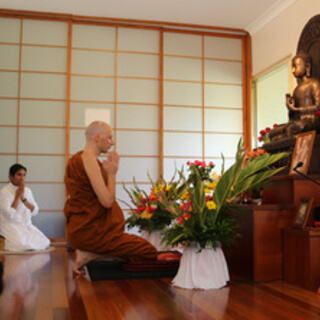
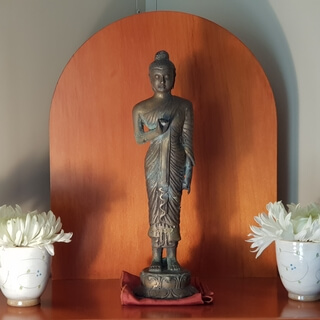
Again the cross-legged posture which you see with the Buddha statue and often even in the full lotus position.
For one,
It's based on an ancient Indian statue and usually they have the full lotus.
Sometimes you also see the Buddha statue in the half lotus position.
But both tend to be difficult for people who grow up in modern society.
When people grow up in traditional society where one sits on the floor all the time,
It's actually not difficult to sit like that.
It's meant to be a really stable and at the same time,
Comfy posture.
For most people,
That is not the case nowadays.
So if that is too much of a struggle,
It's better to sit on a chair or to sit on a stool or something like that,
Rather than trying to sit cross-legged when you can't really do it.
I started doing it really kind of regularly,
Meditating.
Once I started living in the monastery,
Waiting to ordain,
I was about 27,
28,
Still relatively young and even so it took me a few years of daily stretching exercises,
Daily sitting and doing special exercises to really get into the posture at ease.
If you don't have that time to do it,
Then sitting on a stool may be quite effective and actually walking.
Which one did you like better,
The sitting or the walking?
The walking,
Yeah,
Yeah,
I'm not surprised.
Particularly in the young male,
They often have a very strong restless energy.
When you think of the old Thai ladies in Isan,
They can sit all night.
In fact,
The monks often can't keep up.
These old ladies would just sit like a rock for the one-prana,
All-night sittings,
Just sitting there and the monks have to get up and do walking.
So if you prefer,
You can do walking meditation.
The typical way of doing it is not so much this circumambulating,
But the typical way is walking for a stretch of maybe 15,
20 meters and just walking up and down on the same straight stretch of walking path.
I can highly recommend that particular young males,
They often struggle.
They're not very flexible.
Often,
Women seem to be more flexible in the hips compared to the men or boys.
And then the restless energy and with walking,
That's much easier.
And it's a perfectly valid meditation and in some ways,
I would say it's maybe the most Buddhist meditation.
Of course,
The Buddha himself attained supreme awakening under the Bodhi tree in the cross-legged posture,
But other monks attained full release,
Liberation while walking.
And the Buddha would regularly cultivate walking meditation.
In fact,
There's still this kind of long shrine at the Mahabodhi Temple in Bodhgaya,
The very location where the Buddha attained enlightenment.
But a short time afterwards,
He was actually walking basically all night and contemplating dependent origination.
He did that while walking.
Then he would sit down again seven days in one go,
And then he would walk again.
There's also other traditions,
In particular in India,
When you're in India and you go to the Jain temples,
It's often not so easy to recognize on first sight whether it's Buddhist or Jain,
Because they have very similar figures who are also sitting cross-legged and meditating.
So you can find the sitting meditation in other traditions.
But I'm actually not really aware of any other spiritual tradition other than the Buddhadhamma where walking meditation is cultivated as a deliberate technique to that extent.
And already in the Buddha's time,
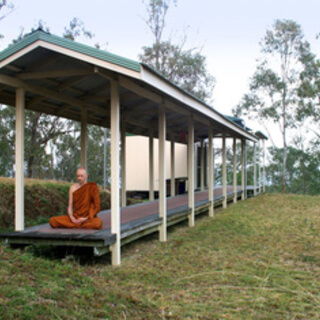
They had specially built walking meditation paths,
And specially built on a raised platform,
And specially built with a cover.
And they even had a Jhankamana Sala,
Like a walking meditation hall that you can walk even in the cold and wind and rain.
And in our monastery,
The Kutis,
All our five Kutis have actually a really nice walking meditation path,
Timber.
That's my favorite,
Actually.
It's really nice.
You can walk.
It's a little bit easier on the knees when you walk barefoot.
It's not so cold.
It's not so dirty.
It's really great on a timber walking meditation path.
Training the mind is quite different from training the body.
If you want to make the body really strong and fit,
What do you do?
Just like resting all day,
Sitting on the couch,
And is that how you get the body fit and strong?
How do you make the body strong?
Because in a running gym,
You have to move the body to make it fit.
However,
With the mind,
It's a little bit the opposite.
The mind runs on its own.
It's quite fascinating.
The body likes to be just at ease and relaxed,
And it takes effort to get the body really moving.
With the mind,
It's the opposite.
The mind likes to run around all the time.
It's very difficult to ever break and stop this incessant process of thinking and imagining images and fantasies and worries,
Emotions,
Feelings.
You can train the mind.
What is really good for the mind is to be still.
In fact,
Having the mind really still means jhanasamadhi.
Just an incredible regenerative,
Incredibly healthy,
And really good for the mind.
How did you go with the walking?
Could you stay with the feeling of walking?
And that's to be easy,
And that's fairly direct and quite strong.
I can recommend that,
And I'm just focusing on that.
Even throughout the whole body,
Once you get into the groove,
Sometimes you have a report and it feels almost like walking on clouds,
And it's so soft and different,
And walking without having to get anywhere.
Usually,
We walk to get from A to B,
And we're already thinking what we do when we're at B.
But like here,
Just walking in a circle,
Or if you walk up and down on the same straight stretch of ground,
It's obviously not the point to get anywhere.
It's just walking for walking,
Walking for the sake of walking.
It's quite beautiful not to have to get anywhere,
And to just walk and enjoy that here in the present moment.
One thing is that meditation is not just when we are sitting quietly,
But the Buddha has a very holistic approach.
The English word meditation,
The closest maybe is in Pali,
Bhavana,
Development,
Cultivation.
And the way the Buddha defines bhavana,
Bhavitabhanga,
There's a whole eightfold path.
All eight path factors have to be developed.
So throughout the day,
When we arouse mindfulness,
Being aware of what we are doing,
Knowing what we are saying,
Being conscious of what we are thinking,
That is also bhavana.
When we communicate,
When you shoot out an email or a text message,
Or upload a little video to TikTok,
That is all communication.
Some of our white communication,
If we can develop that,
The intentions,
The thoughts in our mind,
We can develop the white intention,
White thought.
We try throughout the day,
That is actually a very comprehensive exercise,
Throughout the day we try to abandon thoughts of an essentiality,
Desire,
Evil,
Harming,
Hurting,
Anger.
Whenever these thoughts come up,
We have to notice,
Oh,
These are the bad thoughts.
And we have to make white effort to develop good thoughts,
Like thoughts of letting go,
Thoughts of kindness and compassion,
And loving kindness,
And this goes throughout the day.
And you find if 80% of the time during the day you have rather thoughts of desire and compassion and anger and irritation,
And very few good ones,
And then you sit down and try to meditate,
Very difficult.
On the other hand,
If you manage that most of your thoughts are very wholesome,
Compassion,
Loving kindness,
Letting go,
Throughout the day,
Your communication with others is very wholesome,
Friendly,
Polite,
Reasonable,
Connected,
With the Dhamma,
Encouraging others,
Uplifting them,
And so on,
Then when you sit down,
Much easier to meditate.
The really important one is the precepts.
Do you all know the five precepts?
The first one is not to intentionally kill any living beings,
Including mozzies and midges.
I think I had a midge while I was meditating.
Shoot him away and he came back.
Some stage I decide,
Okay,
Let him bite me.
Because if you shoot him away,
He'll always come back till they finally get you.
So you wouldn't kill intentionally even an ant or a mozzie,
Much less an animal or a human.
Second,
Not to steal,
Not to take what is not given.
No shoplifting or things like that.
The third is to be committed to one's spouse or partner.
So once you're married,
And then someone else is more charming,
Who looks more attractive,
More handsome,
Tough luck,
Too late now,
You're committed,
You have to remain committed.
Number four,
There is truthfulness,
Not lying.
So whatever we say,
Whatever we communicate,
And nowadays communication is a lot not by speech,
But online,
Whether it's tweets or YouTube videos,
Whether you're updating your Insta profile or upload some photo,
Video,
Whatever,
Should all be truthful.
So much fake stuff out on the internet,
We shouldn't contribute to that.
The last one,
Not to take alcohol or any other intoxicants,
Anything that causes carelessness,
Intoxication.
It must be a tough one for teenagers nowadays.
But it may also be popular because you're the only one who can still drive the car.
These things are really important for your formal meditation,
For your samadhi,
Because if you don't keep these five precepts,
That has a real big impact on the mind.
And if you really break them,
And then you try to meditate,
It usually doesn't really work.
Whereas if you keep them very pure,
Then you will find that when you sit down,
You're at ease,
You have a clear conscience.
They say it's easy to sleep well when there's a clear conscience,
But it's even more easy to meditate well.
The other one is punya,
Good karma.
Good karma.
We can't have too much.
So when you sit down and you focus internally,
What you kind of encounter is a little bit in your karmic balance sheet.
And someone who has made lots of bad karma,
Very little good karma,
And then they focus internally,
It will be quite agitating.
It's not nice what you encounter.
The mind may be a little bit dark,
Unsettled,
Unhappy.
On the other hand,
A person who has made lots and lots of good karma and very little bad karma,
When they sit down and they focus internally,
They usually encounter brightness and happiness.
The mind is bright,
Happy,
Joyful,
At ease,
Relaxed,
Calm,
Tranquil,
Glad,
Because good karma and happiness are synonyms,
According to the Buddha.
So one way of improving our meditation,
Our samadhi meditation,
When we are formally sitting or walking,
Is keeping the precepts and generating good karma through generosity and other acts of goodness,
Making the mind bright.