Namo Tassa Bhagavato Arahato Samma Sambuddhassa Namo Tassa Bhagavato Arahato Samma Sambuddhassa Buddham Dhammam Sangham Namassami So we've arrived at the end of the first day of the retreat.
Often the first few days are the most difficult because we come often from very busy lives into a situation where everything is very simple and there's not really an awful lot for us to do.
And what is offered for us to do is,
At first it doesn't seem to be particularly interesting,
Just sitting hour after hour,
Focusing on the breathing,
Being with the mind,
The restless agitated mind,
Struggling trying to find some kind of peace and happiness.
It can sometimes be quite difficult.
So I congratulate you all on being here still,
Surviving the first day,
Because I know it's not easy.
And I think it's helpful for us to reflect on why it is we put ourselves through this.
Often we come on retreats because it seems like a good idea and somebody else came and had a wonderful time and last time we came and it was wonderful and then maybe we arrive and we find,
Well,
Have I made a big mistake?
Is it really quite so wonderful?
How is it going to be?
How am I going to manage?
Is there any point in all of this?
I think we have to acknowledge that much of our human existence is quite mysterious.
There are many things that we can't really know,
We can't really understand or appreciate fully,
We have to just more or less take them on trust.
And there's a particular teaching of the Buddha,
Which I think for most of us is something very much that we have to take on trust,
Which is the teaching about rebirth.
Talk about rebirth being reborn,
Coming back over and over again,
With a whole succession of human bodies,
Well,
Mostly human bodies,
Sometimes I think according to the scriptures one can get reborn in an animal body if one's very unlucky,
Unfortunate.
But just this whole idea of coming back over and over and over again.
And there's a teaching that the Buddha gave that I very much like to contemplate,
Which is his description,
What he says is that it's because of not understanding four things that we all have to keep on trudging around this endless cycle of rebirth.
I just have to keep coming back,
Keep repeating the same thing,
Just because we haven't fully understood certain basic facts of our human existence.
And he talks about it in relation to himself as well.
He says that you,
As well as I,
Have had to trudge through this endless round of rebirth,
To keep coming back over and over again.
But in his final birth,
Where he became enlightened,
He actually came to an understanding of these four basic essential facts of human existence.
And through understanding these,
He was able to free himself.
He was able to arrive at a point of understanding where he wasn't helplessly drawn in to yet another human lifetime.
Talk about getting off the wheel,
Freeing himself from the round of saṃsāra.
So during this time of retreat,
We have the opportunity to begin to contemplate these four things,
Begin to examine and perhaps increase just a little bit our understanding of what we call the Four Noble Truths,
That will perhaps help us in our own human existence to arrive at a point where perhaps,
If we play our cards right,
Maybe we too can get off this wheel.
Maybe we too can avoid having to have another of these human bodies.
Or at least perhaps we can cut down the number of human existences that we have to undergo.
They say that if you can actually become a sotāpanna,
If you can actually have a clear understanding of the path,
Even if you don't fulfill it totally,
At most you'll only have to have seven more bodies.
I don't know if this is encouraging or not.
But anyway,
Let's have a look at what these Noble Truths are,
These essential facts of human existence,
That the Buddha gave many,
Many teachings on,
Pointed to repeatedly in the course of his life after his enlightenment.
The first one,
I think,
Probably after today,
Is pretty obvious to everybody,
Which is the Noble Truth of suffering,
That life as a human being is difficult.
And as I said earlier on,
There are different kinds of difficulty.
Ajahn Chah used to talk about natural suffering and unnatural suffering.
And the natural suffering is just the discomfort that comes as part and parcel of having a human body.
There are certain aspects of it that we can't actually remember,
Or most of us probably can't.
Maybe some of you can remember,
But I can't remember actually being born.
But I can imagine that it must have been a pretty painful,
Pretty frightening process.
We can just take a little time to think about what it must be like being born.
You spent eight or nine months comfortably in a very kind of cozy environment,
Snug,
Cozy,
All one's needs supplied.
And they say that depending on how the mother is,
That actually has quite a powerful effect on how the process of development is for the fetus,
For the baby.
And if the mother is happy and at ease,
Then one's development for those nine months is a fairly peaceful,
Happy,
Comfortable time.
If,
On the other hand,
The mother is in a state of stress and anxiety,
Then perhaps it's not so easeful.
But certainly one's had nine months in a fairly,
Relatively secure environment,
And then suddenly there's the time of birth,
Which I'm told is extremely physically demanding,
Both for the child as well as for the mother.
Tremendous struggle to get out.
And then having got out,
Just the shock of arriving in an environment where the temperature is changing all the time,
Where one's every need is not easily being met necessarily,
Where one has a lot of very harsh physical impingement,
I can imagine that it must have been quite difficult,
Quite frightening,
Quite uncomfortable.
So we have the stress,
The difficulty of birth,
Which is part and parcel of our human existence.
Every one of us was born.
Having been born,
The body is then subject to just routine discomfort.
It gets hungry,
It gets thirsty,
It gets cold,
It gets hot,
It gets tired.
These are things that just happen quite regularly for all of us.
You know,
We've learnt how to take care of ourselves so that we can actually exist without really noticing these things very often.
We have this wonderful central heating in America,
Hot and cold water,
Pleasant bathrooms,
So we don't have to really.
.
.
Everything happens very easily,
Very smoothly,
And for most of us,
Most of the time,
There's plenty of food and drinks,
And we can often take care of ourselves without really actually having to experience much hunger,
Much thirst,
Much physical discomfort.
During this retreat time,
However,
There's probably times that you will experience certainly hunger and probably thirst and other forms of physical discomfort.
And this is very useful to actually.
.
.
As a way of helping us to appreciate what having a human body entails just in the ordinary way.
Then there's sickness,
All kinds of accidents that can happen to the body,
I know myself,
I tended to feel quite invulnerable,
Quite invincible until I got knocked off my bicycle.
And then suddenly I realized that this thing is actually quite frail,
Quite fragile,
It can easily be hurt,
It can easily be damaged.
We can eat something that disagrees with us,
And just having to vomit,
That's a very unpleasant experience.
Having fevers,
Having diseases of one kind or another,
Having things go wrong with the body.
This is something that I'm sure we've all experienced at one time or another.
Then the aging process.
I think probably almost all of us have begun to notice that process happening,
Noticing that maybe we don't remember things quite so well,
Maybe we don't see quite so well,
Hear quite so well,
Maybe we can't get around so easily.
This is something that we can expect,
This is a natural part and parcel of having a human body.
Just like if you have a motor car or anything,
After a time it wears out.
I think they are beginning to manufacture things that don't wear out,
Ever,
But most things sooner or later wear out.
These physical bodies are no exception,
They too wear out.
Apart from things like hips and corneas,
You can get corneas.
I know one or two people who've got new livers,
But mostly spare parts are very hard to come by.
This is important to contemplate.
And then we die,
The body dies.
That's a very major change that we go through as part of our human existence.
This is something that will happen to all of us at some time or another.
None of us knows when,
None of us knows how.
The one thing that we can be sure of is that it will happen.
I'm not trying to depress you,
But more just to contemplate the natural unsatisfactoriness of human existence.
That we really can't do anything very much about.
When we are fully conscious of it,
Though,
We can at least,
In a sense,
Be prepared.
We can at least avoid having unrealistic expectations of our human existence,
Of our own bodies and the bodies of those that we love.
We don't expect them to last forever.
So we can appreciate them,
We can enjoy them,
We can delight,
We can love.
But we have to learn how,
We have to appreciate that things are going to change.
And the Buddha encouraged us to really reflect on this very frequently,
To help us to avoid unrealistic expectations,
Help us to avoid getting caught up in attachment,
In demanding that things be other than the way that they are.
Which brings us on to the unnatural suffering that Ajahn Chah used to talk about,
And the Buddha himself also spoke about.
And this unnatural suffering has an origin,
There's a reason why we suffer.
And I think perhaps I'll talk about that a little bit,
Which will help us to understand what the unnatural suffering is.
Unnatural suffering arises because of desire,
Because of wanting.
And according to the way that the Buddha talked about it,
He talked about three different kinds of wanting.
Wanting to get,
Wanting to have something that one hasn't got.
Wanting to be,
Wanting to exist,
Wanting to become.
And then wanting not to exist,
Wanting to get rid of.
Just wanting to annihilate ourselves.
So we suffer because of wanting.
So this wanting is endless until we really understand it,
Until we begin to let go,
To abandon this wanting,
This desire.
So today perhaps some of you will have experienced a certain amount of wanting.
Wanting to be peaceful.
Wanting to feel comfortable.
Wanting the bell to ring.
Wanting a cup of tea.
Wanting to feel that you're doing all right.
To feel that you understand,
That you can practice.
And I'm sure there were many other kinds,
Many other moments of wanting something or other.
Right now I can't think of other examples,
But I mean it's infinite,
The different kinds of wanting.
So wanting to get something.
Sometimes we like wanting security.
Wanting material possessions,
Wanting prestige,
Wanting status.
Wanting to be with people that we really like.
Wanting to get away from the ones that we don't like.
Then wanting to become.
Wanting to exist.
This is a very difficult one really to appreciate,
Unless we meditate.
And we'll be talking about this quite a lot,
This desire to exist as a separate human being,
As a separate personality,
To be somebody.
And I don't know about you,
But this is one of the things that I've suffered most over,
This desire to be,
To exist.
Where all of us arrive as human beings on this planet,
We're equipped with a body and with a mind.
We talk about the five khandhas,
The body,
Feelings,
Perceptions,
Conceptions,
Or ideas,
Concepts,
And consciousness.
This is something that each of us has.
But the problem is that we tend to identify with it,
We tend to claim it as our own,
Rather than seeing it as being like the body is just part of nature.
The mind,
The aspects of consciousness,
Are conditions that arise,
That change moment by moment.
There isn't actually a permanent lasting me in there.
There is a me that I create,
And I put it together and I have this idea of who and what I am.
Now all of us do that.
We have an idea of what we are.
Then we also have an ideal of what we should be.
We put a lot of energy into comparing what we should be with what we think we are,
And trying to measure them up.
Every now and again we actually manage to be what we think we should be.
There are these fleeting moments,
And then we start worrying we might get conceited.
So we mess it all up.
It's a kind of a hobby,
It's a human pastime,
To be continually creating this sense of who and what we are,
And comparing it with our idea of who and what we should be.
And then we start noticing each other,
And we get ideas about who and what and how everybody else is,
And then we start comparing ourselves with everybody else.
And we think,
Well,
I'm not as good as her,
But I'm a bit better than her,
And I'm not doing too badly compared with him.
And then we get jealous,
And then we get competitive.
And our whole training in this culture is about comparing and about competing,
And about just trying to measure up to some kind of ideal.
And it's a very,
Very painful process.
Even when we actually succeed,
Even when we feel that we're the very best,
And we've kind of reached the ultimate pinnacle of success,
It's a very fragile kind of moment,
Because it only lasts for a very short while before we topple off,
And then we get plunged into dreadful kind of despair.
And it just goes on and on.
Very interesting,
There's a section in the Sutta Nipata,
Which is a collection of teachings of the Buddha that I very much like,
And it comes up quite frequently in a number of chapters in this particular collection of teachings,
Where the Buddha says,
If you think that you're worse than somebody else,
That's wrong view.
If you think that you're better than somebody else,
That's still wrong view.
If you think you're the same as somebody else,
Even that is also wrong view.
But in reality,
There's no me and there's no anybody else as a lasting entity.
These are just things that we keep creating,
The mind keeps creating,
In an effort to be,
To exist.
This second kind of desire that causes us so much suffering.
And then the third kind of desire is the desire to not exist.
The opposite,
The desire just to kind of blank ourselves out,
Or to get rid of ourselves.
When we're sitting here in meditation,
And the mind is just going on and on and on about some trivial matter,
You just kind of think,
Oh,
Why can't you just shut up?
Why can't you just stop?
And we sort of go through times of actually wanting to give ourselves a lobotomy just for a bit of peace.
Or we take refuge in alcohol or drugs or sleep,
And just find some way of escaping from the whole ghastly business.
Just because we haven't really understood that there is a way to end this suffering.
We don't have to annihilate ourselves,
That we can,
There's a much more skillful way of doing it.
So to recap slightly,
The first noble truth,
There is suffering.
And that this suffering has to be understood.
The second noble truth,
That there's an origin to this suffering.
And the origin of suffering is desire.
Desire to get,
Desire to get rid of,
Desire to be,
To exist.
And this origin of suffering has to be abandoned.
We have to actually abandon,
We have to let go of these desires.
And letting go doesn't necessarily mean getting rid of.
Sometimes we think,
Well,
I've got to just get rid of these desires.
I've got to stop having these desires.
I really,
I'm going to practice in order to get rid of these desires,
Because I can't stand having these desires.
Listen carefully.
Can you not hear yet another desire?
So it's like adding to our desire,
Adding to our suffering,
Rather than,
When we think of abandoning,
It's actually just letting go.
So letting go is not necessarily getting rid of,
But it's allowing it to cease.
Sometimes,
You know,
I use quite a strong visual image,
Like this grasping,
Which is like holding on,
Wanting to keep.
And this trying to get rid of,
Which is like trying to throw away.
But letting go is much more like a gentle relaxation.
An acknowledgment of things as they are,
Like when we're caught up in some kind of desire.
We can just recognize that that desire is there.
So letting go,
Detaching,
We're no longer clinging,
We're no longer invested in trying to get rid of the desire,
Because we realize that that's futile.
But we also realize that,
Like everything else,
Desire ceases when we stop engaging with it,
When we stop holding on to it,
When we stop recreating it.
This is very important from the point of view of our meditation,
Because we tend to think we've got to get rid of all our thoughts,
We've got to make the mind be quiet and peaceful,
We've got to get rid of all our unwholesome,
Unskillful desires.
Now in one sense this is true,
Like liberation is a state of peace,
A state of ease,
Where there isn't desire.
But if we don't understand the proper means,
The proper way of doing it,
We just get ourselves in a terrible tangle.
So letting go is actually just making the heart,
Making the mind very,
Very large,
So that the desire is there,
The thoughts are there,
Everything's there,
But we're allowing it to change and cease on its own.
We're creating the right conditions for it to change,
For it to cease.
This requires a kind of trust,
A kind of faith,
Because we're conditioned,
We're trained to engage with things.
We walk into a room and it's a complete mess,
And so if we want to have a clear space in the room,
We have to actually get busy,
We have to pick things up and take them out and get our mop and bucket and start cleaning.
This is what we have to do.
In a sense the work of meditation is like that,
But it's a different kind of cleaning that we do,
A different kind of means that we use.
And we'll talk about this some more later on.
So the third noble truth is that suffering ceases.
When we relinquish desire.
When we abandon desire.
It also ceases,
Or we diminish the amount of suffering that we experience in our lives,
When we understand the reality of our human existence,
When we appreciate certain facts of our human existence.
Because we no longer have unrealistic expectations of life.
We no longer look for happiness,
Look for security in the things that can never fully satisfy us,
That can never provide that security.
We come to an appreciation of impermanence or change,
That everything in the material world,
Even the most long-lasting plastic,
Even Mount Everest,
Is changing.
It can't last forever.
It's not a permanent,
Enduring phenomenon.
In fact,
If we kind of look at the micro,
If we get into kind of nuclear physics and such things,
We see that it's all changing in a much more dynamic way than we could possibly imagine.
So we begin to appreciate change,
Both in the material world and in our own minds.
Things change much more rapidly if we let them.
Sometimes we do kind of,
Through perversity,
Tend to keep things going for a lot longer than we need to.
This is what I've noticed in my own practice.
I manage to suffer a lot more than I need to,
Just through not really enabling change to happen.
But it does.
Change does happen.
And this is where we can see the world of conditions,
The material world,
The world of the mind,
We can see them in contrast to the refuges that I spoke about this morning,
Which we can see as being unchanging,
Which we can see as being secure,
Always there as a reference point for us,
Always there as a place of safety.
So,
As we come to appreciate the refuges more and more through our practice,
Through our contemplation,
We begin to,
And the more they become real,
We begin to live our lives in a way that feels much more secure,
Much safer,
In a way that brings a sense of freedom,
A sense of happiness,
That is very different from the kind of happiness,
From the kind of freedom that people seek in the material world.
People try and earn lots and lots and lots of money,
Millions and millions and millions of dollars,
So that they can have the most fabulous house,
So that they can have whatever food they want whenever they want it,
So that they can have the most wonderful,
Exotic,
Expensive clothing,
So that they can have all kinds of gadgets.
And they sincerely believe that if they have enough money,
Then they can buy a sense of security for themselves and for those that they love,
Their families,
Their children.
I don't know very many wealthy people,
Very many very rich people,
But I have a suspicion that unless people actually have a bit of wisdom,
No matter how much money they have,
There isn't really a great sense of ease and happiness.
I do believe that it's possible to be wealthy and happy if you're enlightened,
If you really understand how to live skillfully with your possessions,
With your wealth,
How to use it in a way that is beneficial for oneself and for others.
I'm not saying that wealth is necessarily harmful or bad,
But it does require an enormous amount of wisdom,
Of understanding,
To be able to live with a lot of wealth,
And similarly with a medium amount of wealth,
And similarly with no wealth at all.
Basically,
True happiness comes when we look for security in a totally different direction.
Then it doesn't matter if we've got a lot of money or nothing at all.
We can still feel secure,
We can still feel happy,
We can still live our lives skillfully.
So,
Suffering ceases when we abandon desire,
And it diminishes when we really appreciate the limitations of this human existence,
When we appreciate the fact of anicca,
Impermanence,
Dukkha,
The unsatisfactoriness of anything that exists in the material world,
And anatta,
The impersonality,
The fact that there's no enduring selfhood in this mind and body.
We'll talk some more about these three characteristics on another occasion,
But when we really understand these,
We can live without suffering in the same way.
And the fourth noble truth is the noble truth of the Eightfold Path.
Sometimes it can all seem a bit airy-fairy.
We talk about letting go,
Abandoning desire,
And so on.
And the Eightfold Path is just like the means,
Very simple,
Practical guidelines that are to be developed in our lives.
And the Buddha gave clear instructions,
Clear guidelines as to how to develop,
How to live this Eightfold Path in order to bring us to the point of perfect freedom and happiness.
It's presented in a particular order,
But often the Eightfold Path is represented as a wheel.
Like just behind me,
There's this wheel here,
Just below the shrine,
Which is a very commonly used depiction of the Eightfold Path,
The eight spokes of the wheel representing the eight different factors of the path.
And the reason for this is because they all work very much together.
If you really develop one aspect of the path,
The others naturally begin to come into focus,
Come into play.
So the Eightfold Path begins with right understanding,
Right view,
Which is understanding the noble truth,
Understanding the limitations of human existence.
These are aspects of right view.
Understanding why we suffer is an aspect of right view.
So right understanding,
Right intention,
Or right thinking.
We'll talk about this some more later on as well.
Right thinking,
Right speech,
Right action,
Right livelihood.
These are all like what we do with our bodies,
With our speech,
How we conduct ourselves.
These are related to the precepts that we spoke about yesterday.
Right action is like refraining from causing harm,
Taking advantage,
And actually cultivating action that is helpful and kind,
Motivated by kindness,
Motivated by compassion.
Similarly with right speech,
Speech that is truthful,
Honest,
Speech that is supportive,
Helpful,
Speech that brings people together,
Brings understanding,
Rather than speech which divides,
Causes unhappiness,
Friction,
And stirs up antagonism between people.
Right livelihood,
Ways of earning our living that are scrupulously honest,
That don't take advantage,
Don't cause harm to others,
Either other humans or animals,
That are respectful,
Kindly,
Realizing that sometimes for some people this can be very difficult,
To find a livelihood that really feels right,
Because very often even things that seem right when you first start off,
You kind of scratch below the surface and you find that actually it's taking advantage of somebody,
Or it's causing harm to someone,
And I realize that it's actually quite challenging to find a livelihood that is really completely right,
But at least to do the best one can,
To earn one's living,
To earn one's livelihood in a skillful,
Wholesome way.
And if you do have the good fortune to have a livelihood that you really feel very comfortable with,
As you reflect on it,
Then that's a great blessing,
To be able to live without any sense of remorse or regret about one's life.
So right speech,
Right action,
Right livelihood,
These all come under the category of Sila,
How we live our lives.
And then the last three,
Right effort,
Right mindfulness,
And right concentration or right collectedness,
These are very much to do with our meditation practice.
You can also divide the eightfold path into three,
Sila,
Samadhi,
Panya.
So how we live our lives,
As I've said several times already,
How we live our lives actually has an effect on how our meditation is.
If we live skillfully,
If we make effort to avoid causing harm,
Then the mind actually settles,
Collects more easily.
Like this retreat is structured in a way to support right concentration.
We're living in a way that we're not causing harm to others.
We're not speaking,
Ideally,
Or if we speak just very little,
So we don't have to remember a lot of foolish things that we've said,
Except I have to,
But you don't.
We're not having to remember unwholesome,
Unskillful things that we've done.
One of the things that you will find,
Probably,
I mean having said that during this time,
Is that you will find that if there are things that you've done in your lives that you regret,
That you probably will find them coming up into your meditation,
And so you have the opportunity to resolve them in some way,
In just a practice like self-forgiveness,
Kindliness towards yourself.
So this actually points to how the Eightfold Path actually does work together.
We can't really expect the mind to be very calm and peaceful.
If we've spent our lives taking advantage of others,
Hurting,
Harming others,
Or living in ways that harm ourselves,
Because when we sit down to meditate,
They come back,
We have to remember.
So a lot of meditation is just really patiently bearing with the memories of our past foolishness.
So this is where we need a tremendous amount of loving-kindness towards ourselves,
Tremendous amount of forgiveness and compassion towards ourselves.
If,
On the other hand,
We have the good fortune to have lived our lives from a very young age,
Skillfully,
Wholesomely,
Then our meditation is going to be much more peaceful.
When I was in Thailand recently,
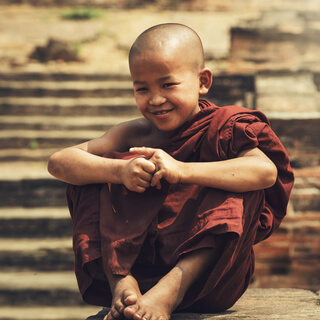
I saw quite a few very young monks.
In Thailand,
Often young boys,
Aged 8,
9,
10,
Their families will send them to the monastery to live as novice monks.
Some of them actually stay,
They're novices,
And then they stay,
And at the age of 20 they can take the higher ordination,
They can become monks.
And they can live as monks for their whole lives.
And I must say,
It took me quite a while before I came upon this teaching,
Before I became a nun,
So I managed to do quite a few unskillful things,
Wholesome things that I have to remember.
And I feel a sense of real,
We have this word mudita,
Real gladness,
Happiness,
At the good fortune of these young kids who are able to come upon a very skillful way of life and live their lives without doing a lot of foolish,
Unwholesome things.
So they don't actually,
They can expect to have quite a peaceful meditation.
But for most of the rest of us,
I'm sure we will probably have a few,
A little bit of a rough ride just because of the fact that we haven't had the good fortune to be protected in this way.
Most of us,
I'm sure,
Have done some foolish things in our lives that we'll have to remember.
So right mindfulness,
Right effort,
Right concentration.
So if we live skillfully,
Then the mind will settle and if the mind is settled,
Then what will arise quite naturally will be insight,
Understanding,
Right understanding,
Which is the third factor of the path.
So we come around in a circle with right understanding,
Understanding of the nature of our human existence as naturally an inclination to live skillfully because we see the harmful results of living unskillfully.
So if we live skillfully,
Then the mind will settle.
So it goes round and round and round in a circle.
That's a very skillful circle,
Really wholesome circle.
Gradually we refine more and more until eventually we arrive at a point of perfect understanding,
Which is what we call Nibbāna.
So these four noble truths are the basic teachings that the Buddha gave in order to help us to escape from the round of rebirth,
To escape from being helplessly pulled in to one birth after another.
We find a place of perfect ease that is not about finding perfect ease on the outside,
Perfect ease in the world,
The perfect situation,
The perfect body.
We find a place of perfect ease that is in the world of the unconditioned.
So the Buddha,
The thing that made him a Buddha was this perfect understanding,
Which allowed him to live with no more rebirth.
So although he,
After his enlightenment,
He continued to have a human body,
He certainly experienced sickness,
He certainly got old,
He lived to the age of 80,
And his body died,
There was understanding,
There was wisdom,
There was clear seeing,
And his life was one that no longer created the conditions for any kind of rebirth.
So each of us also has that potential.
We can just contemplate these noble truths.
I'll just quickly recap and then I think that will be enough for the evening.
Noble truth of suffering and the origin of suffering,
Noble truth of the cessation of suffering,
When we actually realize the ending of desire,
Letting go of desire,
And the noble truth of the eightfold path,
Which we need to develop in our lives,
Which we can develop in our lives.
Gradually,
Little by little,
As we develop this path,
We can expect to experience increasing freedom,
Increasing happiness.
It doesn't happen all at once,
It happens little by little.
And the Buddha,
He talked about,
He likened the teaching and the practice to the ocean,
And he said that it slopes down gradually,
And in the same way the path develops gradually.
So we need to be very,
Very patient,
Little by little.
Just like the dawn,
Like tomorrow morning we'll be able to contemplate dawn,
And right now it's dark,
When we come into the sitting it'll be dark,
And then gradually,
Gradually,
Gradually it gets light,
And we'll be able to see more clearly.
And in the same way with our practice,
Gradually,
Gradually we come to see more and more clearly,
To understand why we suffer,
And to live our lives in a way whereby we suffer less and less.
We'll still have to get old,
We'll still have to get sick,
And we'll still have to die,
But we don't have to suffer about it.
So I offer this for your reflection this evening.