Namo'tasa bhagavato' arhatu summa sambuddhasa Namo'tasa bhagavato arhatu summa sambuddhasa Udhang dhammang sanghang namasami I would like to express my warmest appreciation to my sisters here,
Atmananda Bodhi,
Atmananda Bodhi,
Atmananda Bodhi for their very warm welcome.
And also to express my amazement that such a place exists in the middle of San Francisco,
And to see such a large gathering of people who are obviously enthusiastic about hearing and practicing Dhamma.
It's quite mind-blowing really to have a monastery here in the city and very gladdening for me.
And as you know I live in Amarwati monastery which is a very big monastery in England with a large monastic community as well as places where people can come and stay as guests and come on retreat.
And it's a couple of years ago that the Sisters expressed an interest in coming here and the trust had already been set up in order to support Sisters teaching here and it was actually just a year ago or less than a year that you actually came to live here.
So it's really impressive to find such a lovely place for practice here in California,
San Francisco.
As we were talking about earlier and as all of you know I think our monastic community has been through or is going through quite a confusing time.
Things have happened,
People have become concerned,
Wondering what's going on and if things are all right and what they can do to help and what the way forward is for all of us and for this tradition.
And obviously it's a source of concern because this teaching,
This way of practice is very very precious,
Very precious to all of us who've had an opportunity to just taste it and experience the benefits of living in this way and practicing according to these teachings.
It's not a small thing and so naturally there's a concern and an anxiety,
A wish to make sure that such situations for practice can continue in the sense of well is it all going to be all right?
Is there going to be a monastic community?
Are the nuns going to survive?
And looking at the community right now it's a very real question in the sense of people disrobing,
Leaving.
Is there going to be anything left?
And it's a question for all of us really.
Is there going to be anything left and what can I do about it?
What's a skillful response to this situation at this time?
And of course there's been a tremendous amount of speculation.
I haven't,
I must admit I have not been very diligent in catching up with Facebook and websites and blogs.
I took a peep last December and actually that was enough because there is a tremendous amount of speculation and ideas and kind of taking of positions in regard to all of this and all coming from a very,
I'm not quite sure,
My sense is it's coming from a very sincere interest and a kind of wanting to figure it all out,
To make sense of it all.
You know find out who's right and who's wrong and what's really going on here and what can we do about it.
Very reasonable concerns.
There was a little exchange earlier on in the evening about where somebody lived and somebody said they live here and they live there and I was remembering something that I heard about a very,
Very old monk in Thailand.
I can't actually even remember his name but it's a story that Ajahn Sujito told me one time and then Ajahn Amaro mentioned a similar encounter.
I'm imagining it was the same teacher and he was,
When Ajahn Sujito went to pay respects to him he was very,
Very old and very,
Very frail and I think he was actually just you know lying on a kind of bed and Ajahn Sujito went to pay respects and this monk sort of beckoned him to come close and what he said to Ajahn Sujito was,
You knee,
You knee,
Which in Thai means stay here,
Live here.
And I think this is a very good teaching for all of us,
The idea of making one's place of refuge here in the heart.
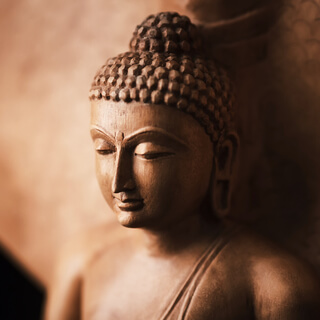
It also reminds me of the beautiful image that you have in the next-door room,
The Prajna statue and for those of you who maybe don't know Prajna or the the Paramita,
The Prajna Paramita is like the,
It's often spoken about as the perfection of wisdom.
I like the word discernment even better than the word wisdom.
Wisdom sounds a bit grand and highfalutin.
The idea of discernment to me points much more to this heart quality of really taking note of what's going on here,
How things register here rather than here.
I mean sometimes people concern wisdom,
Confuse wisdom with what happens up here,
But for me wisdom or discernment is a quality of the heart.
There can be some very bright people,
Very intelligent people,
People who have got very very good brains but actually not very much wisdom or discernment.
In fact some of the most foolish people are the most intelligent and some of the wisest that I've met are people who may be not very intelligent,
Maybe they don't have a PhD or even a degree or even you know high school certificates,
But people who have a capacity to respond to life in a very direct,
Very immediate way,
Who are able to read the language of the heart and for me this is a language that I trust.
I trust it much more than the language of the head.
The language of the head can be useful,
It certainly has its place.
I really enjoy actually listening to people who are very bright,
Very intelligent,
I love listening to scholars,
People who can analyse things and who can talk about things,
Who know a lot of things.
But the place that I really trust is the place of the heart,
The place of the heart that maybe actually doesn't know the right answer to things and I was contemplating this this afternoon in relation to our own community,
Our own situation right now and various issues that are arising and noticing how you know for myself it can be very easy to jump to a conclusion about what's right or what's wrong and what's going on and a kind of intellectual analysis and in some ways that's what we want to do,
We want to understand,
We want to know what the right thing to do is.
But I was out walking in the yard just doing some walking meditation which is one of the things,
One of my kind of recreational activities and it's also where I go if I'm confused,
Just to go and walk up and down on a path and just to really enjoy and this might sound strange to some of you but actually just to enjoy the pleasure of actually not having a clue,
Not having the answer and actually finding a place of peaceful abiding with not knowing,
Not knowing up here,
Not having an intellectual,
Not being able to analyse or to figure it out up here but just a sense of knowing and this might sound a bit arrogant but kind of knowing in the way that the Buddha may be new.
I mean I think he probably knew up here as well but my sense is that when we take refuge in the Buddha,
We take refuge in this quality of the heart.
We trust that.
It's interesting that in our tradition we have a training and encouragement like when we're going to give a teaching not to think about it,
Not to plan it but rather to trust the quality of presence,
The quality of awareness in the present moment because the heart can read things in a much more broad and subtle way than the head.
The Lumpur,
Atran Sumedha talks about intuitive understanding,
That capacity of the heart to register things at a level that is beyond the intellect.
It means that we have to sometimes be a bit daring,
A bit courageous and to be willing to give up on our views and opinions about things because views and opinions come from this whereas this quality of the heart responds to things at a much,
At a different level,
On the level of intuition.
Reading the heart,
Going for refuge to the Buddha,
To the Dhamma,
The truth of this moment,
The Sangha,
That quality of real interest and aspiration to to live in accordance with this truth.
The face that actually is able to dare to let go of the thinking,
The analytical mind,
To keep it in its place.
So I'm sure that the Buddha and the otherwise teachers would never have said,
You know,
Don't think about things,
Don't try to understand things at that level,
Don't plan,
Don't,
You know,
Organize your lives.
The brain is there for us to use.
It's a very wonderful faculty that we have,
The thinking faculty.
But I always encourage people to see it as a very wonderful tool or a very wonderful servant rather than the master to allow our lives to be led by the heart.
This of course can be very frustrating to people There's a wonderful story that Ajahn Amaroh told recently at Amarawati,
Talking about when Ajahn Chah came to England many,
Many years ago and he was visiting the monks.
They were living in a house in a very busy part of London,
A little bit like this house,
The same sort of layout.
It was a kind of high house.
I think it had five floors,
All very,
Very narrow,
A very narrow staircase going between them.
And it was actually opposite a pub.
Do you call them pubs or bars?
And so they would sit in meditation in the shrine room,
Which was sort of similar layout to this,
Similar shape,
Sort of two rooms kind of knocked into one.
And there'd be this really loud pop music coming from the bar.
And so they had even more difficult conditions to contend with than you have here,
Although I did notice a bit of disturbance during the sit.
That kid crying,
Very much like our minds,
Isn't it?
Anyway,
Ajahn Chah was staying with the monks in the Vihara and at one time the president of the Buddhist Society,
The London Buddhist Society,
Which is a very,
Very old institution.
I think it was founded in the 20s,
The 1920s,
With the aim of creating a place where people could study Buddhism.
Anyway,
He wanted to invite Ajahn Chah to come for a special festival and to give a talk.
And he came and he asked Ajahn Chah if he'd be able to come and Ajahn Chah said,
I don't know.
And he kept repeating this invitation and Ajahn Chah said,
I don't know.
And he would smile in a very kind of absolutely charming way.
One of the things about Ajahn Chah was that he had enormous charm and he also didn't mind frustrating people.
So the president would sort of come along and say,
You know,
Venerable sir,
Will you be able to come and speak at our gathering?
And Ajahn Chah just smiled.
I said,
Not sure.
Don't know.
And they were quite frustrated because they wanted to kind of put it on the programme and have a plan.
And Ajahn Chah just sort of kept,
He refused to respond,
Which of course was very,
Very difficult for this person because he was a polite Englishman.
Polite English people don't want to kind of appear to be frustrated or upset in public and certainly wouldn't want to lose their temper.
But Ajahn Chah was kind of pushing him to the limit.
And so there was a kind of question of,
Shall we send a car or not?
Shall we plan for him coming or not?
And in the end they decided to send the car and they finally sort of went,
Are you going to go?
Ajahn Chah said,
Okay.
And he went and he gave the talk.
So he was somebody who very much lived in the moment,
Rather than making a lot of plans into the future.
In that situation,
My sense is that he was trying to also convey a teaching,
Just to enable this person to see the extent to which he was,
Perhaps shall we say,
Addicted to having a clear plan.
As I said before,
It's not that there's anything wrong with having plans,
Having views about things,
But the encouragement is to hold them lightly so that we're able to,
To be able to make the right decisions.
The encouragement is to hold them lightly so that we're able to adapt when things change,
When things don't work out the way that we think they're going to,
The way that we would like them to.
This capacity to be with uncertainty is a quality that I contemplate quite frequently because for me it's like an antidote to the hindrance of doubt.
Those of you who are familiar with the teachings on the hindrances,
There are five,
Five of these hindrances in Buddhism.
We have lists,
Everything is listed,
Which is very,
It's actually very helpful because it can help us to remember different things like the four noble truths,
The three characteristics,
The three refuges.
And then we have these five hindrances.
And when we talk about hindrances,
They can seem like very bad news,
You know,
Oh,
This is something bad,
You know,
A hindrance.
But my sense is that the,
The only bad thing about a hindrance is when we don't recognise it.
But when we're aware that it's present in the heart,
That it's,
That it's,
A hindrance has arisen,
Then we can apply the appropriate antidote rather than being,
Allowing it to pull us off course,
Make us lose mindfulness.
So there's the hindrance of,
Of central desire,
You know,
Wanting to get something pleasurable,
Wanting things to work out in a particular way.
You know,
If we,
If we catch on to that,
Then it can obstruct our view of the heart,
Our capacity to read the heart,
To discern the way forward through the heart.
Because with these hindrances,
They take us up into the head.
No,
I want this.
How can I get it?
Or the hindrance of ill will or aversion,
And wanting to get rid of something that we don't like,
Or wanted to get rid of somebody that we don't like.
And I think all of us,
You know,
Those of you who live in family situations or communities,
There are times when,
You know,
We really upset each other.
And just think,
Only that person wasn't there.
And I think that's the only way that we can get rid of that person.
And if I don't get rid of that person,
Then things will be all right.
Or if I could just get rid of my anger,
Or if I could just get rid of my,
My greed,
Or if I could just get rid of my jealousy or my uncertainty,
You know,
The sense of these unpleasant things that we don't want to have to be bothered with.
And again,
It's a kind of leaning into the future,
You know,
When I,
Like sometimes when people come on retreat,
And they come for an interview,
And they say,
You know,
I've been practicing patients with this,
I just,
You know,
It just won't go away.
I know,
I say to them,
Well,
I think maybe that wasn't quite the right kind of patience.
You know,
If we're practicing patience to make something go away,
There's a little hook in there.
It's not the patient's willingness to bear with this condition,
That's willing to allow it to change in its own time.
So there's a sense of wanting to get rid of what we don't like.
Wanting to get rid of what we don't like.
Leaning into the future,
You know,
When I get rid of,
When I get rid of this pain,
Then things will be all right.
When I get rid of this doubt,
Then things will be all right.
When I get rid of this jealousy,
That'll be all right.
I used to have a terrible problem with jealousy,
And I just,
If only I didn't have this jealousy,
Then things would be all right.
Now I just try to recognize it,
If it's there,
Okay,
So this is what it feels like.
And I trust that having arisen,
Like everything that arises in the mind,
If we can just hold steady with it,
It'll cease.
Letting go,
Letting go of the desire for things to be otherwise.
Finding a place of ease,
A place of letting go of the struggle,
No struggle.
Which means just holding things gently in consciousness.
When we're able to be fully present with conditions,
Then we come to this place in the heart.
Then the faculty of discernment,
The faculty of self-discovery,
The faculty of self-discovery,
The faculty of self-discovery,
Then the faculty of discernment,
The faculty of the Buddha,
Is able to see clearly a response that is going to be for our welfare and the welfare of others.
Because how not to add to the harm and confusion in the world through interfering.
I'm not sure if this is making sense,
I hope so.
Then we have sleepiness,
Dullness,
That's another hindrance.
And this is something that I'm still working at becoming an expert on,
Because it's been an affliction in my elastic life for years and years and years.
And what I realised is that dullness is,
Sometimes we're dull just because we're exhausted,
Because we're really,
Really tired,
We've been doing too much.
Probably for all of you there are times when you've been at work,
You've come home,
You decide to sit meditation and just find yourself falling asleep.
And one can feel very discouraged by this,
But it may just be because you're really tired,
Not getting enough rest.
The other reason that I think sometimes that I began to notice in my own mind about dullness was because there were things there that I didn't want to look at.
There were things there that I didn't want to look at.
Sometimes if there's something we don't want to look at,
We struggle with it,
We try to get rid of it.
Sometimes there's a kind of resignation that can set in,
A kind of feeling of hopelessness,
Dreariness,
And we just blank out,
This kind of desire not to exist,
Not to have to deal with the difficulties of life,
The confusion of life.
Because for all of us there are times when life is very confusing.
So one solution is just to blank out.
The Buddha's recommendation with dullness is to contemplate brightness.
One winter retreat at Chidhurst,
We were following a very,
Very exacting routine.
This was a kind of phase that we went through as a community of having very exacting routines.
We were having to get up at about quarter to three,
In the morning that is,
Because the nuns had a cottage down the hill from,
Well they still have,
A cottage down the hill from where the main shrine room is.
So we would have to get up in time so we could walk up the hill to be there in time for the morning meditation at half past three.
Then we would practice all day until late into the evening.
So we were incredibly tired,
Quite apart from anything else.
At that time we had the Venerable Bonte Dhammawara there,
Who was a Cambodian monk who was very keen on colour therapy.
He was about 95 at the time and so he came to stay for the winter retreat.
So they set up this one special room for all of us who were particularly dull.
So the people who nodded most vigorously would be sent off to this room and in this room they'd had this kind of light set up with a yellow screen over it,
Very very bright light with yellow,
Because yellow was the sort of colour for dullness.
So we would all have to go to this room and stare into this bright light as a way of counteracting our dullness.
It never really worked for me.
I've still managed to fall asleep.
Anyway I experiment with all kinds of things,
All kinds of practices and the best one is keeping the eyes open or even standing up.
That's another thing you can do because it's much more,
Well it's much more disastrous if you fall asleep when you're standing up.
The Buddha's suggestion for like,
If it's really serious,
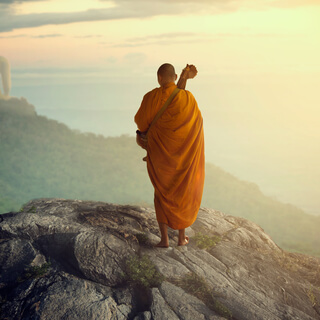
Is to sit on the edge of a cliff.
But I've never dared to do this because I thought I'd probably still fall asleep.
So I've never dared to try that.
But anyway,
He said as a last resort,
Just have a good rest and sometimes that is a good solution.
But if you do have a lot of dullness,
Contemplate the idea of having a good rest.
Practice sitting with the eyes open or standing up.
And the other thing is actually try to take an interest in what your mood is.
What's going on in there?
What am I feeling right now?
Is there something that's really troubling with me?
Is there something I'm really angry and upset about or confused about,
Troubled about,
That I'm not really managing very well?
Is there something I'm not really able to acknowledge about myself or about the situation I'm in?
And try to take an interest in that because my sense is that often dullness is just a kind of way of dealing with things that are troubling us that we're angry or upset about or confused about.
So these are some reflections about dealing with dullness.
The Buddha likened it,
The simile he used was like just being in a very,
Very small stuffy little prison cell with no light,
No window.
So you don't know which is up and which is down.
Can't see anything,
Not really in touch with anything,
Just sort of dull.
So dullness is not necessarily a kind of blankness.
It's often just a blanking out of a tremendous amount of stuff that's going on in there.
Sometimes these things are better examined like on the walking path or even just in daily life,
Just doing quite ordinary things.
You can contemplate,
You can just notice what your mood is,
What's going on.
You're just studying your response in the heart,
Discerning,
Cultivating this quality of discernment,
Interest,
Curiosity,
About our own personal processes.
Restlessness and agitation is another hindrance.
The kind of busy mind,
The busy mind and the busy body,
Always engaged with something,
Always doing something.
And I think our society,
I'm imagining it's the same here as in Britain,
Maybe not,
Or maybe it's even worse.
The feeling of if you're not doing something,
You know,
Fighting for some cause or,
You know,
Holding jumble sails or saving the whales.
Not that these are bad things to do.
I really do think it's good to save the whales.
I'm not being facetious.
I do think there are many,
Many good causes.
And I'm actually very interested in engaged Buddhism,
As well as the sitting on the cushion and just considering ways that we can contribute to the well-being of the planet,
To the well-being of each other.
It's not that I'm against that.
But are we doing it as an avoidance,
As a way of avoiding actually sitting quietly,
Reading the heart?
We can get into the habit of being busy,
The habit of being active,
Doing things,
Sorting things,
Or even in our meditation,
The habit of thinking and planning.
How many of us use our meditation time for thinking and planning?
Often when we meditate,
We can actually find that our minds think and plan better than other times.
And I've told this story many times.
I was a nanny,
Gary Carr,
When I was a novice.
As you know,
The novices are the ones who prepare the meal very often.
At Chittes,
We used to have to cook most days.
And I would spend my evening meditation,
If I was cooking the next day,
Just planning the meal.
And I'd plan it once,
And then I'd plan it again,
And then I'd plan it again.
The mind would just kind of keep going over it,
Over and over again,
Quite compulsively.
I was very,
Very interested in it,
Thinking and planning.
And eventually I made a resolution just to plan the meal once.
So I'd plan it,
I'd get it all figured out,
And then it would start again.
And I'd say,
No.
That was the only way I could deal with it.
As I said about the hindrances,
They're only problematic when we're not aware of them.
When we allow ourselves to tumble into following them.
So with restlessness and agitation,
Rather than just following that habit of thinking,
Planning,
Or doing,
Doing,
Doing,
Actually just for a certain time each day to decide,
This is my time for just sitting quietly,
Attending to the heart,
Just noticing what's going on in there.
If there's thinking happening in the mind,
Just noticing that,
Rather than following it or getting caught up in it.
Cultivating a sense of trust in the refuge,
The refuge of Buddha,
Dhamma,
Sangha.
Resting in the heart,
Resting in the refuge,
And just allowing the thoughts to go their own way,
And just allowing the thoughts to go their own way,
Rather than following them with more thinking or with more activity,
Or struggling to try to get rid of them.
That's the other extreme that we can go to.
And finally doubt,
Which I spoke about at the beginning.
Often our response to doubt is to think,
Or to talk to somebody.
Shall I do this?
Shall I do that?
Shall I do that?
Shall I do that?
And then talk to somebody.
Shall I do this?
Shall I do that?
So you go and talk to one person,
Shall I do this?
Or shall I do that?
And maybe you tell a whole story about it,
And they listen very carefully.
This happens to me sometimes,
Sometimes people come to me,
You know,
I'm not quite sure what to do,
Shall I do this or shall I do that?
And they tell a whole story about it,
And I listen very carefully.
And if I'm not mindful,
Then I say,
Well,
I think you should do this.
And they say,
Oh,
Thank you very much.
And then the next thing I know is they've gone to ask somebody else,
And gone through the same thing.
Because one of the things,
I don't know if you've noticed it about doubt,
Is that it never ends,
Actually.
You know,
Maybe you get one answer from somebody and you think,
Well,
Yeah,
That sounds good.
Or does it?
Maybe I should ask so and so.
They're wise.
I'll go and ask so and so.
You go and ask somebody else,
And they say,
Well,
I think you should do this.
Oh,
Okay,
I'll do that.
And it just goes on and on and on.
Or you decide in your own mind.
Like if you're not one who likes to go and talk to other people about your doubts,
You kind of think,
Can you make lists of,
Shall I do this or shall I do that?
And you weigh it all up and you think,
Well,
I'll do this.
Yeah,
I'll definitely do this.
I'll definitely do this.
And you decide.
And then the wobble happens.
The other side comes up.
And as I said,
It goes on and on.
Thinking just leads to more doubt,
Doesn't solve it.
Just coming back to the heart,
The place of disownment.
Allowing ourselves not to know,
Not to have the answer.
Rather than allowing this doubt to pull us into thinking and planning,
Leading us away from the present moment,
The place of refuge,
The place of liberation.
Of course,
This isn't always practical.
And there have been times when I haven't known and it is just a matter of making a decision.
So sometimes what can be helpful is just to use the presets as a guide.
Would this course of action actually be for,
Would it be harmful?
Would it cause harm?
Is it honest?
Is it asking me to do something that is not skillful?
That actually doesn't really feel right,
If I really think about it.
Or is it something that actually does seem to accord with the presets?
Does seem to be something that would support wellbeing for ourselves and others.
So sometimes we have to rely on our rational mind.
But to use it skillfully,
To really consider what is going to be for everybody's welfare.
And to really consider what is going to be for everybody's welfare.
And then having decided to stick with it,
Try not to tumble into the wobble.
You just do it and be willing to take responsibility.
If we discover we've made a mistake,
To be able to acknowledge that.
And I think one of the reasons that we have doubt is because we're frightened of making a mistake,
Frightened of doing the wrong thing.
You know,
After having decided,
We realise that actually this was a big mistake or that it's not the best thing to be doing,
Then if we can change that,
We change it.
If we can't change it,
We simply acknowledge,
OK,
That wasn't the best thing to do,
OK,
I made a mistake.
And see if we can learn from it.
So I don't want to make the mistake of sending everybody to sleep or talking for too long.
So I think I'd like to end the talk now and to offer these reflections and with the encouragement if anything has been useful then to pick it up and to make use of it in your lives.
And if it hasn't seemed useful then just leave it to one side.
That's fine.
And just to say how,
Again,
How delighted I am to be here and to have this opportunity to share some reflections on Dhamma and to wish you all the very,
Very best with your practice and just encourage you to really contemplate particularly these refuges and the possibility of being guided by the heart.
As the wonderful old monk in Thailand said,
You need stay here.
And see the