Rich,
And I think I could probably spend the rest of the day,
Maybe much of tomorrow,
Answering them all.
But there's a nice one here.
My question is,
Why don't I have questions?
Should I?
And the answer,
It's fine not to have any questions,
It's absolutely fine,
And don't worry about it.
And as to why you don't have any questions,
Don't worry about that either.
You will,
They'll come.
But it's not a sign of attainment either to have questions or not to have questions.
You're doing fine.
I'm just going to have to sort of pick.
This is from Susan,
Ciphers.
Can you further clarify the question asked of Ajahn Jammiyan the other night?
If there is no self,
Then who or what is reborn?
Is there a soul that provides the vehicle for the flow of continuity of causes,
Conditions from one life to the next?
Thank you.
This is a big one and obviously different traditions have different ways of viewing this.
And even within Buddhism there are different ways of it being talked about.
But my understanding,
According to the tradition that I've been trained in,
Is that actually consciousness,
I think I've spoken about this briefly before,
Is not a fixed continuous thing.
It's like a series of discrete mind moments,
If you like.
But it has the appearance of continuity because we're not sufficiently mindful yet to see the distinct separate moments of consciousness.
So in fact,
Rather than seeing it like a continuous flow that will continue after death into some future rebirth,
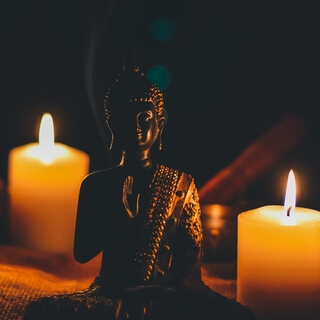
An image that I've heard used is like just of a candle flame.
And the moment of death is like the extinguishing of one candle but then the immediate lighting of another one.
The flame is passed from body to body,
If you like.
So the self still remains like an illusion and there is an illusion of continuity.
But what is actually like at the moment of death,
What actually happened is that if there is still some residual energy or desire for being,
Then that is that desire that will take you into some future birth rather than any self.
It's more just like a flow of energy from one body to another.
If on the other hand,
One has attained to a place of perfect understanding of the nature of existence,
Then at the moment of death there is a relinquishment of that desire for a future rebirth.
All the conditions to support a future rebirth simply aren't there.
And so at the moment of death it's like an extinction of the flame,
A final extinction of the flame.
There's no need for it to be relit anywhere else and the body can just quietly return to its elements.
So that's the way I've heard it described in our tradition.
And perhaps the best way of coming to a deeper understanding of this is just to look at the process of rebirth as it happens in the course of our own existence.
So rather than thinking in terms of the lifetime of this body,
The death of this body and then finding some future body,
We take rebirth all the time.
Every moment we're being reborn into some future state of existence when we identify with the conditions of mind and body.
So if we want something,
We want some future happy mind state,
Then if we attach to that desire,
Then when we experience that future happy mind state it's like being reborn as a happy person.
That's a kind of rather crude way of describing it.
But I suggest just really contemplating rebirth and the arising of self moment by moment in this lifetime rather than worrying too much about some future bodily existence,
But more just the future existence as we experience it.
Even in the course of this question and answer session you may find many different selves arising and ceasing.
So we would say that there isn't a soul,
That there isn't an enduring being that reincarnates.
We use the phrase rebirth rather than reincarnation.
So it's not like there's something that finds a body and is reincarnated,
But more that rebirth arises as long as there's that desire for existence floating around.
I think that's the best I can do with that one.
Would you please say more about the second,
Third and fourth foundations of mindfulness?
And how they can help us.
That's a question from Judy P.
Phillips.
Judy Phillips.
OK,
I'm glad you asked.
Because yes,
The body is reasonably easy to get a hold of how that works as a foundation for mindfulness and I certainly gave a lot of instruction about that.
The others are a little bit more subtle and not quite so easy to get a handle on in terms of practice.
I'll try to give some pointers because I think that's the best I can do.
Pointers and the encouragement just to,
Even if you don't completely get it this time,
There's going to be a tape.
And so you can have a listen to the tape and maybe little by little there'll be a sense of how it works in practice.
So the second one is Vedana,
Vedana Nupasana.
Vedana is feeling which is different from emotion.
And usually in our language when we talk about having one's feelings hurt it means some kind of an emotional reaction.
Whereas Vedana is just simply a noting pleasant,
Unpleasant or neutral,
Neither pleasant nor unpleasant.
Certain emotions often,
Well I mean they're always associated with one or other of these feelings.
So if you're feeling inspired,
Happy,
That's usually a pleasant feeling.
If you're feeling discouraged,
Bored,
Depressed,
Doubtful,
Irritated,
These are usually what we would describe as unpleasant feelings.
But that's not a hard and fast rule necessarily.
So I invite you to investigate for yourself when you're in the middle of some emotional state.
Is this pleasant?
Is it unpleasant?
Or is it just kind of neutral?
With feeling the traditional teaching says well with pleasant feeling there's an attraction to it,
We want more of it.
A kind of we reach out to grasp pleasant feeling.
With unpleasant feeling we want to get away from it,
Want to get rid of it.
These are the instinctive reactions when we're not mindful.
With neutral feeling we can just go to sleep,
We don't notice.
So when we use Vedana as a foundation for mindfulness,
Like you might decide to use a period of meditation just to contemplate Vedana,
Say outside when you're doing walking meditation or in the hall here sitting or in the course of a day,
You might want to just say okay today I'm going to be attentive to Vedana.
So instead of just falling into habitual reaction,
See if you can notice this is unpleasant feeling.
Or if you have fallen into a struggle,
See if you can establish mindfulness by just simply noting unpleasant feeling,
Rather than following that struggle for things to be otherwise.
It can be very illuminating just to try to notice neutral feeling.
Because as I said those are times that we often just go to sleep,
We don't notice.
So in the course of the day you can contemplate neutral feeling,
The times when nothing very much is happening,
There's no great passion,
Either to get something that you really want or to get rid of something that you really don't want,
But things are just you know reasonably okay.
So you can also use that as a contemplation and you can contemplate well is it really neutral,
Is it really neither pleasant nor unpleasant,
And to see how even something like the breath which generally speaking is fairly neutral,
But if we're really present with it,
Is it neutral?
Or is it sometimes just slightly pleasant and other times slightly not so pleasant?
Is the in-breath pleasant and the out-breath unpleasant?
You can play with it in that way.
So Vedana as a foundation for mindfulness.
Citta,
The mind itself,
The state of mind,
And to appreciate that we can make a distinction between the state of mind and the mind objects.
The state of mind is like the mental climate or the atmosphere.
And as I was saying when I talked about this the other day that the traditional teaching talks about knowing the contracted mind as contracted,
Knowing the expansive mind as expansive,
Knowing the agitated mind as agitated,
The doubting mind as just recognizing the quality,
The mental climate.
I found this useful in my own practice.
Sometimes there's just a kind of a mood of just not feeling very bright and positive.
And I can easily just get pulled into a struggle with that,
Just feeling that it's not right,
This is not right,
This is not okay,
Things are not okay,
I'm not okay,
My practice is not okay,
Nothing is okay.
And just actually stopping that by saying,
Okay,
What is the mind like right now?
And even using a label,
Using some metaphor to describe it can be helpful as a way of just bringing the awareness to the state of mind.
So metaphors of the weather can be very handy,
Like noticing what the weather is like today,
It's kind of a bit dull and cloudy and that can be actually quite a sweet,
Sort of slightly faintly melancholy state.
So sometimes the mind is like that.
Other times it's really bright and sunny,
Other times it's stormy,
And kind of just agitated or restless,
And just seeing if you can begin to develop a vocabulary for just the mind,
The kind of subtle shifts in the quality of mind,
And just being attentive to how that changes throughout the day.
And I think that probably when I was talking about it before,
You can actually notice sometimes,
You can be feeling very expansive and kind of at ease with everything,
And then somebody will say something that upsets you,
Or you'll remember something that is really disturbing,
And immediately there's a kind of contraction that happens,
It's almost like a physical thing.
So to begin to notice that,
And then the mind objects,
Which are like visitors,
Usually when we're not mindful we're so identified with the mind objects that they take up the whole of the mind space.
You know,
If the mind is filled with thought,
That's all there seems to be.
But when we begin to make a distinction,
We begin to see that we can create a sense of spaciousness around the thought,
We can notice a thought arising,
We can notice a space around it,
We can examine it and notice when it's left.
We can also contemplate the teachings as dhammas,
As mind objects,
So you can quite deliberately bring up,
Say,
The Four Noble Truths,
Like if you're really struggling with something you can say,
Well,
This is suffering,
The First Noble Truth.
That can be very helpful,
Just to use the contemplation of the teaching as a way of bringing awareness to what's happening rather than getting lost into some kind of reaction to it.
So I think that's all I'd like to say for now about the second,
Third and fourth foundations,
Just to go over the list again,
The first foundation is body,
Contemplation of body and many,
Many different ways of doing that.
The second one,
Contemplation of feelings,
Pleasant,
Unpleasant,
Neutral.
And any state has a corresponding feeling associated with it.
Any state of mind or body,
Any perception,
Any sankhara,
Mental formation,
Has an associated feeling,
Pleasant,
Unpleasant or neutral.
Then the mind itself,
The kind of vessel,
If you like,
The container.
Just one more thing about the mind itself,
It's fun as a contemplation.
Just whether the mind is in the body or is the body in the mind.
That's just a question for you.
Just beginning to get a sense of the fact that the mind can expand to the limits of consciousness,
To the limits of the universe,
Or it can contract down just to the tip of a pin or a needle.
We're very,
Very focused on the breath state,
The tip of the nose.
The mind is really just very one-pointed or it can be very,
Very expansive.
So the mind itself as a foundation for mindfulness and then mind objects,
Which can be a noting of the kind of thinking,
The thoughts that you're having,
Or using an aspect of the teaching as a way of establishing that quality of presence,
Rather than being lost,
Caught into a reactivity.
So we can actually even use the hindrances that I spoke about this morning as mind objects,
As a way of just anchoring the awareness with,
Okay,
Right now this is what lust feels like,
This is what aversion feels like,
This is doubt,
This is restlessness,
This is sleepiness,
Sloth torpor,
However you want to describe it.
This is how it tastes,
This is how it manifests.
So I hope that answers the question,
Judy.
An S is it?
An San?
San?
Okay.
Dear Ajahn Chandasiri,
During walking meditation,
Do you recommend keeping the attention on the feet and the bodily experience of walking,
Or might one also expand one's awareness as we have been doing while sitting?
And a short answer to that question is yes.
When I teach walking meditation I recommend focusing the attention on the feet and the bodily experience of walking,
Just because I think when we first start practicing with the walking meditation,
It's helpful to have something very obvious to focus on.
And that's actually what I do in my walking meditation,
I focus on the feet or the body,
And so I tend to teach what I do myself.
But there's absolutely nothing to say that one can expand one's awareness and one can contemplate body,
Feelings,
Mind,
Mind objects in exactly the same way.
So I think I've also spoken about how you can,
When you're walking,
You can just say,
Who's walking?
Or,
Is anybody there?
Or you can also use a kind of mental noting,
Like sometimes if I'm caught up in obsessive worrying,
Sometimes as I walk along the path,
I can notice the mind struggling with this worry,
And then I can just go,
Worry,
Worry,
Worry,
Worry,
Worry,
Worry,
Worry,
Worry,
Worry,
Worry,
As a way of just like playing with the mind,
Playing with the mind state.
So there's many,
Many different things that you can do.
The important thing though is to really make sure that you don't get caught,
Carried away from the present moment.
So to,
You know,
Whatever you can use to bring the awareness into the moment while you're doing walking meditation is what I would recommend.
Okay?
And a nice,
I've been experiencing a lot of gratitude for the teachings and this opportunity to practice,
And for the awakening of sanity,
Some in brackets,
That has resulted.
Could you say something about the feeling of gratitude?
This is a very wholesome quality,
And it's in the Mahamangala Sutta,
It comes as one of the greatest blessings.
It's a very beautiful quality,
It's an uplifting quality,
It's associated with a quality of well-being,
And definitely something to be cultivated.
So if you're feeling utterly wretched and miserable,
I suggest you make a deliberate effort to contemplate the blessings of your life,
To really cultivate a sense of gratitude as an antidote to self-pity,
Despair,
Dullness,
Aversion,
Negativity,
Jealousy,
All of these unpleasant things you can just bring up a sense of gratitude.
And use it as a way of brightening the mind,
And if it arises naturally then just enjoy it.
Very,
Very good,
Very lovely.
And could you please say more about doubt and its antidote?
Right now I'm contemplating a feeling of doubt in my own mind that has arisen.
So we can use doubt to establish the awareness in the present moment,
Or we can allow it to pull us into a state of agitation.
Shall I do this?
Shall I do that?
What's the right thing to do?
What will be the best thing?
It can appear like a very wholesome quality,
Because we want to do the best,
We want to make the best use of this opportunity.
We can also notice that when we do that there's a little hook in there.
It may be fear,
Because we don't want to waste this opportunity.
It may be a subtle kind of greed.
We're afraid that we're going to miss the best of the goodies if we make the wrong choice.
I find it helpful,
I had some very good advice years ago from a Christian nun.
She was a very wise old lady,
A very close friend,
And she said,
Well,
If I have a decision to make and I'm not sure what to do,
Then sometimes what I do is I ask people who I trust.
If I have a wise friend and I really can't find my way forward with it,
I'll talk it through with them.
And with her she would pray about it as well.
And I can't actually remember what else she said,
But certainly it's alright to consult with people that you trust,
That you respect.
Also using the precepts as a guide,
Also using the reflection on the intention.
Is my intention wholesome or is it unwholesome?
If there's an unwholesome intention there,
If it's coming from a strong desire just to sort things out and be done with the doubt,
That's a kind of aversion,
Isn't it,
A negativity.
If on the other hand the intention is wholesome,
A genuine interest in supporting or helping a situation,
Then we can follow that.
And maybe the most important thing in making a decision if there's a doubt is a willingness to take responsibility.
So if we finally decide what we're going to do,
To follow it through,
But with the understanding that even if it turns out not to have been the best thing,
To say,
OK,
Well,
I can take responsibility for that.
The most difficult thing I think is when we make a decision about something and it turns out not to be the best thing is the tendency to find someone to blame.
OK,
Well,
I did this but it wasn't really my decision.
It was because of what she said or whatever,
Which just perpetuates a state of fear and anxiety.
It doesn't lead to a sense of well-being and confidence.
So it's making a decision but being willing to get it wrong.
Another very useful thing with doubt is to notice the automatic wobble that arises as soon as we've decided something.
I was giving a talk on sort of watch the wobble because that can very easily kind of perpetuate the sense of doubt.
You know,
You decide something,
You say,
OK,
Yes,
I'm definitely going to do this.
Right,
I've decided.
Well,
I think I'm going to do this.
On the other hand,
I remember reading somewhere that this is better.
And of course so and so said that you should never do that.
So maybe I'll do this instead.
And then you decide again and then,
Well,
I'm not so sure.
You know,
When I did that last time it wasn't so good.
And it just,
It's endless.
I find sometimes if I've got a big decision,
Just giving myself a holiday from deciding can also be useful.
You know,
Say,
OK,
Well,
I'm not going to decide until tomorrow.
And really be very clear about your determination not to decide until tomorrow.
Not to fill up the whole day with,
Well,
Maybe I'll do it,
Maybe I won't.
I'll think about it,
Making lists of pros and cons and,
You know,
Give yourself a holiday.
And then when the time comes,
Decide and just follow through.
So these are a few strategies that I can suggest in regard to working with dirt.
But maybe the most important one is just making peace with it.
Making peace with not knowing what's going to happen.
And the decision will,
It'll arise sooner or later.
But it's a very interesting one because we can suffer so much with doubt,
With not knowing.
But if we can just really say,
OK,
Right now there is doubt,
Using it as a foundation for mindfulness,
This is what doubt feels like,
This is what it feels like to know.
And then,
You know,
Actually taking an interest in it.
Sooner or later the decision will get made.
You'll do something.
And either it'll be the right thing or it'll be the wrong thing and you'll learn from it either way.
So either way you win.
I'm just going to see if Sister Jithapala would like to say anything more about that.
I may just support the last reflection you gave that for me contemplating doubt is somehow the most useful step because I have tended to really find the best solution for everything.
And it was never the best solution.
At some point I got just this image of,
I don't know how you call that in English,
There's a Greek mythical serpent,
I think it's called Houdra in German,
But in American you say probably Hydra.
And it's famous for if you cut off its head,
Twelve new heads are growing.
So at some point I realized that if I want to answer kind of a question,
That's okay,
But I have to be aware that each answer brings up twelve new questions.
So it will be never the end of doubt.
And of course sometimes I have to make decisions and then I consider and I do it as good as possible.
And I tend not to call it a mistake any longer when the outcome is not what I was expecting.
It's just a learning step.
So that makes me quite peaceful most of the times.
And just a kind of P.
S.
That sometimes there is a result and you think,
Oh dear,
I shouldn't have done that.
I always bring up a kind of don't know at that point because very often,
Sometime later one realizes that it was exactly the right thing to have done.
You might have said something that seemed a bit harsh or mean and sometimes the other person will come back and say,
Do you remember that conversation we had three weeks ago?
It was exactly what I needed to hear.
So to actually allow yourself to not know whether it was the right thing or not can be helpful rather than being too quick to judge.
Please address under which circumstances it can be appropriate or even productive to share with someone that they have hurt you and how do you verbalize this with metta.
Thank you.
The Buddha said that there are.
.
.
He was asked a question one time whether it was OK ever to use speech that was unwelcome and disagreeable.
And his response was,
If what you have to say is truthful,
Beneficial and agreeable.
.
.
Hang on.
If it was truthful and beneficial and agreeable,
You could utter it knowing the right time and place.
If it was truthful but not beneficial and agreeable,
Then better not to utter it.
If it was not truthful but would be beneficial and agreeable,
Better to leave it.
If it was truthful and not beneficial and unagreeable,
Don't say it.
If it was untruthful,
Beneficial and unagreeable,
Don't say it.
If it was truthful,
Beneficial and even if it is unagreeable,
Then you can say it.
But knowing the right time,
The right situation.
So with giving feedback to somebody,
It's important to find the right time.
The first,
Most important.
.
.
I mean,
As I said,
That it's true.
You make sure you've got your facts right.
That it's something that you're saying from an intention or you really believe that it's going to help the person to hear this,
Whatever it might be.
And it's certainly going to help you to express it.
Other things that the Buddha said is to notice if there's a heart of kindness.
So it's very interesting that you ask about how to verbalise this with metta.
You have to wait until there's a feeling,
Let's say,
Until you've let go of the feeling of aversion or blame that you might feel or the wanting to put somebody right.
If there are these things in your heart,
Then it's better just to wait.
The result tends to not be so good.
So to wait until there's a feeling of really wanting to support well-being and really caring about your relationship.
I had a situation some years ago where things were difficult.
I was living with some friends and I was getting a growing sense of unease about how things were working among us.
And I tend to hold back from sharing difficulties.
It's not something I'm very comfortable doing.
But because I really cared about our relationship,
Our friendship,
It meant too much to me just to let it keep happening on this level of disconnection.
And so I realised I needed to speak about it.
And so I waited until there was a situation where I knew that we had plenty of time.
I knew we weren't going to be interrupted.
We'd just had breakfast so our bellies were full,
We were comfortable in ourselves.
And then when all of these circumstances came together,
I was able to talk about what I had seen happening.
So I was clear about what I was describing.
I was clear about how it made me feel.
And I was clear that I was actually checking out because I didn't know what they were thinking.
So I wasn't making assumptions about what was going on for them.
I don't know if any of you are familiar with NVC.
Marshall Rosenberg talks about,
First of all you bring up the observation,
What do you notice?
What have you observed,
What have you heard,
What have you seen?
Not what do you presume.
So what have you seen,
What have you heard,
What is the result,
What do you feel when you hear and see these things?
You're not assuming anything about what the other person has in their mind.
And it was incredibly helpful in this situation because I described what I'd seen,
What I'd heard,
How I felt,
And what that feeling was based on,
Like the need,
The underlying need.
And I invited them to respond,
Is that really what was going on for you?
And they responded very honestly and they were able to say,
Well to some extent it was,
But it wasn't because of what you'd done.
We were able to get into a really good discussion about it and it just really cleared the air.
I think it's safe to assume that we never want to hurt each other,
That if we do hurt one another it's usually because of some kind of hurting that we're experiencing.
So if somebody has hurt us or if we have experienced pain as a result of something they've done or said,
Then it can be very helpful if we really care about the relationship to find a way to bring it out into the open.
I think one of the fears is that it's going to destroy the relationship forever if we say something that might be perceived as unpleasant or difficult to receive.
But I've always found when I can do it out of a genuine concern and interest and a love of that sense of connection and friendliness,
That the result is always much,
Much better than if I stay hemmed in through my own fear of what might happen.
I'm quite sure Sister Chitapala will have something to add for this one.
So I'd like to invite her to say some more.
It'll certainly be useful.
I must say we have sometimes little NVC training sessions and I,
Tranjana Surya and myself,
We were attending and learned a lot from that.
For myself I can just say that distinguishing between the observation and the judgement which comes up in myself,
The feelings and the underlying judgements,
That it was really necessary for me to learn to distinguish between them and not to assume that my judgement is in any way,
Or my interpretation of the situation is in any way correct.
As an example I just can say that I probably,
Like many of you,
Have been growing up and learned a conditioned response that when my mother is angry that I'm the cause of her anger.
When she was angry I felt guilty.
So with a closer look at it that actually we get angry not because of the other person but because of the way we interpret things and also that we have certain needs which are not met,
Which make us feel dissatisfied.
So the usual response is very mixed,
It's all kind of glued together,
So we really think I'm angry because you said that.
But if I use the encouragement of Marshall Rosenberg to look at what is the situation,
What can you observe,
What is the feeling in yourself which is coming up and what needs are behind your feelings,
Suddenly I could see that my reaction didn't have much to do with the situation.
My feelings were not determined by the situation but really by my feelings.
By my needs.
By my needs,
Sorry.
And it's so enlightening in a way to observe that in India.
I had several situations where I could really see that when you travel together with somebody in the same situation one person is not affected by it at all and the other person is just all over the place with anger.
I could only enjoy the sunset and the other person was just so angry that we were kind of using a road which was not the road she thought we would need to drive.
And so that is really quite puzzling to see that.
You know that the same situation shoots one person right up into the hell of burning flames and the other person says,
What?
I think the four foundations of mindfulness are really good training in order to get these responses a bit separated.
What is meant by good fortune in terms of rebirth?
Regarding people born into poverty and material hardship versus the wealthy,
Etc.
Aren't the poor often the most rich in heart or at least as likely to be?
I think anybody who visits India will have that sense.
That's certainly a time that when I first went there in 1977 it kind of blew my mind because there were all these very wealthy people looking kind of quite bored or else being very worried about keeping their possessions,
Worried that people were going to come and steal them.
Really bound up by their possessions.
And then there were the beggars.
I have to say that some of the beggars were not fortunate.
Some of them really did look very miserable and they didn't have enough to eat and they didn't have enough to where they had physical,
Obvious physical pain.
But there were enormous numbers of them who were just having a really good time.
Really bright,
Alert,
Present and they knew how to enjoy themselves.
So it's not like this question about good fortune.
One has a sense that it's not nearly so simple as we make it.
That it's not necessarily the people who are rich and successful and beautiful who are experiencing good fortune.
It may be a very bad comer to be born wealthy and beautiful and talented.
But sometimes one has a sense that people who don't have much,
Who maybe are not so beautiful and not so talented,
In a way are much better off.
So it's more what you make of it and you have a sense that actually it's much more to do with the character,
The disposition,
The sort of psychological disposition that is the kind of rebirth that we're talking about here.
Not at all to dismiss the fact that it is quite nice to have,
Like the Buddha always said,
That there's no point trying to teach Dharma to people who are starving.
You need to actually feel their bellies first.
Make sure they have the basic essentials.
But once they have that,
Then you can teach them.
So he doesn't totally dismiss the value and the fact that it is good fortune to have enough and to have a way of making a good livelihood.
Sometimes people think,
Well,
Buddhists shouldn't have anything at all.
You should live out in the street with nothing.
Then you're a good Buddhist.
Give away all your possessions.
But it's a much subtler kind of good fortune.
So you have rich people who are very happy and joyful.
They have a heart of gratitude.
They're generous hearted.
They know how to use their wealth.
They know how to use their talents.
And that is good fortune,
Just as for very poor people who know how to be glad about the things that they have and who are able to use it in a way that brings benefit to themselves and to those around them.
You can see that that also is good fortune.
Whereas people who are rich and mean or poor and mean and miserable,
That has a feeling of being not such a good comer.
So it seems to be much more to do with the disposition.
I've seen very poor people who are very,
Very joyful and blessed.
You just get a feeling that they're blessed.
And then rich people who are blessed also.
And poor people who are not blessed.
And rich people who are definitely not blessed.
So it's not quite so clear.
Interesting quote that comes to mind where the Buddha talks about,
Within this fathom long form there is the world,
The arising of the world,
The ceasing of the world and the way leading to the cessation of the world and equally with suffering.
Within this fathom long form there is suffering,
The origin of suffering,
Cessation of suffering and the end leading to the cessation of suffering.
Recently I've been just really contemplating the way that we create our world,
Just within our own being.
And we create the world that we take rebirth in.
So sometimes we have a happy rebirth and sometimes we have a wretched rebirth.
And if you want to transform a wretched rebirth into a fortunate rebirth,
Then just count your blessings,
Bring up a sense of gratitude in the heart or look around and see if you can actually be of service to others.
As I've said already on one occasion,
Sometimes the times I'm most miserable is when I'm really concerned about my practice.
You know,
In the hopeless case I'm no good,
I'll never be any good.
And if I just kind of take a few moments to just,
I don't know,
Straighten something out around the monastery or here just pick up a piece of rubbish or make way for somebody,
You know,
It could be very,
Very little things that we can do.
Even just smiling at somebody who looks a bit down,
Just coming out of ourselves,
Out of our preoccupation with me and mine and have I got enough and realizing that of course we've got enough and that we can be reborn in a heavenly state,
In an instant.
The contemplation of Kama,
I'm kind of very cautious to say things in general because basically I don't know from experience.
I mean,
I know from reading.
So the crucial thing with Kama is really understanding that Kama is intentional action which has fruits,
Which has consequences.
I try to use that pointer for my decisions in the present and not so much for contemplating or thinking about these questions in general.
So when I know that what I do has results then I try to do,
To act in a way which has good results and avoid actions which may have not so good results.
I think that's the only thing I really want to say.
OK.
Dear Ajahn Chander Siri,
Can you talk about trusting the knowing?
Thank you.
I think the first time I had a taste of this was many years ago.
Before I was a nun,
I was staying with a friend for a few months and I was very struck by the way that she didn't really seem to plan very much.
I was very used to planning things out,
Thinking what I was going to do and quite organised in a way.
And I noticed,
It wasn't always the case actually I have to say,
But that there were times when she seemed to have an ability just to allow things to happen.
And I was very struck by this because there seemed to be a sense of ease,
A sense of happiness and somehow or other things seemed to work out in a very good way.
And I saw how burdensome it was to always be kind of thinking and planning and sorting things out.
Later on in the monastery and in community,
I could see my mind when it was in a planning mode,
Kind of wanting things to go a certain way,
Being very clear about the kind of result that I wanted and noticing what happened if I allowed myself to follow that,
What it was like to actually get what I wanted when I'd manipulated it.
Because there were times that I really very much wanted something to happen a certain way and then sometimes it did.
And I gradually began to have a sense that I'd somehow or other lost the plot when that happened.
It never really felt very good.
And I found that when I could actually let go,
I might have a sense of,
Well it would be really nice if this happened or I'd really like that to happen,
But when I could actually let go of that desire,
That kind of tendency to kind of want to control things,
That the result was much much better.
And over time I have come to trust that quality of presence much more than any amount of thinking and planning and manipulating of things.
My heart as a result is much lighter,
I enjoy life much much more,
And it's much more exciting,
Much more interesting,
Because I don't know what's going to happen.
And even if things seem to go wrong,
When we're in that state of presence,
When we're mindful,
There's a way of responding,
There's a sense of ease,
There's a sense of presence that kind of knows how to respond.
And just somehow or other things tend to work out much much better.
This doesn't mean that we don't sometimes have a very clear sense of what would be helpful for us.
I mean it's interesting this whole thing with the Marshall Rosenberg training,
I mean I found it incredibly difficult to acknowledge that I had any needs.
They have these four stages like observation,
Feeling,
Which is not the same as Weidner by the way.
It's like feeling angry or feeling sorrowful or feeling frightened.
They use feeling in terms of the emotions.
And then the underlying need that has not been met or that has been met.
It was a long time before I could actually allow myself to acknowledge that there were things that I needed or things that I appreciated,
Put it that way.
And that it was all right to acknowledge these and to take steps towards having these needs met.
So there is a place for speaking out if one wants a particular thing to happen.
But to speak out on the understanding that it may not come about.
But if we really allow ourselves to trust in the awareness,
In the knowing that whatever does happen will be for the best.
For the best,
By that I mean that one will maintain a sense of presence and the well-being that naturally arises when one is fully present with things as they are.
So it's a gradual training,
This going for refuge.
We may have glimpses of it and we test it out and then as we test it out we become more confident that this is a way of living that brings a positive result for us in our lives.
That is liberating from that kind of burden of always having to think and plan and hold things the way that we feel they should be.
We begin to have a sense of just how burdensome that is and that we just don't have to do it in that way.
So it's learning how to hold things lightly.
Our good ideas,
Our plans are wanting just to hold it rather lightly.
And maybe it will happen,
Maybe it won't.
But that's alright.
I'm going to fumble around for another one.
Would you please offer suggestions or guidance for working with firstly recurrent flashbacks and memories of traumatic experiences and secondly of associations,
Relationships with loved ones from the past,
Family,
Friends,
Etc.
So we're talking about memory really and the tendency of,
Like particularly in retreat,
For things to just come up,
To find ourselves reliving,
Remembering the sweet memories of childhood or growing up or our first love affair or our first romance or positive things,
People who were very special to us.
I'm going to be going to the second one first and just to realise that this is natural.
So if during the retreat you've found that this has happened a lot,
Just to realise that it's a function of mind to remember.
It's normal.
Like what happens to us in our lives makes an impression,
It makes an imprint.
And usually in daily life we don't actually have the time or the leisure to process every single thing that happens to us.
Dreaming is one way that we deal with these things.
Like during our sleep we can find ourselves having sort of weird and wonderful dreams about things,
Which is like the mind's way of making sense of what has happened,
Processing it.
But a lot of things just don't really have the attention perhaps that they're asking for.
So like a retreat time is like a time that these things do arise for us.
Sometimes we can experience,
I remember one story I once made about a man of 35,
40,
Who in a retreat suddenly just found himself inconsolable,
Just experiencing this incredible grief because of the death of his mother that had happened when he was a child.
And being a boy,
Of course,
Boys don't cry.
So he'd never really had a chance to feel the incredible sorrow and sense of emptiness and loss over that particular bereavement.
So at the age of 35,
40 he found himself just crying like a child.
So this is something that can happen.
There's nothing wrong with it.
It might be a bit embarrassing,
But in a situation like this we have the permission to allow these things to come up.
Also there can be these recurrent flashbacks or memories of traumatic experiences.
And with mindfulness we can often deal with these in the same way,
Just in our meditation,
Just allowing them into consciousness,
Cultivating,
Aware of the associated emotion,
Fear,
Feeling of hurt,
Feeling of grief.
And it can be very insightful because often we find with these things that it's because of these experiences that we relate to life in particular ways.
Maybe we've never been able to trust authority figures or older women or older men.
So if these things arise for us we can learn a lot from them.
It can also just be the mind's way of making sense of something that has happened to us.
Like times when I've been sick or when I've had an accident,
I noticed for years afterwards a kind of replay of this event.
And it's almost as though even the body has a need to make sense of things.
It's almost like there's a shock that happens and that just is released very slowly.
And one of the monks had a very awful experience.
His father committed suicide in a very awful way and so he had the memory of seeing his father.
And at that time he went into a state of shock that was never really dealt with.
And then years later when he was watching a video of an autopsy or something with the other monks,
He just went into a complete state of shock and practically stopped breathing and got very,
Very cold.
And it was obviously quite alarming for the people around him.
But it was very clear to him that it was just because of dealing with something that hadn't really properly been digested.
So we are very impressionable and the mind,
The body finds many different ways of dealing with shock,
With trauma.
And some of them are effective and some of them are perhaps a little bit dysfunctional.
It's like the whole being does the best it can.
So in meditation or in daily life we may find these things coming up.
And as I always say,
Mindfulness is the best solution if we can be present with it,
If we can actually allow ourselves to feel what we are feeling and stay present with it while it kind of plays itself out.
It may be that we need some extra help,
Which is where some of the therapies that are on offer these days can be helpful.
It's really important though if we go through a therapeutic process that we don't end up just creating a whole sense of self.
Around our past,
Sometimes when you talk to people you have a sense that they've just used the therapy to kind of create a whole sense of well of course I have this terrible trauma and this is why I am the way I am.
As a kind of excuse for all of their stuckness.
So to be able to use it as a way of just processing the experience.
So I tend not to put too much importance on the actual story line because that's about self.
Sometimes the techniques that focus more on body are helpful because the body is less personal.
I think maybe to invite Sister Chittapala,
I just noticed we only have a few more minutes at this time,
But I'd like to hear what she has to say about this and then the other questions I shall read through carefully and hopefully there will be a way of tying them up in the talk this evening and if I haven't then we'll make a time that they're dealt with.
Or you may find that the answers actually just come by themselves.
But I'd like to just hear from Chittapala about these flashbacks.
Do you have anything to say?
Would you like to say something?
I could say something.
I had a few flashbacks.
Especially during phases of more intense meditation it can happen that things just pop up.
I must say,
Especially connected with breathing and also focusing on body sensations.
I realised that some pains,
When I tried to allow them and make space for them,
Suddenly these areas in my body started speaking by just releasing memories.
Sometimes that was easy and sometimes that wasn't easy because I didn't understand that.
So when it was easy I could just kind of,
Like in a movie you just let it run through and then anyway it's gone.
I just needed acknowledgement in a way.
But with other things I didn't have the capacity to hold it so there was a lot of fear and resistance I suppose.
So that was rather frightening then.
I was lucky that I could speak about it and just having somebody who listens without judgement could help.
But I also have made the experience that sometimes there is more professional listening needed because especially when we are on retreat together and we offer to listen to each other,
Sometimes the other person is so affected that you don't really want to put it on them.
So it's better to speak with somebody who is in the therapeutic field and used to hold things and teach you how to learn to hold that yourself.
So in a way what I learned is that meditation is meant to bring up a few things and that it's good to start sometimes with shorter periods of meditation just in order to establish enough mindfulness or strength of mindfulness,
Or we call it containers,
So that if things come up we are not completely blown over.
So for me in the beginning what was really helpful was something Ajahn Chah said,
Whatever happens it's just the mind,
It's just mind stuff.
And actually that helped.
It sounds like nothing but it actually helped to not make more out of it.
But sometimes it's good to learn to embrace things and actually be willing to feel it,
But in order to do that you need to have built up a bit more capacity of holding even very.
.
.
Mind states which have been overwhelming in the past,
Especially as a child or at the time when that happened to us.
So it's good not to start with a heavy weight in the beginning.
It's good to ask for advice before we make too much of it in our minds.
I think this is what I can say.
Shall I read out the other questions so that you know what's still kind of floating around?
And then we'll break for the meal.
There's a question about our life as a nun,
Going forth into homelessness,
Living the life of a mendicant.
Please talk about how you practice in this way,
Yet have the ability to stay grounded.
The Buddha Dhamma Sangha is the safe secure refuge of all beings.
Question mark of animals,
Of people who do not know Buddha Dhamma,
Of poor practitioners,
Of people who do not have the ability to be conscious of themselves due to mental or emotional disability.
How can this be true?
An ethical question.
This is one about the exhibition from China at Boston Science Museum,
A collection of corpses reduced to muscles and bones and nerves,
Etc.
For my high school students this would be a tremendous learning experience,
But what about the objectification and the dubious source of the bodies?
Question from Deborah.
Can you please offer some thoughts about how to avoid confusing aspirations with craving,
Becoming or trying to get rid of?
Thank you.
Also,
I love considering aspirations as an aspect of Sangha.
That was a comment,
That last one.
Dear Ajahn Chanda Siri,
How do you cultivate faith?
And can you make a distinction between cultivation and awareness in practice and when each is appropriate?
Thank you,
Tom.
And if there is enough time,
Please talk about the part of the evening chanting when we bow and make amends to the Buddha,
The Dhamma,
The Sangha.
Thank you.
We'll see what we can do.
Thank you.