This open awareness meditation was recorded by MBSR teacher Adele Stewart at Woonoona Medical Practice March 2020.
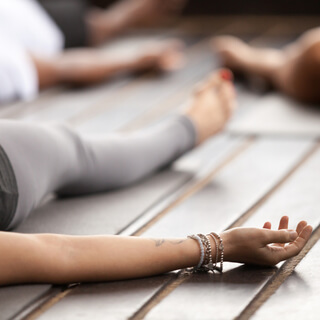
Finding yourself a comfortable seated or lying posture for the practice of open awareness.
Noticing the posture that you've chosen.
Perhaps having a sense of settling into that posture of arriving.
And a simple acknowledgement of anything that's present right now in the body,
Heart and mind.
Noticing the whole body seated or lying in the room.
Bringing awareness to the breath.
Wherever it's easiest to notice.
Perhaps that might be in the nostrils or the throat.
The rise and fall of the chest or abdomen.
Having a sense of really getting intimate with that breath.
Not thinking about or imagining or analysing the breath.
But really noticing the direct felt experience of the breath in the body.
The breath that flows in and out through our time in this body.
And also the connector to the outside world.
No need to control or manipulate it.
It's natural breath breathing itself.
And if at any point during the meditation it feels right,
You can always just bring your attention back to the breath.
And ignore the instructions.
For those of you who'd like to notice now the body expanding that awareness around the breath into the effect of the breath on the body.
Maybe you might notice it's not just in the nostrils or throat or chest and abdomen.
But you might even notice it in your underarms or your sides or your back.
Or maybe even a subtle sense in the whole body.
Noticing anything else there is to notice about the body.
Again the felt sense.
No need to visualise or imagine.
Perhaps scanning through,
Noticing sensations in the face,
The head,
The scalp,
The neck.
The shoulders,
Arms and hands.
The torso and pelvis and back and buttocks.
The legs and feet.
Noticing sensations in the body.
And moving the attention now to sounds.
No need to analyse the content of the sound.
Perhaps thinking of it as a soundscape.
Noticing sounds rising and falling,
Coming and going.
Different pitches,
Volumes,
Durations,
Tones.
Noticing sensations in the body.
Bringing sounds to the foreground of your attention.
And letting other experience recede to the background.
Noticing sensations in the body.
And letting go of attention to sounds now.
Noticing that in the same way that sounds come and go,
Thoughts come and go also.
As best you can becoming curious about the phenomenon of thoughts coming and going.
Not necessarily getting too engaged in the content of the thought.
Sometimes that can be interesting.
But today let's focus more on the way the thoughts come and go,
The way they present,
The way they can suddenly grip us.
Or come accompanied with an emotion or a body sensation.
Noticing sensations in the body.
Having thoughts in the foreground and other experience in the background.
Noticing sensations in the body.
And if it feels okay for you now,
Moving into that state of open awareness.
So no longer having the focus of attention on any one part of your experience.
But allowing all experience to come and go as it wishes.
And if at any point this becomes too overwhelming or confusing,
There's always the option to go back to attention on the breath.
To do that for a short time or to do that for the whole time.
And the metaphors that might help being that still grounded mountain with all the change on the surface and around the mountain coming and going.
Perhaps imagining the mind as the vast and spacious sky with all experience being seen as the ever-changing weather.
Or perhaps that idea of sitting in the stream of your experience,
Not trying to hold on to anything or not trying to push anything away.
Not observing it flow through you or around you.
Noticing if there's a bit of a collapsing in on any one object.
Like our breath or sounds.
Or getting lost in a train of thought.
We want you to notice that opening up again as vast as we can to allow all experience.
Thoughts are welcome.
We notice that we've been completely lost in a train of thought.
Opening up around that.
Expanding our awareness so that we can see the thoughts and sense all the other experiences as well.
Perhaps notice when your attention is taken by a sound.
A sound.
And then a thought might arise.
A subtle emotion.
Another sound.
An itch or a discomfort in the body.
That makes it easier.
You can give a really soft label.
Maybe pleasant sound.
Planning thoughts.
Or otherwise no labeling.
Just noticing the constant stream of experience.
The ebb and flow.
The ever changing nature.
The impermanence of all experience.
비� Aww.
Remembering that things like restlessness or urges to move,
Drowsiness,
All part of your experience.
It's best you can maintaining that friendly curiosity about all experience.
Again and again opening,
Expanding.
If you do have to move,
Make that part of the meditation really slowly and mindfully moving noticing that that's your experience right now.
No need to intervene and control your experience as best you can allowing it to come and go like the breath.
No need to intervene and control your experience as best you can allowing it to come and go noticing if the attention's collapsed in and opening it expanding it especially as best you can.
No need to intervene and control your experience as best you can.
No need to intervene and control your experience as best you can.
No need to intervene and control your experience as best you can.
No need to intervene and control your experience as best you can.