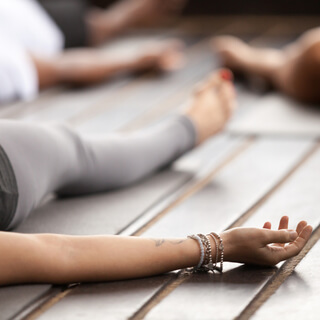
If you'd like to lie down,
Flatten your back,
That's absolutely fine.
If you'd like to sit,
That's fine.
And I'm going to start with a quote,
Which is by Wahid,
Who is a young feminist American poet.
And she says,
And I said to my body softly,
I want to be your friend.
It took a long breath and replied,
I've been waiting my whole life for this.
So perhaps just heading into the meditation with actually that intention of perhaps just being a friend to the body,
Take out any effort or trying or being a fantastic meditation student and just settle in for the ride.
And as you're finding your comfortable posture,
Often in in mindful self compassion,
We we start meditations with with putting our hands and our heart,
You don't have to,
But you might like to try it can be just a lovely reminder that this is not just about awareness.
It's about loving awareness.
And at any point during this meditation,
If it feels helpful,
You can bring your hands back to your heart.
You can come back and forth,
Whatever feels right.
So in this meditation,
We're going to be bringing real kind of warm hearted attention to each part of our body.
We're going to be moving from part to part,
Just practicing being with each part with a kind,
Compassionate manner.
And if you can bring to mind a favorite pet,
Or perhaps child in your life that just brings that kind of uncomplicated kindness and affection towards just to see if there's any way that you could bring some of that towards this,
This hard working body of yours.
And because there's quite a lot of our body to cover,
I won't be giving the full instructions for each part.
But the general idea is that if you feel ease and well being in a body part,
Then perhaps inviting a bit of appreciation or gratitude.
And if you notice unpleasant sensations or judgments regarding a body part,
That's where that compassion comes in.
Just that softening towards the part.
And again,
I won't give a full set of instructions.
But for some people,
Something really concrete,
Like imagining a nice,
Warm,
Soft towel around a part of the body that might be uncomfortable is really helpful.
For others,
Like sort of maybe imagining some light,
Some gold light,
Or some warmth,
Or some cool,
Or some soft words,
You know,
May you be at ease.
Or perhaps if you can reach the body part,
You touch that body part gently,
Softly.
Okay.
And of course,
Our bodies have all got their own stories as well.
So it's really natural for some difficulties to arise and emotions to be evoked.
And if an area of your body is too difficult to stay with,
This is a real opportunity to offer more compassion.
So in this practice,
We don't suggest that you push through that in any way.
Just back off,
Give yourself a little compassion,
Move to another body part.
So bringing the attention now,
Right down to the toes of your left foot.
Noticing sensations,
Heat or cold,
Dry or moist,
Tingling,
Perhaps nothing.
Not trying to make them be anyway.
Just noticing what can I feel in my left toes.
And if your toes feel good,
You might even give them a little wiggle and a smile of appreciation.
How nice to give our toes a bit of appreciation.
I'm moving the attention now to the sole of the left foot.
Just noticing the bottom of the toes,
The ball,
The heel,
Perhaps an area where it's not touching the floor.
What can you notice?
You know,
Our feet have this such a small surface area,
Yet they hold our whole body up.
A lot of the day,
Goodness,
They work so hard.
Perhaps you could even send the left sole,
The left,
The sole of your left foot.
Some gratitude.
And if there's any discomfort,
Opening to it in some kind of tender way.
Now noticing the whole left foot.
Again,
Perhaps sending a little bit of gratitude.
Perhaps just a little bit of appreciation for the inner workings of the foot.
So many bones and joints,
Muscles,
Fascia,
All doing its best.
All doing its best.
And again,
If there's any discomfort,
Perhaps just allowing that area to kind of soften.
Maybe wrapping it with that warm towel or sending it some kind words.
It might even be just something like,
There's a little discomfort there.
Okay,
Okay.
Moving the awareness now to the right foot,
The right toes,
The sole of the right foot,
The whole of the right foot.
Noticing sensations.
Sending a dose of gratitude and appreciation if that feels appropriate.
And or some,
Some softness and tenderness and compassion.
And we'll move up the legs,
Both sides at once here.
You can either do both sides at once or you can kind of pendulate back and forth.
Neither is right or wrong.
Noticing the ankles.
It's very intricate joints.
The foot has more range of movement than you probably realize a lot of the time.
And think how useful pointing the feet are and bending them back.
Walking,
Lots else.
Perhaps some appreciation to the ankles.
Perhaps some compassion,
If that's needed.
Moving up the legs to the lower legs.
Noticing sensations around the shins.
With the bones quite close to the skin.
The sides of the lower legs and those calves,
Muscles in the calves.
Noticing any sensations.
Calves are a reasonably common place to to get sore plates or spots.
Which might be tightness in the muscles.
There might be little nerves doing some firing things.
It's kind of normal actually.
Perhaps even seeing how that would be to to see any slight tension and discomfort is just a normal part of having human calves and not have to fix it.
Perhaps giving those spots a really gentle mental massage or even an actual massage if that feels right.
Sending a little kindness.
As well as appreciation for those lower legs doing the best they can.
And moving now to the knees.
My goodness,
What astonishing joints these are.
We know so much about the knee joints now that we didn't used to.
Like the cartilage actually regenerates and it actually loves being walked on.
Even if you've got arthritis in your knees.
Or cartilage or ligament problems,
Walking is really really good for them.
Perhaps even having a sense how how it is for the knees to hear that.
Sending appreciation for the for the knees.
Being able to straighten and bend at the knee is a pretty important thing.
And of course sending compassion,
Kindness if there's discomfort.
Noticing that like in any meditation of course your mind will wander during this.
I just want to be really clear that that's not a failure.
That is what humans minds do.
If we were just robots we could probably have perfect knee joints and no thoughts whatsoever.
But it's because we're human that we have thoughts.
And what I'm saying in the meditation will get your mind going.
It's totally fine.
Just notice where the mind goes.
Then bring it back to the part of the body.
We're up to the thighs now.
So noticing sensations in the thighs,
Fronts,
The sides,
The backs.
Perhaps the heaviness of the the bones here.
The bulk of the muscle.
Perhaps sending some appreciation for these really strong parts of this that that that help give us our sense of kind of solidity and groundedness,
Steadiness.
As well as lots of other things.
Walking,
Running,
Swimming,
Kicking,
Cycling.
And of course send kindness and compassion if there's discomfort.
Perhaps you might send some nice words to your whole,
The whole of your legs and feet now.
May my legs and feet be at ease.
May they be well.
So moving up to the hip joints now.
Just noticing any thoughts or emotions that come up there.
Same thing applies to the hip joints as the knee joints.
They love weight bearing.
They love movement.
The joints love to be moved.
Builds up the synovial fluid which blows around the joints and lubricates everything.
Keeps the muscle strong.
The joints just love it.
Maybe sending some appreciation to your hip joints.
And also some kindness,
Compassion if they need it.
And you can experiment with some words or light or cool or just a sense of compassion.
Or something a little bit more gentle.
A little more concrete like the warm towel or gentle actual massage.
Moving the attention to the buttocks now.
Poor old buttocks are given a bit of a rough time.
Like they're so useful.
Imagine trying to sit without having buttocks.
They really are useful.
Yet we're just,
You know,
We're really happy with them.
So this is an opportunity to really send them some deep appreciation.
All that hard work they've done at the back of us being neglected and maligned.
You might want to even give them a gentle pat of welcome.
I'm just sending mine a little apology for some of the things I've thought about them before.
And they might need quite a bit of kindness and compassion if there's discomfort there.
Or perhaps it's really hard to send appreciation.
Give yourself some compassion then.
I'm moving up into the pelvis.
A bit of a tricky area for lots of people.
It's absolutely fine just to let my words wash over you and skip that area.
If it feels okay,
You might just notice what sensations you can feel in the pelvic area.
Perhaps you can send some appreciation and gratitude to all those important organs there.
There might be some organs that aren't there anymore.
You can send those appreciation as well for when they were there.
Maybe a little compassion for not being there anymore.
If there's any discomfort or difficult emotion that comes up,
Just giving yourself a really big dose of compassion.
Not feeling like you have to push through anything.
So noticing it's not just organs that are in the pelvis.
There's also that kind of pelvic bowl of bone that surrounds them,
Nestles the organs,
Supports them.
And also what's often called the pelvic floor muscles or the pelvic hammock is a lovely way of thinking of it as well.
It's a common place to hold a lot of tension.
You may find on a breath or two,
You can relax a little tension in that,
In those pelvic hammock muscles.
And if not,
It's a perfect opportunity to just send so much kindness and compassion there.
Moving up to the lower back now.
Another area that can hold a lot of stress and tension.
Have you noticed any of that?
You might imagine your muscles relaxing,
Melting a bit,
Maybe with that warm towel.
Send some compassion,
But also some appreciation for what that back is doing,
How it holds you up,
Enables you to bend and twist.
And this goes for the whole spine.
Maybe some of you have had x-rays and scans and know that you've got all sorts of bits and bobs in there.
In the pain field now,
We like to call that gray hair and wrinkles on the inside.
Even if you've been told you've got a herniated disc or a bulging disc or all sorts of alarming things like that,
We now know that these are incredibly common findings have very little relationship to pain.
How is it to think of them as like gray hair and wrinkles on the inside,
Or perhaps the kisses of time,
Just a normal part of being human.
Perhaps you might even want to move slightly to relieve any discomfort in the back.
Not thinking about what you should do or doing what you think you should do,
But really listening to your back.
You might want to do some kind of cat-cow kind of movements from yoga.
And if what I've said has got the mind spinning a bit,
You can let the mind know that this is meditation has been recorded,
So you can listen to that again.
Right now,
Just lots of appreciation,
Kindness and compassion towards the back.
Moving the attention to your abdomen now.
Another complicated part of the body,
Lots of organs and body functions.
Also,
It's your gut.
So it's the seat of often your gut instinct.
Seeing if you can send appreciation for all these important digestive metabolic functions of organs within the body.
And compassion,
Perhaps as parts that are missing,
Parts that aren't working so well.
Believe me,
They're doing the best they can.
They really are.
They're not your enemy.
They're really,
Really trying hard for you.
And of course,
The belly is another place that gets quite a lot of judgment.
Perhaps right now,
You might want to send a little mental dose of maybe a little apology,
A bit of appreciation.
Perhaps an intention going forward to be kinder to your belly.
And moving up,
You might notice the diaphragm,
The big flat kind of muscle between the abdomen and the chest.
It moves up and down with the breath.
That appreciation and or compassion.
Moving right up to your chest,
The center of your breathing,
Your lungs,
And of course,
Your heart.
Not just the physical heart,
But the heart center.
Infusing your chest with awareness.
What can you feel?
The breath,
The heart beating.
Perhaps some emotions within the heart.
Perhaps some appreciation for all the hard work that the heart and lungs do all day,
Every day.
On their own.
And if there is some issues with either the physical heart or the emotional heart or the breathing,
Sending so much kindness,
Compassion.
You might like to put your hand over your heart and just gently have the heart sense that kindness,
That appreciation,
That compassion.
And continuing to incline your awareness towards your body with that quality of warmth and affection you might have towards a pet or a child that's uncomplicated and just brings that smile to your face.
That as we bring our attention to our shoulders,
You might even experiment with a little bit of a smile towards your shoulders.
These shoulders work hard.
They hold a metaphorical load.
They hold a lot of stress and tension.
And they do lots as well as complex,
Intricate joints and the rotator cuffs,
Muscles and ligaments.
And again,
Remember,
It's not a failure if there's tension there.
It'd be kind of weird if you didn't have tension in your shoulders.
You don't need to make it go away.
Can you just accept it as a part of being a human?
Perhaps you might like to cross your hands over and gently touch each shoulder.
Not pressing hard,
But just sending warmth and kindness and softness and thanks.
To the shoulders.
Moving down the arms now.
So the upper arms with the biceps and triceps muscles and arm bones.
Appreciation.
Kindness and compassion.
The elbows.
What can you feel there?
Fronts and the backs,
The points of the elbows.
Sending some appreciation for these little but important joints.
Be really hard to hug,
Wouldn't it,
If you didn't have elbows?
And down to the forearms,
What can you notice the fronts and the backs and forearms,
The bones within?
Appreciation,
Some compassion.
And then the wrists.
Tiny,
Incredibly intricate joints.
Wow.
Again,
Like all joints,
Wrists love to be moved,
Especially when we spend a lot of spend a lot of time on the computer.
We just love to be moved,
Get all the synovial fluid moving.
Mindful movement is the best movement.
I'm a bit biased.
You might like to put a hand on your wrist one at a time and just feel the movement.
And then the other hand.
And you might like to put a hand on your wrist one at a time and send some appreciation.
Or perhaps some kindness and compassion.
I'm moving to the hands.
Wow,
Human hands are something else like.
Just noticing sensations in the palms,
The backs of the hands.
The fingers,
The fingertips.
The thumbs,
These opposable thumbs that can do all these amazing things.
If you can,
Sending so much appreciation,
Maybe wiggling the fingers a little bit and really savoring the sensations.
As you move them gently.
Now noticing the whole of the arms and hands.
The shoulders right through to the fingertips,
Perhaps noticing the the aliveness,
The vividness.
Or perhaps not,
It's fine if you can't feel much as well.
And now proceeding with awareness towards the neck.
If you like,
You might touch your neck with your hand.
Or both hands.
Maybe giving a bit of appreciation to this neck that holds up your heavy head all day.
And also.
Most of us probably go days or months or years without thinking of all the important tubes that pass through the neck.
The air comes from the environment into our lungs and back out again.
The blood comes from my from my heart and to the head and drains back down again.
And where we have our food and nourishment come through.
Perhaps sending a bit of like appreciation for the amazingness of this.
And then there's the spinal cord,
Which was travels right through the spine.
Terminates in the bottom of the skull,
This part of us that's really almost part of our brain.
And just a reminder that the spinal cord just loves movements of the back and neck.
Stretches the ligaments around it and keeps it soft and supple.
And our neck holds a lot of tension almost always.
You might want to gently find those points of tension and.
Breathe in and out of them to relax them.
Or massage them really gently.
Just reminding you and your neck that there's no failure in this.
This is a part of being human.
And if there's any part of those many important functions that the neck that are not going so well or pain or discomfort.
Just sending so much compassion.
May my neck be at ease.
May my neck be well.
So moving up to your head now.
So beginning with the back of your head.
The hard surface,
The skull is it's protecting your brain.
You might like to gently touch that part of you with your hands or just touching it with awareness.
Just thanking it for its important function.
Compassion if there's an issue there.
Maybe moving up to the sides of the head and the top of the head.
Noticing any sensations that are there,
Tingling,
Itching,
Vibration.
And then moving and offering the same loving,
Appreciative,
Compassionate awareness to all of our organs of perception.
So perhaps starting with the ears.
Wow,
Sense of hearing.
How important is that?
It's a big thank you to the ears and say some compassion.
If perhaps our ears,
Our hearing is not quite as good as we'd like it to be.
They're doing their best.
Moving to the face now,
Maybe noticing that the face in general,
All the intricate facial muscles that express emotions,
Which is really important to communication and relationships.
But also means that there's often tension between the eyebrows at the temples,
Around the jaws and some appreciation and some compassion.
How about the eyes?
Sense of sight,
My goodness,
So amazing,
Such a part of our life.
Noticing any tension in the eyelids,
In the eyeballs,
They really work hard in our life.
And a bit of compassion if perhaps our sight's not so good or we've got issues with our eyes.
And then moving to our nose,
Perhaps noticing sensations on the outside of the nose,
In the nostrils.
Perhaps noticing the breath as it comes in and out of the nostrils.
How that air can go right back into the sinuses behind the nose.
And maybe some appreciation for the sense of smell and some compassion if we've got some hay fever or other issues with the nose.
Moving down to the mouth,
Noticing sensations in the lips,
In the teeth,
The gums,
The tongue.
And perhaps appreciating the whole area that helps us eat and speak and smile and sing.
And some compassion if there's some difficulty around that area.
And noticing our brain now,
In this skull,
A tender brain composed of billions of nerve cells that are constantly communicating with each other to make sense of the world.
And even during this practice,
You will have had new junctions between nerves form,
Neuroplasticity working.
Maybe you'd like to say a huge thank you to your brain that constantly works for you.
Knowing that all that overthinking and worrying and ruminating and whatnot is the brain trying to help us,
Just trying to keep us safe.
That's just sending a bit of like,
Oh,
Yeah,
I get it.
It might drive me mad,
But I get it.
Now noticing the whole body,
The whole body.
And some people really like to end this by offering their body a final shower from head to toe of appreciation,
Compassion,
Gratitude,
Respect,
Whatever is called for,
Even if you can't name or label it,
Just allowing the shower to suffuse the whole body.
And spending a little bit of time now to start by noticing the effect of the practice.
Whatever your reaction is,
Whether it's calmness and really enjoyed it,
Or perhaps it's been very challenging,
Perhaps you've blanked out,
Nothing is wrong here.
It's just a matter of being aware of what's going on in your body.
And if you're not aware of what's going on in your body,
Then you're not aware of what's going on in your body.
And if you're not aware of what's going on in your body,
Then you're not aware of what's going on in your body.
And if you're not aware of what's going on in your body,
Then you're not aware of what's going on in your body.
And if you're not aware of what's going on in your body,
Then you're not aware of what's going on in your body.
And if you're not aware of what's going on in your body,
Then you're not aware of what's going on in your body.
And if you're not aware of what's going on in your body,
Then you're not aware of what's going on in your body.
And if you're not aware of what's going on in your body,
Then you're not aware of what's going on in your body.
And if you're not aware of what's going on in your body,
Then you're not aware of what's going on in your body.
And gradually coming to a seated posture in the same mindful way.
And going about your day.