Welcome to body scan practice.
You can choose a position.
For most of the mindfulness practices,
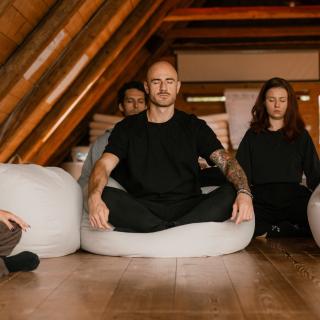
It's best to be sitting up or standing up.
For body scan,
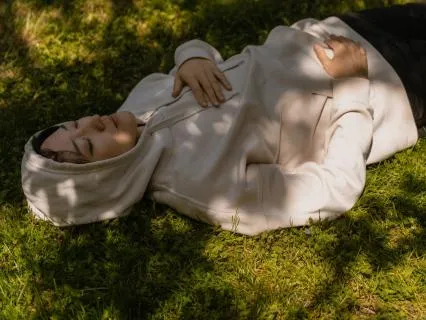
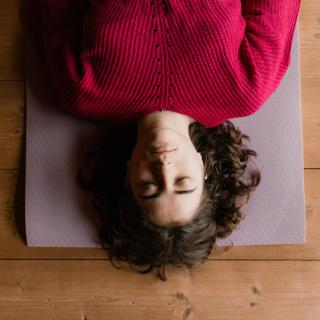
You might also choose to lie down.
If you would find yourself falling asleep,
You can sit up or stand,
Or you can just observe moving between a vacant state and between sleep.
You can ask yourself,
What is my intention?
Maybe it is getting to know your body more,
Becoming friends with your body.
And you can also reflect what's your motivation.
And then,
Let go of your intention and motivation and find a place in your body where you can sense your breath and start observing the path of your breath through your body.
From the place where it enters your body,
Down the neck and lungs,
And then up again.
Notice the sensations in the parts of your body through which air is running.
And if it works for you,
You can also count to three or four for each in-breath and to three or four for each out-breath.
And notice whether regulating and observing your breath does not come with any pressure or tension.
And if you would notice any pressure,
Tension,
You can just make a little bit less effort and soften around all the tense parts of your body.
Are there any thoughts coming in?
If you notice any,
Let them come in and pass by,
Not blocking them.
Thoughts are okay.
We just might try to not engage with them and just observing our breath.
And you can stop counting your breaths and just put more emphasis on your out-breath.
You can breathe out properly with sound,
Letting your body relax a little bit more with each out-breath.
Let your bones,
Joints and organs release and come a little closer to the ground.
And now we can let go of those deep out-breaths and just let the breath breathe by itself,
Staying with the breath for a couple more moments as a good friend.
And then expanding our attention to the whole of the body,
Noticing any tension anywhere or any strong or soft sensation.
And then taking a hand of our attention as if we would walk a child and gently,
Slowly bringing it to our right foot.
What are the sensations in your right foot?
Is there any tingling or warmth or coolness or maybe vibrations or just the sense of contact with the ground or another part of body or anything else?
And now let's compare what I sense in my right foot and in my left foot.
And then coming to our left foot fully.
How does my left foot feel today?
We don't have to do anything with sensations that we find,
Just be with them.
And then we can move up to our left calf and shin.
And it might happen that in any part of the body,
There is no sensations and that's really okay.
We might just notice,
Hey,
I've got this part of the body,
It's there and that's enough.
And then notice the left knee and the left thigh.
Are the sensations pleasant,
Unpleasant or neutral?
All these options are fine.
In meditation,
We learn to be with whatever there is,
Whether we like it or not.
And with the next out-breath,
Let's move to our right calf and shin.
And then move up to the knee.
Do we feel the joint somehow or maybe not?
And then we move up to the thigh,
Noticing that there might be tiny sensations in just one point and bigger sensations that take more space.
And now let's move up to our buttocks.
Is there any sensation of pressure related to the contact with the floor or the bed or the chair?
And how our genitals feel today?
And how about our pelvic floor?
There might be small muscles that are tense or relaxed.
Let's take a deep breath in and move up to the belly.
What's happening in my belly right now?
Maybe there's a sense of breath affecting how our belly feels,
Creating movements in our belly or maybe anything else.
Let's make a little pause to see,
Am I still here and now in my body or have I got lost in thinking?
And if we got lost in thinking or drifting away,
That's totally okay.
It happens to everyone.
Just we might now gently take the hand of our attention and bring it back now to the chest.
What's present in my chest?
Maybe I sense my cloth moving on it,
Maybe I notice the heart beating inside or maybe anything else or nothing.
If there is nothing in any part of the body,
See what the mind is saying about it,
Whether it's panicking,
For example,
Or if it's okay with that.
And in general,
You can notice what the mind is saying about your practice.
There is any judgment,
Maybe something like,
I'm not doing this well enough,
I should meditate deeper or be more focused or anything like that.
If there is any judgment like this,
You can just smile at it.
Your mind is trying to protect you.
Then let go of effort,
Relax a little bit,
Any tension that you notice in the body,
Maybe in your shoulders or jaw or belly or temples or forehead.
And then taking your attention to explore what's present in your back.
Is there any strong sensation or is there rather a soft sensation?
We can see if the mind has any preference.
Let's welcome both strong sensations and soft sensations.
And you can also notice that maybe different parts of your back feel differently.
And then,
With another out-breath,
Let's see how our right shoulder is today.
And then going down to your right arm,
The upper arm,
Elbow,
Lower arm and then the wrist.
Can we sense the pulse in the wrist?
And then the right hand,
Maybe the sense of contact with something else,
Maybe any pulsation or vibration or itching or what is there right now.
And we can compare how my right hand feels and how my left hand feels.
And then leaving the right hand and moving fully to our left hand and slowly moving up through the wrist and the shoulder.
And if it would happen that some sensation in another part of the body is calling for attention,
Maybe some discomfort or anything else,
You can just take a moment to give that sensation your attention.
Maybe breathing into that place if that works for you or maybe caressing the place with your hand.
And then gently coming back to where we are right now,
Which is the neck.
You can notice if there's any tension,
Maybe swallow to notice also what's inside your neck and then slowly moving up to your jaw.
Is it relaxed or tight?
Noticing your teeth and tongue and lips and again just noticing,
Am I still with this practice or have I drifted away?
And it's totally okay if we drift away or get lost in thinking,
Even if it happens a lot of time during the practice.
It's about finding the awareness and losing it and then finding it again.
And we might now give a little bit of attention to our nose.
Maybe it's moving when you're breathing,
Noticing your cheeks and eyes,
Are they moving behind the closed eyelids or maybe are the eyelids moving,
Even if they are closed?
And then taking a moment to explore our forehead.
Also,
Forehead is one of the places where we often hold tension.
So you can notice the area between your eyebrows and nose and your temples,
Which are above your cheeks and the crown of the head and the whole head and we also add the torso and with another out-breath spreading the attention to our right arm and left arm,
Right leg and the left leg and the whole body.
And also notice your breath as it's filling up your body.
If it works for you,
You can imagine the breath is spreading through whole of the body to the tips of your toes and to the crown of your head and then leaving through the edges of your body to the outer space.
If there is any pressure or effort,
Just let go of that,
You can just be,
Just exist.
Breathing in,
Breathing out.