Hello.
Welcome.
Kirtan.
What is kirtan?
So kirtan comes from the tantric tradition in India and it's devotional chanting.
Devotional chanting.
What do I mean by devotional chanting?
Well,
Chanting to consciousness,
Chanting to the power that creates the whole universe,
Chanting to,
We might even use the G word and say God,
Chanting to the absolute,
Chanting to certain deities or potencies of the absolute.
These are all things that can happen in kirtan.
Now,
Don't worry if that sounds a little bit highfalutin.
No,
You're not quite sure what that means.
Kirtan itself reveals its mysteries over time.
Now,
One of the things that I love about kirtan is it's very compassionate.
Meditation is beautiful and sometimes it can feel a little bit daunting.
Oh,
I don't know how to still my mind.
Oh,
I'm a little bit scared.
I've got to be in the thought-free state,
Don't I?
How do I start to meditate?
What's the way I do it?
These are often questions that I am asked by people.
There are specific ways to address all those questions.
But for now,
Let's turn our awareness to kirtan.
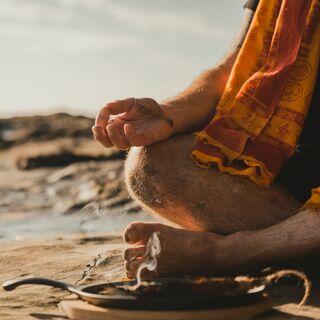
All you have to do when you're practicing kirtan is find a comfortable posture.
That could be sitting on the floor,
If you're familiar with traditional cross-legged postures,
Or that could be sitting on a chair.
The main thing is you want to create space in your upper body.
You want to create space.
This will help you to make the sounds that are so important when we're working with kirtan.
So you make space in your upper body.
You make sure that you are elongated,
Your spine is elongated,
Rather than hunched down.
You want to be gently up.
And then you relax into the process of kirtan.
Now when we chant kirtan,
It's usually in Sanskrit.
Sanskrit is the ancient Indian spiritual language and it's a vibrational language.
It's designed to vibrate.
It's a language of frequency,
If you like,
Of vibration.
So when we chant,
Whatever chant it might be,
Let me give you an example.
I'll give you an example.
Let's go Kali Dorige,
Namo Namah.
So I'm going to sing this and just,
You can just listen to the vibrations,
If you like.
You can keep your eyes open or you can close them,
Whatever you want to do,
But just listen to the vibration as I'm chanting.
Chanting kirtan,
Chanting kirtan.
You'll hear those two phrases interchangeably,
Okay?
Kirtan,
Chanting.
Kali Dorige,
Namo Namah.
So each kirtan has a particular focus.
So this focus here is on the deities Kali,
A fierce goddess,
A goddess who destroys limitation,
And Dorige,
Who is also a fierce goddess,
But perhaps a little bit more measured than Kali.
If you like,
She's about justice,
Fairness.
She'll also destroy things that hold you back.
Kali,
On the other hand,
Is fierce.
She'll go in and she'll destroy everything that holds you back from your true nature,
Often in a very fierce manner.
But it's out of her love,
Her great love for you,
That she does this.
So when you're chanting that,
I'm going to chant it again.
You might want to join in with me.
Hey mother Kali,
Hey mother Dorige,
Kali Dorige,
Namo Namah.
Kali Dorige,
Namo Namah.
So the literal meaning,
Hey mother Kali,
Hey mother Dorige,
Hey mother Kali,
Hey mother Dorige,
As in the divine mother.
Kali Dorige,
Salutations to you again and again.
Salutations to you again and again.
So what to do when you're chanting kirtan?
The lead singers will first of all sing together and then you respond.
So the lead singers sing and then you respond.
It's a very simple process.
The main thing to do is to be present.
It's to be present.
So be present.
Be present with the mantras.
Be present with the names of the deities.
Be present with the vibration and let the vibration of kirtan take you into a natural state of meditation.
It's devotional.
It's about the heart.
It's about connecting into the heart.
This is what kirtan is about.
Over the course of the kirtan,
You'll probably find it going faster and faster and faster.
The reason for this is the shakti,
The energy builds.
Also,
The faster we chant,
The more it encourages the mind to drop its preoccupations and just be with the mantras.
Just be with the kirtan itself.
This releases bliss.
This releases joy.
This releases happiness.
Now,
If you've done kirtan before,
You understand what I'm saying.
If you haven't done kirtan before,
That's totally fine.
Find a way to engage with kirtan.
It might be finding a local chanting group or kirtan group.
Whatever way you do it,
Just start to engage with the practice with the understanding that it is designed to take you to your heart.
It's designed to take you to your heart.
This is why I love kirtan.
When I was in America,
When I was in India,
We would receive rigorous training around kirtan,
Around pronunciation,
Around how to work with the mantras,
How to really feel a vibration,
How to pronounce the Sanskrit properly.
That's important,
Mike,
Because they're vibrations.
They're vibrations.
So through correct pronunciation,
You call in the energy,
Call in the energy in a very powerful way.
But one of the most important things I learned through all that rigorous training is that you do that training in order just to let go.
Just to let go.
Let go into the bliss of the chant.
Let go into the joy of the chant.
Let go into the kirtan.
Give yourself a hundred percent to it.
If you're surrounded by hundreds of people all chanting the same divine names as you,
It's very easy to feel unity.
It's very easy to feel that bliss and to live from that place.
I say live from that place because kirtan is yoga and yoga is union.
Union with what?
With your true nature,
With consciousness,
With awareness.
The more you practice kirtan,
The more you can be in that state.
This is why I love kirtan.
So to end,
Let's do the kirtan chant one more time.
Why not?
Let's do it one more time.
So comfortable posture.
Ready?
Chant along with me if you like.
Otherwise just listen to the syllables and let them take you to peacefulness.
And if afterwards you can sit quietly and meditate,
That's ideal because kirtan helps the mind settle.
And when the mind settles,
Meditation is much easier.
Okay,
Here we go.
Kali Durga Namo Namah Here you have it,
Kirtan.
See you again very soon.