Resting the mind meditation,
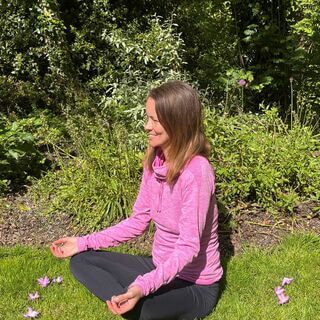
Finding yourself a comfortable position,
Sitting or lying down.
So although we cannot always control the mind,
We can encourage it to be more at ease.
By teaching the mind to do this,
It helps us respond rather than react to thoughts and emotions.
With this meditation practice,
It gives you the opportunity to train the mind.
We're training the mind to slow down when it becomes overactive.
As we do this,
We induce a state of relaxation.
Helping us to deal with challenging situations.
When those challenging situations occur and the mind begins to race,
We can take a few deep breaths.
Join me with this.
So as you inhale,
Feel the lungs completely.
And then slowly exhale.
Breathing in completely.
And exhale slowly.
As you let the breath go,
See if you can empty the lungs slowly and completely.
Recognize you cannot control every thought that arises.
With the breath.
Allowing the mind to relax a little.
When you're ready,
Bring in the mind.
When you're ready,
Bring in the breath back to its usual pace.
Allowing the thoughts to be there.
Mentally say to yourself,
May my mind be at ease.
May I be at ease with my mind.
Each time you breathe in,
Say an easeful,
Each time you breathe out,
Mind.
Easeful mind.
Then changing it to peaceful mind.
Each time you breathe in,
Peace.
Each time you breathe out,
Mind.
Peaceful mind.
When you notice many thoughts coming to the mind,
Come back to the breath.
With the mantra,
Peaceful mind or easeful mind.
Or just mentally saying to yourself,
May my mind be at ease.
May my mind be at ease.
Peaceful mind.
Awareness to the inhale.
Awareness to the exhale.
Smiling to the breath.
Noticing the in-breath and the subtle pause.
And the out-breath.
And the pause before the in-breath.
Noticing the slight breaks between the inhale and the exhale.
In-breath,
The pause,
The out-breath and the pause.
Bringing the awareness back to the body.
To the fingers,
The toes.
And gently opening the eyes.