Hi and welcome.
My name is Peter and I'm here to share with you a guided mindfulness meditation,
Which is a Buddhist teaching.
We all have different reasons to choose meditation,
So firstly,
Thank you for joining.
Mindfulness is a valuable technique that enables us to remove our awareness from our busy minds,
Whoever you identify as,
Whether that's a friend,
A co-worker,
A family member.
And for the duration of the practice,
We let go of the attachment to the role that we play and come to a space of pure consciousness.
Knowing that our thoughts don't identify who we are and enabling us to simply become the witness to our thoughts and emotions,
Befriending them.
And so we will begin by setting our seat and without judgment,
Knowing that your body today might feel different to yesterday and that's completely okay.
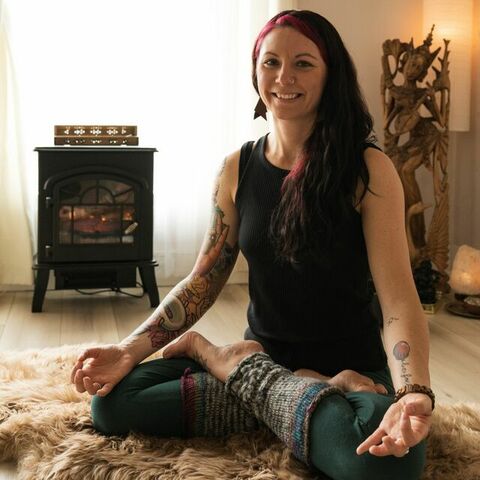
You may want to set yourself up cross-legged on the floor,
Use props,
Cushions,
Or a chair,
Or even lay down.
However you choose to sit,
Please set yourself up so that you can maintain stillness and a steady breath.
So let's begin with some gentle breath work.
Please allow your eyes to become soft and closed.
We will do six rounds of breath,
Inhaling for a count of four with a brief pause at the top,
Exhaling for a count of four with a brief pause at the bottom.
I'll guide you through the first round.
So take a cleansing breath before we begin,
Inhale deeply and exhale with a sigh and I'll count you in.
Inhale two,
Three,
Four,
Pause,
Exhale two,
Three,
Four,
Pause and continue on your own for three more rounds.
Now just allow a little bit of time here for your mind to finish wandering before you ask it to come to stillness and start to observe your body without expectation,
Without judgment or feeling that you need to make any changes.
Notice where in your body you might be holding tension,
Your hands,
Your feet,
Your shoulders,
Your jaw,
Your forehead.
Just observe,
Witness and move on.
And you might notice that somewhere in your body there is a feeling of discomfort,
Tightness,
Without attaching a story to it.
Just acknowledge it,
Know that it's there and push it aside.
Now begin to bring your awareness to the depth of your breath.
Are you breathing into your shoulders,
Your chest,
Your lower ribs,
Your belly?
Now notice any feelings or emotions that may be arising.
Are they pleasant,
Are they unpleasant or are they neutral?
And just allow them to arise and pass like clouds in the sky.
And bring your awareness now to any thoughts,
Thoughts,
Memories,
Plans that are coming to mind.
And are they associated with the past or the future?
And without attaching judgment to them,
Allow them to arise and pass.
And start to notice the sensation of your skin,
The temperature,
Your clothes that are in contact with your body.
Maybe there is a strand of hair touching your face.
Now is there a taste in your mouth,
Perhaps the taste of your toothpaste or the last coffee that you had?
What smells can you notice around you?
Maybe the smell of your shampoo or your soap,
An aroma in the room.
And now bring your awareness to your sense of sound.
What can you hear?
Maybe you can hear the sound of your inhale,
Your exhale,
The sound of your swallow,
The creeks in the walls.
And what about outside the building?
And sound that is furthest away,
Cars,
Trucks.
And bring your awareness now to your sight.
What can you see?
Your eyes are closed so perhaps you can see darkness.
And if you look beyond the darkness,
Are there any shapes,
Specks,
Lights,
Patterns?
Now bring your awareness back to your breath,
Back to your body.
Notice the weight of your limbs and the depth of your inhale compared to when you first sat down.
And begin to invite some subtle movement into your fingers and your toes.
And scrunch up your face,
Exhale and release.
And start to rub your hands together,
Create warmth and then cup them over your eyes.
Take a deep inhale and as you exhale,
Sigh and softly drag your fingertips down the side of your face.
Begin to gently tap the top of your thighs with your hands.
And come back to stillness.
When you're ready,
Keep your gaze soft and low and open your eyes.
View everything that you can see as if you're viewing it for the first time.
Thank you for sharing this time and practicing mindfulness meditation with me.
Remember that you have the ability to practice this meditation at anywhere,
Anytime.
From my heart to yours,
Namaste.