Hello!
Today we're going to do a breathing exercise to help us bring our attention into the present moment.
We carry our breath with us everywhere,
So that means we don't need anything except our own bodies for this practice.
So I encourage you to do this either sitting up or laying down.
If you think you're going to fall asleep doing this laying down,
Then I encourage you to do it sitting up.
It's a good experiment to do it both sitting up and laying down as two separate practices,
Just to see how the body experiences this practice differently.
Sometimes when we're sitting up we're in more of a doing mode,
A more highly aroused state,
And when we're laying down we're used to relaxing.
We also may find that the diaphragm moves differently when we're sitting up versus when we're laying down.
So what I'll have you do is bring one hand onto the chest and one onto the belly,
And this is often called three-part breathing.
Okay,
We're also going to add in some regulated breathing,
So breathing in with a certain count and breathing out.
So first,
Making a decision to practice.
Finding a seat that brings you into this moment.
So if you're sitting at the computer the way you normally work,
I want you to put some distance between you and the screen or even just orient yourself away from the screen.
If you happen to have a mat or a cushion on the floor or able to remove your shoes,
Those are also ways you can change what your body is doing so your mind knows we're doing something different.
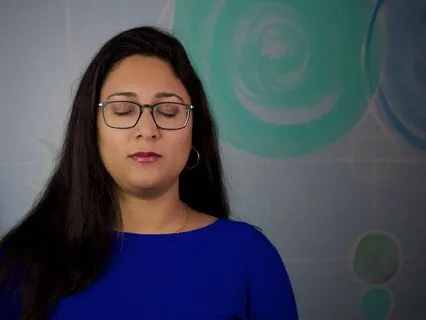
Allow the eyes to close,
And if they're not closing easily,
You can just soften the gaze to focus on a neutral point.
If you'd like to close the eyes,
You may try to squeeze them shut and relax them.
Squeeze them,
Tighten up the muscles of the face,
And then relax.
Noticing here if you're experiencing tension in the jaw,
Letting the jaw relax.
Noticing if you're holding the shoulders tight,
And noticing if you're clenching the hands,
Trying here to open up the palms,
Relaxing the fingers.
And then noticing here if you're on an inhalation or an exhalation,
Noticing if it feels easy to breathe or if it feels labored.
Notice if the breath feels smooth.
Notice the temperature of the breath.
Is it warm or cool?
Notice the nose.
When we breathe here,
We need to breathe in and out through the nose.
If you're experiencing some congestion,
This is normal,
And you may use the mouth,
But ideally,
You want to breathe in and out through the nose.
What are the sensations in the nostrils?
Is one nostril more dominant?
And is the other nostril more dominant?
And then noticing any other qualities of just this breath.
And then bring the hands to the belly and the chest.
Noticing the movement of the hands.
And then bring the hands to the belly and the chest.
Noticing the movement of the belly and the chest.
Is one area moving more than another?
And then imagine that you're filling up a cup with water.
As you inhale,
The belly expands,
Then the chest,
Then the shoulders.
As you exhale,
The shoulders drop,
The chest drops,
And the belly draws in.
Breathing in,
The belly,
Chest,
And shoulders all expand.
Exhaling,
Shoulders drop,
Chest drops,
Belly draws in.
Keep noticing the movement in the torso as it relates to breathing.
Can you feel the side ribs expand?
The upper back.
You can even put your hands on the side ribs to see.
Can I feel those sides expand?
Because we breathe in all directions.
The whole torso expands with breath.
Now we're going to regulate the breath.
And the goal here is as we breathe in,
The belly expands,
The chest expands,
The shoulders lift.
As we exhale,
Shoulders drop,
Chest drops,
Belly draws in.
You might notice that you have reverse breathing.
You might notice that it feels uncomfortable to move your hands.
It feels uncomfortable to breathe in all directions.
So remember,
This is all an experiment.
So beginning together on an inhalation.
Breathing in,
Two,
Three,
Four.
Breathing out,
Two,
Three,
Four,
Five,
Six.
Breathing in,
Two,
Three,
Four.
Breathing out,
Two,
Three,
Four,
Five,
Six.
Breathing in,
Two,
Three,
Four.
Breathing out,
Two,
Three,
Four,
Five,
Six.
Breathing in,
Two,
Three,
Four.
Breathing out,
Two,
Three,
Four,
Five,
Six.
Extending the inhalation now.
Breathing in,
Two,
Three,
Four.
Breathing out,
Two,
Three,
Four,
Five,
Six,
Seven,
Eight.
Breathing in,
Two,
Three,
Four.
Breathing out,
Two,
Three,
Four,
Five,
Six,
Seven,
Eight.
Let's do six more rounds.
Last one.
And then take a moment here to notice what has shifted or changed about your breath as it resolves to your natural breath.
Notice if anything has shifted in the mind or the body as well.
The breath can be like a remote control for your stress.
You both notice that we're stressed because our breath is shallow and we can be in more control of the way our body stays in stress mode by regulating our breathing.
So stress happens outside of us,
But it's within our control how we hold on to it in our bodies.
And what's most useful practice when we're looking to be more mindful at work and more stress-free at work is to regularly return to homeostasis,
To calm,
To parasympathetic nervous system dominance where we're receptive.
So I want to thank you for this practice.
I hope you can practice it both sitting up and laying down so you can see the changes in your own body's regulatory systems.
And then develop a regular practice after that.
Thank you for practicing with me.