Hello,
Welcome,
Welcome beautiful souls.
Hello,
Hello.
This is Whispers From Within.
And it's so interesting because we are at,
I've been working with thresholds and part of this idea of being within a threshold.
And we are at the equinox tomorrow,
The fall equinox.
And we have a new moon tonight.
Both so,
Like they're massive thresholds.
Like the equinox is that threshold around balance,
Right?
And the new moon is like this threshold of like planting seeds,
Getting ready,
Right?
Moving into something new.
And here we are doing a,
You know,
I'm doing a live on really getting into that inner guidance,
Right?
That guidance that we have through automatic writing.
Automatic writing is the most beautiful way to approach a threshold,
To move through a threshold.
So I'm really excited.
So we have this threshold energy all around us.
And I think I'm gonna weave that in today to our automatic writing.
Because that idea of balance and the equinox and the idea of like planting seeds of the new moon and being able to connect into our own inner guidance and our inner wisdom around this time,
It's like equinox season.
It feels like really powerful.
So the stream of consciousness writing or free form writing,
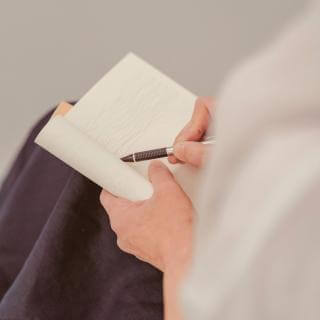
That would be where you put your pen on the paper and you don't let it stop.
You just let it continue.
So stream of consciousness writing is actually the skill,
Right?
That's the skill that bypasses our critic,
All of that chatter,
All of that noise,
All of the conditioning,
All of the blame,
The judgment,
The fear,
Right?
All of that.
Stream of consciousness writing is what like helps us bypass that.
That's the skill,
Right?
So that's what stream of consciousness writing is.
And some of you may have heard of it from like the morning pages.
You know,
Julia Cameron talks about the morning pages in the artist's way.
And she uses stream of consciousness writing as a dump,
Right,
As like a vent or a dump to clear for the day.
Stream of consciousness writing can be used to open up your creative flow and projects.
It can be used to vent.
It can be used to get to the meat of things,
Right?
So stream of consciousness or free form writing is the skill that we're gonna be using.
And automatic writing is the listening.
It's the art of listening.
It's the art of being open,
Of channeling,
Right?
So what happens is that stream of consciousness writing is the gateway,
Right?
That's the gateway.
We open that gate,
We use that skill,
And then we begin that process of listening.
And we get to channel through.
And of course you can automatically write with so many different,
You can automatically write with your own self,
Right?
Your higher self,
Your soul,
Your energy,
Your spirit,
Whatever you wanna call it.
You can automatically write with your guides,
Your guardians,
Your angels,
The ascended masters.
You can automatically write with a process.
You can automatically write with your creativity,
With pieces you've created.
So you guys can see some of my soul art is back here.
I've automatically written with every one of my soul art pieces.
That's how I find a lot of my insights,
Right?
So just know that the stream of consciousness is the skill and automatic writing is listening and the ability to kind of channel it through.
But it is really important to be able to get your pen moving,
Right?
Without stopping.
And really the most beautiful thing I can say about that is that's your only job.
That's the job,
Right?
We set the intention and we work with it.
And then your job is just to keep your pen moving.
It's a pretty simple job,
Though it can be rough when you have a lot going on up here,
But that's what it helps us to surpass,
Right?
To bypass.
So we'll be doing a little bit of warmup in some of that stream of consciousness writing.
We'll do a little visualization.
We're gonna work with that threshold that we're all sitting in right now,
That threshold of the new moon,
The threshold of the equinox.
And then we'll do some automatic writing with that visualization in that space.
And we'll look back at what you wrote.
We'll gain the insights.
All right,
Let's get going.
We're on the threshold.
So we're gonna start with just warming up.
And then we'll get into some breath.
We'll get into some visualization.
We'll get into automatic writing.
Stream of consciousness writing is when you put your pen to the page and you let it go,
Right?
You let it go.
You let it move.
You don't stop it.
And that may mean that some things come out nonsensical.
Some things come out messy.
Some things come out,
Sometimes mine have an attitude.
They just write back at me sometimes when I'm just stream of consciousness writing,
And things will just come out.
It's not supposed to be pretty.
It's not supposed to be something that you're publishing.
It's not supposed to be,
The skill is actually just to bypass,
To begin to bypass all this stuff that we've grown up with around writing.
I find so there's a lot of categories of people when they're writing that stop them.
One of the things is rules of writing.
I could have said that better.
I don't know about punctuation.
I didn't spell that right,
Right?
Those are kind of things,
That's one of the categories that stops people.
Another category that tends to stop people is,
I don't know what I'm doing.
I'm not really good at this,
Right?
Or is it supposed to be this way?
Another category would be perfection.
So there are different ways that we stop ourselves.
Again,
Your only job is to keep your hand moving.
That's it,
That's it,
Right?
We're just gonna spill onto the page.
You can even think of it as we're here,
Just warming up like that whole Julia Cameron,
Venting out,
Kind of offloading onto the page.
And I'll give you a prompt to start with,
But of course you can start with anything.
We're just gonna write for five minutes to get moving.
So I love,
And anyone who's been with me before,
I use this prompt a lot because it's just such a beautiful prompt and I'm gonna write it in here,
But the prompt is,
I remember.
So you're gonna write at the top of your page and I'll write it up at the top of mine.
I remember.
And you're just gonna place your pen on the paper and just write,
Don't let your pen stop.
You may write,
I remember,
I remember,
I remember,
I remember.
You may write,
Ah,
I don't know what to write.
You might write A,
B,
C,
D,
E,
F,
G,
H,
I,
J,
K,
L,
Little bit of B,
Right?
It doesn't matter what you write.
The only job you have is to keep your hand moving.
That's it,
That's simple.
It kind of lets you off the hook a little bit,
Right?
So we're gonna start writing now for about five minutes just to warm up and start with that I remember.
It may be that as you write,
You can start writing now.
As you write,
You might find your thoughts,
You might have criticisms of yourself or criticisms of things.
Let them come out,
Let them flow out.
Gail Godwin wrote a beautiful essay called The Watcher at the Gates.
And it just so clearly states why we do a stream of consciousness writing as a dump,
Right?
Because she talks about The Watcher at the Gates where we have all these ideas and creativity and all this stuff that's up here in our minds,
Right?
In our mind's eye even,
Right?
And we have this thing at the gates that goes,
Nope,
Not that one,
Not that one.
That's not good enough,
That's not it.
But she talks about how important it is to let everything out because what's behind that one,
If you stop that one up,
What's behind it is never gonna get out.
So you just let out whatever,
Messy,
Real,
Fake,
Doesn't matter,
Just keep your pen moving.
I remember.
Any time you feel like you're getting,
Starting to stop your hand,
Have that in the back of your mind,
I remember.
And you could just write that as many times as you need to get through the time of keeping your hand moving.
I'm just gonna stop for one minute while you keep writing.
Sometimes,
And I just wanna mention this because I just did it,
Which is sometimes when I'm in the middle of a thought,
All of a sudden there'll be a word association that comes up,
Right?
All of a sudden I'll think something and I will not finish my sentence.
I will put that word association in there and I'll flow with it.
So like I just had an interesting one where I was like,
I remember the constancy of love and the gorilla baby on the swing set.
Like those two things were not in the same thought.
I was on a nice thought,
Constancy of love.
And then I was like,
And there was a baby gorilla on a swing and that got in there.
So that's what I'm saying.
Don't worry about it being like making sense,
Being perfect,
Being maybe deep or right and meaningful.
Just get your movement of your hand going out there,
Continuing.
And if you end up with strange word associations,
It's all good.
Won't you go for one more minute?
All right.
And just put your pen down for a minute.
You might wanna,
You know,
If you're not used to stream of consciousness writing or freeform writing,
You might wanna just give yourself a little bit of a love on your hands or your wrists.
How was that for you?
How was stream of consciousness?
How was that freeform writing?
Did you feel like you were able to catch the flow?
Were you able to just keep your pen moving?
Or did you feel pressure to stop?
Did you feel like maybe thoughts or,
You know,
Maybe even criticisms or judgments or anything that was happening stop you?
So it's good to kind of just sit there for a minute and take that in,
That experience for you.
And also for a moment,
Take in the fact that you just filled a page,
Right?
That you just,
You started filling,
Maybe you started filling a page,
Maybe you didn't get a whole page,
But maybe you started filling a page.
How did that feel to start filling a page just with your hand moving?
That is the skill that we use to enter into automatic writing.
We're gonna start with a little bit of a visualization,
A little bit of grounding,
Because though the skill is stream of consciousness writing,
That's a skill that the gateway that we enter into automatic writing.
Automatic writing is about listening,
Being open,
Having that intention.
So that's a big part of being automatically writing,
Right?
I'm not just gonna be all of a sudden writing into I remember and I'm channeling whoever I wanna channel or whatever I'm working with,
Right?
That's more of like that human experience,
The stream of consciousness.
And so wherever you are,
Put your pen down,
Turn to a blank page.
Maybe it'd be nice to turn to a blank page now.
So turn to a blank page,
Have your pen at the ready and just get comfortable where you are.
Sit down,
Lay back wherever you are.
If you can close your eyes and bring your awareness inward.
Just notice for a minute what your breath is like.
Notice just for a minute what your natural breath is,
How your body is breathing you,
Just notice.
Notice if there's any parts of your body that expand with the inhale and contract with the exhale.
Notice if you want to take a deeper breath.
Notice if your breath is shallow.
Notice if you're naturally breathing through your mouth or your nose.
And we're just gonna take a hand and put it on your heart.
Just take a hand and put it on your heart with your eyes closed.
Can you feel your hand across your chest?
Can you feel it across the center of your chest?
Can you feel the pressure,
The texture of your hand?
The heat or the coolness of your hand across the center of your chest?
Can you feel the energy?
And from the other side of that coin,
Can you feel the center of your chest from your fingertips,
From the palm of your hand?
Can you feel the landscape of the center of your chest here?
With your hand.
And let's take a few deep breaths.
Inhaling through your nose.
Exhaling with a gentle stream of air through your mouth.
Inhaling through your nose.
And exhaling through your mouth.
And one more time,
Inhaling through your nose.
And exhaling through your mouth.
Releasing your breath,
Leaving your hand here over your heart space.
All the guidance and wisdom that we need is right here within us.
And we are at a threshold.
We are at the equinox,
A threshold toward balance,
Night,
Day,
Endings and beginning,
Openings and closings.
And we're also at that threshold of the new moon,
A time of planting seeds,
New beginnings,
Of intentions.
And today we're at the threshold of both of these things.
With your eyes closed,
With your hand on your heart,
Imagine that you're in a space where the whispers of this threshold are alive.
Breathe in this space.
Open your inner ears.
Open to the vibrations of this space,
This threshold.
Open to the whispers.
Open to the whispers from within.
And while you're in this space,
Notice any sensations in your body.
Notice any images that come up.
Notice anything you smell or hear or taste or remember.
Notice this space of the threshold where the whispers are alive.
What do the whispers look like?
What do they sound like?
Are there any colors,
Shapes,
Symbols?
And take a nice deep breath through your nose into your belly.
Open your mouth and sigh it out.
Let your hand come down.
And again,
Inhaling through your nose.
Open your mouth and sigh it out.
Go ahead and open your eyes.
Pick up your pen.
And we're gonna begin automatically writing with that prompt,
At this threshold,
My inner voice whispers.
Put that at the top of your page and just let your pen move.
Don't let it stop.
Keep it moving.
Even if it feels messy at first,
Even if it doesn't make sense,
Keep your pen moving.
Remember,
That stream of consciousness,
That keeping the pen moving is the skill to move us into automatic writing.
At this threshold,
My inner voice whispers.
Keeping your hand moving.
It is okay if it's messy,
Okay if it doesn't make sense.
There will be a time when you're writing and all of a sudden,
Something else creeps in,
In a good way.
Starts to feel a little clearer,
Feel a little more steady,
Surprise you.
All of that is when you're beginning the shift from stream of consciousness writing into automatic writing.
I'm gonna remain quiet for about eight minutes.
Go ahead and write.
Just writing at this threshold,
My inner voice whispers.
Wherever you are,
Just continue to write.
Don't let your pen stop.
Continue to let it move across the page.
Remember,
It doesn't have to make sense right away.
And even so,
When you're done writing,
Some of the things that you think don't make sense actually have ties to things you write with.
Later or earlier.
So don't worry about any of that.
Just let your pen move.
And you can always come back to maybe the word,
The whispers or the thresholds or whatever it is you want to play with.
Inner voice,
Any of those words,
You can always come back and even repeat them like over and over again until the gateway begins to shift open.
There's no right or wrong here.
It's really just the skill of moving the hand,
Opening intention and listening.
Just a minute more.
So you might want to finish up.
Let your sentence finish.
Let your thoughts finish.
Whatever it is you're working on,
Allow it to come to a close.
Just for the next few seconds here.
Okay,
So you can put your pen down for a minute.
You might want to shake your hands out.
Shake them out.
Give yourself a little bit of a massage.
How did that feel for everyone?
What we're going to do is we're going to go back through and we're going to read through what you wrote.
Now it might be messy.
When you are automatic writing,
When you slip into that space,
You always read back through your writing because there's a certain amount of time after automatic writing that you can recapture what you were talking about in case you can't read it.
You can recapture it.
I found my time is probably about 20,
30 minutes.
So go back through your writing.
And I want you to think about as you read through,
If there's any words,
Phrases,
Ideas,
Images,
Anything from your writing that gives you maybe a sensation or a response,
A physical sensation,
Or it gives you a sense of calm or a chill or something that all of a sudden it drops into you.
As you read it,
You're like,
Wow,
Okay.
All right,
I got this.
Anything like that.
I want you to circle,
Underline,
Star,
Highlight,
Use italic on your computer,
Whatever you're working with.
And just make note of that in your writing.
And you might find themes or threads,
Or it might be that you wrote three pages and like one word stood out.
And that can be really powerful.
Also,
While you're going through,
Whenever you find things,
Like you might find that you have a few words or phrases that you've written,
I find a really beautiful practice.
You don't feel like you have to do this,
But I find that a beautiful practice is to look at the theme or whatever came through,
Whatever teaching came through or wisdom came through for me.
I like to commit to a small act that brings that into my energy.
Whatever that small act is for you,
I find that it's really helpful to do it.
Just a small act that connects to the theme or the wisdom or the insight from your writing.
Really what that does is it anchors it within.
It anchors it into our energy field.
It anchors it into our heart,
Right?
So yeah,
This is a powerful time.
You have the new moon tonight,
Right?
And then you have the equinox tomorrow,
The fall equinox.
You both are uniting us in this threshold,
Right?
This threshold of balance,
Of newness.
It's a perfect time to work with all the whispers within,
My friends.
Yeah,
Remember,
We're not broken.
We have all the guidance within us.
We are becoming.
We are becoming,
Right?
We're not broken,
We're becoming.
All right,
My friends,
Enjoy the rest of your Sunday or whatever day it is for you.
Namaste.